Showing posts with label animal families. Show all posts

Friday, March 13, 2020

Whoo-ku.... whoo, whoo, whoooooo.....

Whoo-Ku Haiku: A Great Horned Owl Story  
by Maria Gianferrari; illus. by Jonathan Voss
32 pages; ages 4 - 8
G.P. Putnam's Sons Books for Young Readers, 2020

theme: owls, haiku, animal families

A great horned owl pair
Finds squirrel’s nest of oak leaves
Perched high in a pine.

Pairing haiku with stunning ink and watercolor illustrations, Whoo-ku shows the life of a great horned owl.

What I like about this book: Just as haiku is the postcard of poetry, every whoo-ku in this book is a snapshot of that particular bit of a great horned owl’s life. The hard part, which author Maria Gianferrari does well, is linking them together to create a larger picture of the owls.

And there is Back Matter! Want to know more about owl feathers? Eggs? Owl pellets? It’s in the back matter, along with recommended books and websites for curious naturalists.


Last week I caught up with Maria long enough to ask One Question ~

Sally: How did you come to write this book in haiku?

Maria: Unlike most of my other books, this book began with the title, Whoo-Ku, so it’s the only book where the title actually dictated the form. When my daughter was in elementary school, we used to “write”/recite haikus on long car rides. She cleverly came up with that title and gifted me with her own written and illustrated Whoo-Ku book as a birthday present, a story of owls written in haiku. It’s one of my most treasured gifts! We had been reading haiku books like Wonton, by Lee Wardlaw, and Dogku, by the late Andrew Clements. Many years later I decided to try my hand at my own version of a haiku story, starring a Great horned owl family. And that’s how it all started!

Beyond the Books:

Learn how to identify great horned owls with this Audubon field guide.

What do great horned owls sound like? You can listen to their hoots and calls here.

Write some haiku about one of your favorite animals - or plants.  Here's how. Grab some pencils or markers or paints and create some pictures. Whooo knows - maybe you'll end up with your own book!

Maria Gianferrari is a member of #STEAMTeam2020. You can find out more about her at her website.

Today we're joining Perfect Picture Book Friday, an event where bloggers share great picture books at Susanna Leonard Hill's website. Review copy provided by the publisher.

Friday, May 17, 2019

Birds! Birds! Birds!

themes: birds, family, don't give up

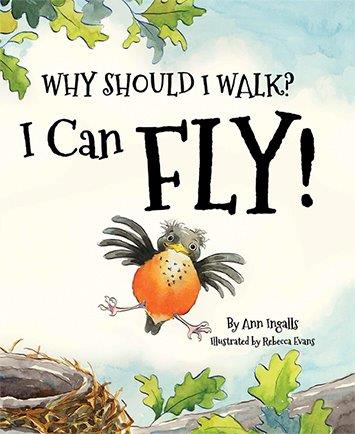
Why Should I Walk? I Can Fly!
by Ann Ingalls; illus. by Rebecca Evans
32 pages; ages 3-8
Dawn Publications, 2019

Why should I walk? I can fly.
I've made up my mind to try.

A little bird. A big sky. And mama's nudging him out of the nest. This is a mistake - he's sure - why can't he fly like ... chickadees, for example. And not being able to fly puts him in danger!

What I like about this book: It's told in first person, from the baby Robin's point of view. Who knew first flight could be so scary? For sure, kids will identify with his timidity in embracing something so drastically different.

If the text doesn't get you soaring, the illustrations will. They are bursting with humor and do a wonderful job revealing the Robin's emotions. Maybe it was fated that Rebecca Evans create the art for this book - when she was a first grader she rescued two injured baby sparrows and helped them learn to fly.

I also like that there's back matter: a "fact or fiction?" page, some thoughts about teaching baby birds to fly, and STEM activities.

Ruby's Birds
by Mya Thompson; illus. by Claudia Davila
36 pages; ages 3-7
Cornell Lab Publishing Group, 2019

School's out. Mom and Dad are at work.

Ruby's home with grandma and Alex, the parrot. She's bored. But downstairs neighbor, Eva, asks if she wants to go to the park. They walk past the one with slides ... all the way to Central Park. To the woods, where Eva looks up and listens. Turns out that Eva's on a mission to find a Golden-winged warbler, and enlists Ruby's help.

What I like about this book: The birds that illustrator Claudia Davila sneaked onto each page - you have to search for them! I like that Ruby learns how to identify the warbler and shares her knowledge.

Of course, there is back matter! That's where you'll find more information about birds in the city. There's a handy list of birds that are in the book - birds you are likely to find in your town or city. And there's "Ruby's Tips for taking a nature walk"!

Beyond the Books:

Draw a Bird. It could be a robin (here's one way to draw a robin) or a pigeon (here's how to draw a pigeon like Mo Willems). Or you can download coloring pages from Why Should I Walk? to use as inspiration.

Learn more about the birds living in your town or city. Need info? Check out Celebrate Urban Birds and Feathered Friends for activities and identification.

Learn to identify birds by their songs and calls. Here's a "tweet cheat sheet" for Eastern Birds, and here's one for Western Birds - by amazing cartoonist, naturalist, and science writer Rosemary Mosco.

Take a close look at a feather. If you find feathers on the ground, spend some time looking at them. Draw their shape and color them. Try to figure out who lost a feather. The best way to examine a feather is to get a chicken feather or other feather from a craft store so you can spend time looking at it with a magnifying lens. Here's a feather activity guide. (note: it is illegal to collect and keep feathers you find on the ground. You can draw them and, if you have a hand lens with you, take a closer look at them.)

Today we're joining Perfect Picture Book Friday, an event where bloggers share great picture books at Susanna Leonard Hill's website . Review copies provided by the publishers.

Friday, March 22, 2019

Nests

Nests 
by Pepe Marquez; illus. by Natalia Colombo
40 pages; ages 4-9
Starberry Books / Kane Press, 2019

In nature, there are many creatures.

Some live on land, some in the water, and some are birds. Those birds come in a great variety of sizes and shapes - and so do their nests.

This book combines spare, honest statements about birds and their nests with imaginative and bold artwork to put a fun spin on the concept of "home".

What I like about this book:
The illustrations! Natalia Colombo is an illustrator and graphic designer who lives in Buenos Aires. Her usual media include colored and black pencils, acrylics, pen, ink, and markers on different types of paper and in digital format. For this book, she says, "the illustrations are made with acrylics, and with a reduced color palette: orange, red, turquoise, blue and white. The characters are very simple, with large brush strokes and undefined contours and in contrast to the backgrounds. Then I worked on the computer to give more contrast."


It's those undefined contours that I love. They give the feel of featheriness to her birds. The hint of grassy tufts to her nests.

I love the wry juxtaposition of vibrant graphics with statements of fact. And the way Colombo interprets statements such as, "Some birds build their nests in very high spots." Her take: a nest built on the head of a giraffe! What fun!

Beyond the book:

1. Where do birds in your neighborhood build their nests? Try to find their nests and draw a picture of what their nest looks like. Here are some interesting nests.

2. Become a Nest-Watcher! Here's how.

3. Make your own nest out of tissue paper and glue. Here's how. Perfect for Easter eggs (or chocolate!)

We're joining Perfect Picture Book Friday. It's a weekly event where bloggers share great picture books at Susanna Leonard Hill's website. Review copy provided by the publisher.

Friday, December 9, 2016

Picture books you can sing

 Marianne Berkes has two more fun sing-along-while-you-read books. One features mother and baby animals found on the African Savanna: zebras, giraffes, hippopotamuses, lions, chimps, apes... and my favorite, meerkats.

The other features familiar barnyard animals: goats, cats, cows, horses, ducks and even owls. As in her other books, the text introduces the less familiar baby names - "kid" for goat, "poult" for turkey - and is structured as a counting book. There's also lots of action as the mothers and their babies gallop, swing, strut, stalk, yip, neigh... all things that the kids listening to the book will want to act out on their own.

What I love about these books is that at the end there's the music so you can sing along with the story ... which, if you grew up singing "Over in the meadow" you might do automatically.

There's also lots of "beyond the book" activities at the back of the book, including more information about each featured animal. Back matter in Over in the Grasslands includes a map of Africa showing where the animals live, a key to "hidden" animals (they show up in the book but you really have to take a second or third look to find them!), and some awesome tips from the illustrator, Jill Dubin, that might inspire you to try your own cut-paper art. More activities here.

Activities in Over on the Farm focus on math, science, language arts, music, movement, and art. Did you know you can grow a plant from the top of a carrot? There's also a section about food "from farm to table" with activities for making butter and "honey corn". More activities here.

Review copies from the publisher.


Friday, August 26, 2016

Little Cat's Luck

Little Cat's Luck
by Marion Dane Bauer; illus. by Jennifer A. Bell
224 pages; ages 8-12
S&S Books for Young Readers, 2016

Patches is an indoor cat, but when a golden leaf flutters and flitters and catches her attention, Patches must follow. She pushes her way through a window screen and out into the big, wide world. Not only is she curious about the leaf, but she is on a mission. Patches us looking for a special place.
She doesn't know what it will look like, but she'll know it when she sees it.

This story is told in verse, using visual placement of words to "show" the story. For example, when a leaf disappears
                of
         peak   a
     the           red
Over                  roof

And then there's this, the beginning of chapter 7:
The problem with searching
for a special place
without knowing
where such a place might be --
or even what
it might look like
should you find it --
is that the search
can take a great deal
of time... 

Readers discover why Patches need a special place all of a sudden - and how she tamed the meanest dog in town - in this sweet, fun-to-read book.

We'll be hanging out on Marvelous Middle Grade Monday with other  bloggers over at Shannon Messenger's blog. Hop over to see what other people are reading.  Review copy provided by publisher.

Monday, December 28, 2015

A Friend for Lakota

 A Friend for Lakota: The incredible true story of a wolf who braved bullying
by Jim & Jamie Dutcher
48 pages; ages 4-8
National Geographic Children's Books, 2015

"Spring blooms over the Sawtooth Mountains of Idaho. Wildflowers splash patches of bright colors across the meadows. And a young wolf pup, Lakota, rolls in the fresh green grass."

Lakota spends his days roaming the forest and meadows with his brother, Kamots. But where Kamots is fearless, Lakota is timid. A year later new wolves join the brothers, and they form a pack. As with all wolf packs, every member has a place. Some are leaders, some trouble-makers. Lakota's job is to help everyone play. But his low position in the pack makes him a target for aggression (bullying).

Fortunately, Lakota has a friend who won't let the others tease and bully. And that makes all the difference in how Lakota develops into the compassionate adult he is today.

Back matter includes a map and facts about gray wolves. The authors also write about their life living with the wolves, and include lots of resources for curious kids who want to learn more about wolves.

 Today we're joining the roundup over at the Nonfiction Monday blog where you'll find even more book reviews. Review copy provided by the publisher.

Monday, December 21, 2015

The Lucky Litter

The Lucky Litter: Wolf Pups Rescued from Wildfire
by Jenifer Keats Curtis; photos by John Gomes
32 pages; ages 4-8
Arbordale, 2015

When a huge wildfire engulfed the Funny River in the Kenai National Wildlife Refuge in Alaska, firefighters expected smoke and soot. The last thing they expected was to rescue a family of wolf pups. But sure enough, there they were - five fuzzy blue-eyed pups... and no tracks near the den. These pups were on their own.

The pups were covered in dirt, prickly with porcupine quills, and in desperate need of food and water. So medics used syringes to give each pup a drink, then flew them to the Alaska Zoo. This story follows the keepers who fed and cleaned the pups, played games with them, and helped each one find his or her place in the pack.

Back matter highlights the importance of wolves as a keystone species (animals that help hold an ecosystem in balance). There's also information on wildfires and some activities related to the book.

Come back next week for another book about wolves growing up.
Today we're joining the roundup over at the Nonfiction Monday blog where you'll find even more book reviews. Review copy provided by the publisher.

Friday, December 18, 2015

Animal Groups

Animal Groups
by Jill Esbaum; photos by Frans Lanting
32 pages; ages 5-8
National Geographic Children's Books

If you're hanging out at the Arctic you might notice a colony of Atlantic Puffins, or perhaps a celebration of polar bears. If you're in Africa you might come across a cackle of hyenas or scare up a zeal of zebras.

No matter where you are, if you come across a group of animals there's likely a collective noun to describe them. Jill Esbaum describes ten animal groups, sharing secrets of their family life. Each page features gorgeous photos plus extra facts in "Did You Know" boxes. Did you know that zebras help to keep their friends looking sharp?

Back matter includes additional animal facts, a list of names of other animal groups, and a map showing where the photos were taken.


This year sure has been the year for books on collective nouns for animals. Check out these other books, here and here.

If YOU were in charge of making up names for groups of things, what would you call a group of puppies? A group of kittens? A group of flies? A group of kids at school? A group of books about animal groups?

Today's review is part of the STEM Friday roundup. Drop by STEM Friday blog for more science books and resources. Review copy from publisher.

Monday, October 19, 2015

A Tower Of Giraffes


A Tower of Giraffes: Animals in Groups
by Anna Wright
32 pages; ages 3-7
Charlesbridge, 2015

What do you call a bunch of geese hanging out at the park next to the river? A gaggle, says Anna Wright. Animals can live in large social groups or small families, but no matter how many are in a group, each species lives in a unique social order.

She writes about their social lives in this book of collective nouns. Squirrels hang out in "scurries", and when danger threatens, they whistle out a warning to their buddies. They scurry away, and you realize that's how they got their name.

Wright collects a bunch of the best collective nouns (question: what do you call a bunch of collective nouns, anyway?). For example: a flamboyance of flamingos, a romp of otters, a parcel of penguins. I've learned that I have a mischief of mice in my basement, and the correct name for my friend's collection of hedgehogs is prickle.


The names are fun, and the tidbits about their social lives are cool - but what really drew me to this book are the illustrations. They are mixed media with fabric, feathers, wallpaper.... they are fun, fun, fun! Especially the sheep, who look like they are made from bits of sweater, and the peacocks with real peacock feathers.

So, what do you call a book that combines great science and imaginative art? STEAM. So go ahead. Pull out some field guides and your basket of scraps, and have fun creating your own artsy animals. And if you're looking for more collective nouns for animal groups, check out this post on Archimedes Notebook.

Today we're joining the roundup over at the Nonfiction Monday blog where you'll find even more book reviews. Review copy provided by the publisher.


Monday, October 12, 2015

The Wolf~Birds

The Wolf~Birds
by Willow Dawson
40 pages; ages 5-8
Owlkids Books, 2015

Deep in the wild winter wood, two hungry ravens huddle together, waiting for their next meal. Running through the snow below, a pack of wolves chases their next meal.

This is a story of survival in the winter woods. Hunting is hard work, and the hunters come up empty-handed, and even lose a member of the pack in the process. But when the ravens and the wolves team up, they both feast.

The book is based on scientific data and anecdotal reports from Aboriginal hunters, and explores an ecological relationship that could be thousands of years old. After all, ravens are called "wolf birds" for a reason. Lyrical, spare text is paired with acrylic paintings to tell the story. What I like is that there is enough room within this tale for readers (and listeners) to ask their own questions: what happens to a predator injured during the hunt? What happens if they return home with no food? Why do some animals help others of a different species?

Today we're joining the roundup over at the Nonfiction Monday blog where you'll find even more book reviews. Review copy provided by the publisher.

Friday, June 26, 2015

Over on a Mountain, Somewhere in the World

Over on a Mountain: Somewhere in the World
by Marianne Berkes; illus by Jill Dubin
32 pages; ages 3-8
Dawn publications, 2015

This book will not only have you singing along, but checking an atlas, globe, or whatever mapping app you might have. It's downright fun and a great addition to the "Over in" series that Marianne Berkes has been adding to over the years.

I like it because it's a world tour of mountain ranges - and it has animals from every region. Plus Berkes includes a handy map in case you don't have a globe at hand. Plus it's a counting song... so it's win-win all around.


The illustrations are beautiful cut paper, filled with texture and detail.

All the animals in the book act the way that Berkes portrays them. Snow leopards leap, bald eagles soar, and penguins waddle. And they live in the mountains as shown in the book. But they don't have as many babies as in her rhyme!

There is wonderful back matter for parents and curious kids. Berkes includes mountain facts, reveals the "hidden" mountain animals, and provides more information about the animals featured in the book. There's also an entire page of "tips from the illustrator" - what fun for the budding artist! And, at the back there is music and words for the song in case you're chosen to lead the next sing-along.


Today's review is part of the STEM Friday roundup. Drop by STEM Friday blog for more science books and resources. Even though "perfect picture book Friday" is on summer break, you can still check out recent posts at Susanna Leonard Hill's site. She keeps an ever-growing list of Perfect Picture BooksReview copy from the publisher.

Friday, June 20, 2014

Big Pigs!

Big Pigs
by Leslie Helakoski
32 pages; ages 3-7
Boyds Mills Press, 2014

Take three little pigs who are tired of being "good little pigs", toss them out the barn door and see what trouble ensues.

"First one to sneak into the garden is a big pig," says one... and the challenge is on. They scrape and scramble, squiggle and jiggle, shove and shimmy until one of them finally ends up in the garden.

Now it's time for a new challenge: who can eat a whole row of vegetables the fastest? The competition is rife with colorful verbs until one pig wins. Now, with no vegetables, the garden is a perfect place to wallow in the mud.

I really like how each challenge builds on the one before it - and I love the muddy hoof-prints all over the pages and the pigs try to make it back to the barn - but will they evade mama pig's detection? and if she finds them, what will she do?

The illustrations are such messy muddy fun that you might kick off your shoes and head out to squish your toes in the mud. Review copy provided by publisher.

Friday, November 8, 2013

Shark Babies in the Ocean!


Shark Baby
By Ann Downer; illustrated by Shennen Bersani
32 pages; ages 4-8
Sylvan Dell, 2013

Shark Baby lives in a works of “stripes and shadows, where seahorses played,” writes Ann Downer. He’s impatient to get out of his egg case and see the wide blue ocean. Then, even before he hatches, a storm snaps the egg case free of its attachment to kelp, The current bounces him off rough coral and drags him along the bottom of the sea. All that tumbling rips a hole in the egg case and Shark Baby can see spots. 

“What are you?” asks Shark Baby. The spotted shark answers that he’s a horn shark. “Maybe I’m a horn shark, too, says Shark Baby. 

But horn sharks have spiral egg cases, and Shark Baby’s is a flat “mermaid’s purse”.  When he sees a striped pajama shark he thinks he might belong to that sort of family. Then he’s advised by a wise octopus to seek the mermaid; she will have the answers. Shark Baby meets other sea creatures and eventually makes it home where he hatches and learns what kind of shark he is. 

Though the story is fanciful, it’s backed up with four pages of shark information, fun facts, and a comparison of different kinds of shark egg cases. 
 
 This is part of the STEM Friday round-up. Check out the other science books and resources reviewed this week. Review copy provided by publisher.

Friday, October 18, 2013

Penguins!


About Penguins (revised)
by Cathryn Sill; illus by John Sill
48 pages, ages 3-7
Peachtree Publishers, 2013

Whenever I go to a zoo, I always look for the penguin house. Who can resist watching the antics of these tuxedo-clad seabirds? They may not fly, but they move with such grace and precision beneath the water.

About Penguins is a new, revised version with updated material and an overview of seventeen species of these amazing birds. Each double-page spread features simple text and an illustration featuring one of the species. Cathryn gives us the science while John manages to capture great expressions on the birds' faces. Take the Royal Penguin (South Pacific) - in addition to the crown of yellow feathers, he manages to catch their most regal expression.

Readers learn the basic facts: penguins have special waterproof feathers; they can change direction quickly to avoid predators (at least while swimming underwater); and some eat squid. They don't all nest on ice - some build their nests in forests, in caves, or in burrows. And they don't all live in cold places - the Galapagos penguin lives in the tropics!

As with other books in the series, there is excellent material at the back: six pages of detailed notes that expand on each illustrated spread, plus a glossary and suggested books and websites.

Today's review is part of the STEM Friday round-up. Check out the other science books and resources reviewed this week. Review copy provided by the publisher.

Friday, September 27, 2013

In the Trees, Honey Bees


In the Trees, Honey Bees
by Lori Mortensen; illustrated by Chris Arbo
32 pages; ages 3-8
Dawn Publications, 2009

Theme: insects; animal families and social relationships; ecological value of bees

Opening:  "Morning light. Warm and bright. In the trees, honey bees."

With simple, clear language, Lori Mortensen leads children into the daily lives of honey bees. Rhyming text in large fonts tells the bones of the story: when the sun comes out, the bees head out to collect nectar and pollen. Back at the nest - and it is a nest built inside a tree hollow - other bees are busy with housekeeping chores. Then there's the bear to contend with, and a thunderstorm.

Supplemental text at the bottom of the pages give more details about honey bee lives. There are cool facts, too. Did you know that the average colony can have as many as 50,000 worker bees but only a single queen? And did you know that, in addition to collecting nectar and pollen, bees gather sticky sap from trees? They use it as glue in their nests.

Why I like love this book: It's fun to read! The language is lively, and gets the facts across in short, accurate statements. It sings! Also, there's lots of good info at the back for parents and teachers - and kids who want to read further: details about the bee life cycle, how bees pollinate flowers, how honey is gathered, and lots of resources for further study. I'm not the only one who loves this book - it has won at least ten awards.

Beyond the Book: Head outside on a bee hike. Right now, the bees are busy stocking up on winter stores. We find lots of honey bees and native bees on the goldenrod and asters. How many bees do you find?

Do a Bee Dance. In the book, the returning scout bees do a waggle dance to let the other bees know where the flowers are. By the way they orient, and the number of waggles, they communicate direction, distance and quality of nectar and pollen. You can do a "traditional" bee dance, or make up your own to communicate where the "good stuff" is in your house.

Make a candle. Here's some simple directions. All you need is a sheet of beeswax and some wick.

Today's review is part of the STEM Friday round-up. Check out the other science books and resources reviewed this week. We're also joining PPBF (perfect picture book Friday), an event in which bloggers share great picture books at Susanna Leonard Hill's site. She keeps an ever-growing list of Perfect Picture Books. 

Review copy borrowed from a library.

Monday, March 18, 2013

The Dogs of Winter


The Dogs of Winter
By Bobbie Pyron
312 pages, middle grade
Arthur A. Levine Books (Scholastic) 2012
 
When Ivan’s mother disappears, he ends up on the streets of Moscow. It’s winter – deep, dark, bitter cold – and all he’s got to keep him warm is his coat, a hat, his Famous Basketball Player shoes, and the memory of his mother.

Ivan falls in with a tribe of street children and is put to stealing and begging by the gang’s leader. It’s a harsh life, made worse by the cruelty humans inflict on each other. The dogs treat each other better, Ivan thinks. So when a twist of fate lands him in the middle of the dog pack, he becomes one of them. For two years he and his adopted canine family roam the landscape, using their wits to find food and shelter.

Ivan and his pack discover a greenhouse that makes a perfect winter home. In the summer they run through the forest, hunting or, when needed, collecting food from the dumpster behind an amusement park.

This is a story of survival. It’s a story that examines the things that make us human. It’s also based on a true story, and masterfully written by Bobbie Pyron who, it just happens, lives with her own pack of dogs. Bobbie was gracious enough to answer Three Questions:

Sally’s Bookshelf: So, Bobbie, how did you come to write this book?

 Bobbie: In 2005, I read an article in Best Friends magazine. (Best Friends is a huge, no-kill animal sanctuary in southern Utah). The article was about feral children – children who supposedly have been raised by animals. I’ve always been fascinated by this idea, possibly because I’ve always felt more canine than primate. That article, Bobbie explains, opened with the story of a four-year-old Russian boy, Ivan Mishukov…. The boy who becomes the main character in Dogs of Winter.

Bobbie:  I was absolutely riveted by his story and found myself wanting to know more. Why were there tens of thousands of children living homeless on the streets, particularly one as young as four? How did Ivan survive the cold and the lack of food? How did he and the dogs live day to day? And what happened to Ivan after he was taken from the dogs two years later? The more I thought about Ivan’s story with the dogs, the more I felt I had to write it, but as fiction.

SB: It looks like you did a tremendous amount of research – there’s a 3-page bibliography at the end of the book. And the details are so vivid. Did you travel to Russia to visit the places you wrote about?

Bobbie: I’m a librarian, so research is in my blood and bones. First, I started searching on line for anything I could find on Ivan Mishukov. I also realized I need to know more about the socio-economic conditions in Russia after the fall of the Soviet Union – I needed to understand why there were, by some estimates, close to a million homeless children and teens living on the streets of Moscow and St. Petersburg. And of course, there were the street dogs of Moscow. How did they live? Again, there was a surprising amount of information on that, even YouTube videos showing them using the subway system! But I never did visit Russia, and that made me very nervous because “place” is very important to me when I write. I was also very fortunate to come across an award-winning documentary, The Children of Leningratsky made around 2003, which followed a group of homeless children in Moscow over a year.

SB: You have a soft spot in your heart for dogs, and in your blog when you do author interviews, you focus on their relationship to their dogs. Tell me about this connection - how it connects with your life.

Bobbie: I was born and raised in the South, and we southerners have very strong connections to our dogs. Dogs were always a part of everything my family did, and as a shy child, my best friends were dogs. That is still true today. (Bobbie has three dogs: two rescued Shetland Sheepdogs and a rescued coyote mix) I love how “in the moment” they are; I love watching the dynamics between them.  I love just being in the company of dogs. They offer us trust, unconditional love, and a guilelessness that is in short supply these days. They have a way of bringing out the best in us, perhaps because we want to be the person they trust that we are. I think that’s why the authors I interview – many of whom don’t usually do interviews – love the chance to just talk about their dogs. 

This is part of the Marvelous Middle-Grade Monday round-up. Check out more great reading here. Review copy from publisher.