Showing posts with label birds. Show all posts

Friday, June 18, 2021

Homer on the Case


Homer on the Case 
by Henry Cole 
144 pages; ages 8-12
Peachtree, 2021

After meeting Homer, you’ll never look at pigeons the same way again. Sure, he’s a homing pigeon – but he’s a homing pigeon who’s taught himself to read. What? You think pigeons can’t read? You’d be wrong… back in 2016 a scientist demonstrated that pigeons can recognize words. And they can do math, too.

Unlike lab pigeons, Homer taught himself to read by using the Dick Tracy comics and local news in the papers used to line his cage. So when people start losing jewelry in the park, Homer reflects on what Dick Tracy would do. He observes, watches, trains his mind to remember the traits of suspects.

The crime spree gets personal when Otto’s grandfather loses his gold pocket watch. Fortunately, Homer has friends who can help – an Amazon parrot named Lulu and a park pigeon named Carlos. With advice from Dick Tracy, Homer and Lulu crack the case. Now all they need to do is get their humans to climb down the storm drain into the underground tunnels. There’s just one small problem: Homer and Lulu need to figure out a way to communicate with their humans. 

What I like about this book: There are heroes and villains – but even the bad guys aren’t all bad. And the ways Homer tries to get messages to his human, Otto, are … creative. Just take a minute to think about how you might communicate something important to another species if you don’t speak the same language – and they think of you as a “cute pet.”

This is a great book for kids who like animal stories, for kids who like STEM, for bird-lovers of all feathers, and for kids who believe that comic book superheroes have wisdom to share.

Thanks for dropping by today. On Monday we'll be hanging out at Marvelous Middle Grade Monday with other  bloggers. It's over at Greg Pattridge's blog, Always in the Middle, so hop over to see what other people are reading. Review copy provided by the publisher.

Friday, February 12, 2021

I’ve Got Birds on the Brain

This coming weekend is the Great Backyard Bird Count, so I’m thinking about birds. And I found these fun bird-related stories nesting in the bottom of my book basket.

theme: birds, feathers, imagination

Lali's Feather 
by Farhana Zia; illus. by Stephanie Fizer Coleman 
32 pages; ages 4-8
Peachtree Publishing, 2020 

Lali found a feather in the field.

But whose feather was it? Lali sets out to find feather’s home, asking various birds if the feather is theirs. One after another, Rooster, Peacock, and Blue Jay reject the feather. It is too little, too plain, too pokey – besides, what can a feather like that do?

What I like about this book: I like the creative way Lali puts the feather to use. And I like how, when she loses it, the birds try to help find it. And I especially love the ending – which is fun and surprising and I will not spoil!

Ivy Bird
By Tania McCartney; illus. by Jess Racklyeft
32 pages; ages 3-6
Blue Dot Kids, 2020

When the sun comes up, Ivy wakes to tweets and cheeps.

With a bit of seed, Ivy is up and moving. She pecks in the sunshine, warbles, sips nectar, fluffs feathers. But Ivy is not a bird. She is a girl with a huge imagination.

What I like about this book: Each spread introduces a different bird that Ivy meets during her day. Some are in the world around her, and some are in her imagination – but all are hidden somewhere in the pages of the story. Fortunately, there is Back Matter where we can learn more about these birds! (and you know I love back matter!)

Beyond the Books:

Get involved in bird Citizen Science
– Join the Bird Count this weekend. Simply watch birds for 15 minutes or more, at least once over the four days, February 12-15, 2021, and tell us what you see!

Birds have a lot of strategies for staying warm in the winter. Check them out here. My favorite is to get puffy! How do you stay warm in winter?

With no leaves, it’s easier to find bird nests tucked in shrubs and bushes. If you see one, take a good look but don’t disturb it – the bird might return in the spring. What is it made from? How big is it? How far is it from the ground? From the edge of the bush? Take a photo or draw a picture. 
Here's one I found a few weeks ago. 

Today we're joining Perfect Picture Book Friday, an event where bloggers share great picture books at Susanna Leonard Hill's websiteReview copy provided by the publisher.

Friday, March 13, 2020

Whoo-ku.... whoo, whoo, whoooooo.....

Whoo-Ku Haiku: A Great Horned Owl Story  
by Maria Gianferrari; illus. by Jonathan Voss
32 pages; ages 4 - 8
G.P. Putnam's Sons Books for Young Readers, 2020

theme: owls, haiku, animal families

A great horned owl pair
Finds squirrel’s nest of oak leaves
Perched high in a pine.

Pairing haiku with stunning ink and watercolor illustrations, Whoo-ku shows the life of a great horned owl.

What I like about this book: Just as haiku is the postcard of poetry, every whoo-ku in this book is a snapshot of that particular bit of a great horned owl’s life. The hard part, which author Maria Gianferrari does well, is linking them together to create a larger picture of the owls.

And there is Back Matter! Want to know more about owl feathers? Eggs? Owl pellets? It’s in the back matter, along with recommended books and websites for curious naturalists.


Last week I caught up with Maria long enough to ask One Question ~

Sally: How did you come to write this book in haiku?

Maria: Unlike most of my other books, this book began with the title, Whoo-Ku, so it’s the only book where the title actually dictated the form. When my daughter was in elementary school, we used to “write”/recite haikus on long car rides. She cleverly came up with that title and gifted me with her own written and illustrated Whoo-Ku book as a birthday present, a story of owls written in haiku. It’s one of my most treasured gifts! We had been reading haiku books like Wonton, by Lee Wardlaw, and Dogku, by the late Andrew Clements. Many years later I decided to try my hand at my own version of a haiku story, starring a Great horned owl family. And that’s how it all started!

Beyond the Books:

Learn how to identify great horned owls with this Audubon field guide.

What do great horned owls sound like? You can listen to their hoots and calls here.

Write some haiku about one of your favorite animals - or plants.  Here's how. Grab some pencils or markers or paints and create some pictures. Whooo knows - maybe you'll end up with your own book!

Maria Gianferrari is a member of #STEAMTeam2020. You can find out more about her at her website.

Today we're joining Perfect Picture Book Friday, an event where bloggers share great picture books at Susanna Leonard Hill's website. Review copy provided by the publisher.

Friday, November 29, 2019

Bird Tales

Winter is coming and it’s the perfect time to watch birds ~ birds that visit our back yard, birds that peck for bugs on the side of our house, and birds that inspire us.
So today I’m sharing books about birds ~  here on Sally’s Bookshelf and over at Archimedes Notebook.

 Theme for the day: birds, friendship


Hello, Crow
by Candace Savage; illus. by Chelsea O’Byrne
32 pages; ages 4-8
Greystone Kids, 2019

Franny was a dreamer. That’s what her dad said.

Dad thinks Franny doesn’t pay attention to the things she is doing. But Franny is paying attention – to the trees outside, and the calls of the birds. And one special crow.  Dad doesn’t think a crow can be a friend, but this crow greets her every day and even brings her small gifts. A button. A bead.

What I like about this book: Crows are smart birds, and can identify friend from foe. And sometimes they really do leave presents for people, like the crow in this book. I like that the author includes back matter with some crow facts. And the end pages are fun – you can look for things in a meadow of flowers and leaves.


Johnny’s Pheasant
by Cheryl Minnema; illus. by Julie Flett
32 pages; ages 3-8
Univ Of Minnesota Press, 2019

Johnny and Grandma were on their way home from the Grand Market with a sack of potatoes, a package of carrots, a bundle of fresh fruit, and frosted cinnamon rolls.

Then Johnny sees a lump near the ditch. When Grandma stops the car, Johnny runs over to discover it is a pheasant. He thinks it’s sleeping, and wants to take it home and make a nest for it. Grandma thinks it is dead, and wants to use its feathers in her craftwork.

What I like about this book: I love Johnny’s enthusiasm (Hoot! Hoot! he shouts) as he makes the nest. I love the surprise when the pheasant hoots back. And flaps about. And eventually finds its way outside. And leaves a gift for Johnny.

Beyond the Books:

Do birds really leave gifts for people? Crows do – you can watch a video here.

Learn more about pheasants – and listen to the sounds they make - here

Be a friend to winter birds – make a pinecone bird feeder. (allergy warning: uses peanut butter)

Today we're joining Perfect Picture Book Friday, an event where bloggers share great picture books at Susanna Leonard Hill's website. Review copies provided by the publishers.

Friday, May 17, 2019

Birds! Birds! Birds!

themes: birds, family, don't give up

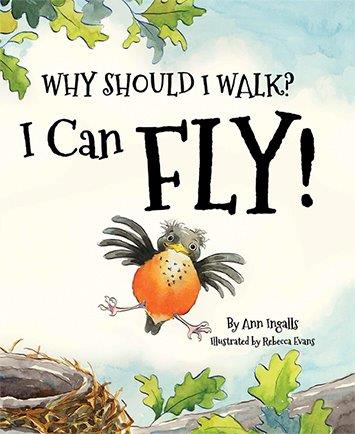
Why Should I Walk? I Can Fly!
by Ann Ingalls; illus. by Rebecca Evans
32 pages; ages 3-8
Dawn Publications, 2019

Why should I walk? I can fly.
I've made up my mind to try.

A little bird. A big sky. And mama's nudging him out of the nest. This is a mistake - he's sure - why can't he fly like ... chickadees, for example. And not being able to fly puts him in danger!

What I like about this book: It's told in first person, from the baby Robin's point of view. Who knew first flight could be so scary? For sure, kids will identify with his timidity in embracing something so drastically different.

If the text doesn't get you soaring, the illustrations will. They are bursting with humor and do a wonderful job revealing the Robin's emotions. Maybe it was fated that Rebecca Evans create the art for this book - when she was a first grader she rescued two injured baby sparrows and helped them learn to fly.

I also like that there's back matter: a "fact or fiction?" page, some thoughts about teaching baby birds to fly, and STEM activities.

Ruby's Birds
by Mya Thompson; illus. by Claudia Davila
36 pages; ages 3-7
Cornell Lab Publishing Group, 2019

School's out. Mom and Dad are at work.

Ruby's home with grandma and Alex, the parrot. She's bored. But downstairs neighbor, Eva, asks if she wants to go to the park. They walk past the one with slides ... all the way to Central Park. To the woods, where Eva looks up and listens. Turns out that Eva's on a mission to find a Golden-winged warbler, and enlists Ruby's help.

What I like about this book: The birds that illustrator Claudia Davila sneaked onto each page - you have to search for them! I like that Ruby learns how to identify the warbler and shares her knowledge.

Of course, there is back matter! That's where you'll find more information about birds in the city. There's a handy list of birds that are in the book - birds you are likely to find in your town or city. And there's "Ruby's Tips for taking a nature walk"!

Beyond the Books:

Draw a Bird. It could be a robin (here's one way to draw a robin) or a pigeon (here's how to draw a pigeon like Mo Willems). Or you can download coloring pages from Why Should I Walk? to use as inspiration.

Learn more about the birds living in your town or city. Need info? Check out Celebrate Urban Birds and Feathered Friends for activities and identification.

Learn to identify birds by their songs and calls. Here's a "tweet cheat sheet" for Eastern Birds, and here's one for Western Birds - by amazing cartoonist, naturalist, and science writer Rosemary Mosco.

Take a close look at a feather. If you find feathers on the ground, spend some time looking at them. Draw their shape and color them. Try to figure out who lost a feather. The best way to examine a feather is to get a chicken feather or other feather from a craft store so you can spend time looking at it with a magnifying lens. Here's a feather activity guide. (note: it is illegal to collect and keep feathers you find on the ground. You can draw them and, if you have a hand lens with you, take a closer look at them.)

Today we're joining Perfect Picture Book Friday, an event where bloggers share great picture books at Susanna Leonard Hill's website . Review copies provided by the publishers.

Friday, November 18, 2016

Flip the Bird & author interview

Flip the Bird
by Kym Brunner
368 pages; ages 12 & up
HMH Books for Young Readers, 2016

Mercer Buddie wants two things in life: a girlfriend, and the chance to show his father that he is serious about becoming an apprentice falconer. But on the day he and his master-falconer dad set out to capture a juvenile Red-tailed hawk, 14-year old Mercer screws up. He had one job to do: remember the mouse.

Time is ticking as they stop by a pet store to get a replacement mouse - bait for the trap that will humanely snare the hawk (and allow the mouse to be released into the woods). Will the hawk still be there when Mercer and his dad and brother arrive? And how long does it take to buy a mouse anyway? Turns out - when the girl of your dreams is in the pet store - it can take too long.

Mercer's dad is a demanding falcon master. He also runs a wildlife rehabilitation center, and is constantly impressing upon Mercer the need to do things correctly, so he doesn't lose his license (and livelihood). Mercer's older brother is working his way toward master-level. And the girl of his dreams? She's a member of HALT - a fanatical animal rights group that opposes mistreatment of animals including keeping hawks in cages. Shades of Romeo and Juliet...

Mercer tries to keep his hawk (named Flip) and his dad's rehabilitation center secret, but eventually the two worlds collide. When HALT members vandalize the center and release the birds, Mercer realizes he needs to take responsibility and do what's right.

I love the tidbits of falconry history and lore scattered throughout the book - like that people have been hunting with falcons since 2,000 BC! I loved the description of the mews, and crafting the hoods and leashes, and the training that Mercer and Flip shared.
So I just had to ask author, Kym Brunner Three Questions:

Sally: What inspired this story?

Kym: I went to a dinner show at Medieval Times, and near the end they had a falconry demonstration. I remember thinking, Wow! I never knew you could train a hawk to fly around and come back to you on command! I came up with the idea of a time-travel story of a modern kid going back into medieval times - and then found out I'd have to do a ton of research for medieval times AND for falconry. Eeek! So.... I decided to write a contemporary story about falconry.

Sally: You have so much authenticity in the story. What kind of research did you do?

Kym: I knew I wanted a story that revolved around falconry, but wasn't sure what the plot would be. So I took falconry lessons - six or more seven-hour apprentice lessons at SOAR (Save Our American Raptors). The master falconer told us a story about how they were once scheduled to do a demonstration at a forest preserve and animals rights demonstrators showed up. They made so much noise that the falconers had to cancel the event. When I asked about going on a hunt with a group of falconers, the SOAR leaders (George and Bernadette Richter) connected me to Troy, a falconer who lived in my neighborhood. Troy was extraordinarily helpful. He let me study his mews, and go on a couple hunts. Later, he read my manuscript to check for accuracy.

If I had one wish it would be that I could convey how dedicated falconers are to these majestic birds, and how fragile the relationship is between bird and prey. There are no guarantees; may the best bird - or prey - win.

Sally: I love the "Romeo/Juliet" aspect of the story. How did that evolve over the writing?

Kym: At first I thought about having a random group of protesters mess things up for Mercer and his family. But then a wonderful "what if..." question popped into my mind. What if, instead of being a random protester, the ones responsible for causing grief to Mercer's family business ended up being the parents of the girl he was hot for? The more I thought about it, the more I realized what a quandary that would be. I once dated a guy in high school who had a motorcycle - something my parents had forbidden me to ride. But this guy was cute and mysterious... so we met at the end of the block so my parents wouldn't know that he had a bike. I think being in love can override a lot of rational thought... and that's exactly the turmoil I hoped to portray in Flip the Bird.

If you'd like to learn more about falconry, here are two sites you might find interesting:

NY state regulations and a falconry exam study guide - check your own state for licensing regulations and examination requirements
the North American Falconers Association


Review copy provided by publisher.

Monday, October 12, 2015

The Wolf~Birds

The Wolf~Birds
by Willow Dawson
40 pages; ages 5-8
Owlkids Books, 2015

Deep in the wild winter wood, two hungry ravens huddle together, waiting for their next meal. Running through the snow below, a pack of wolves chases their next meal.

This is a story of survival in the winter woods. Hunting is hard work, and the hunters come up empty-handed, and even lose a member of the pack in the process. But when the ravens and the wolves team up, they both feast.

The book is based on scientific data and anecdotal reports from Aboriginal hunters, and explores an ecological relationship that could be thousands of years old. After all, ravens are called "wolf birds" for a reason. Lyrical, spare text is paired with acrylic paintings to tell the story. What I like is that there is enough room within this tale for readers (and listeners) to ask their own questions: what happens to a predator injured during the hunt? What happens if they return home with no food? Why do some animals help others of a different species?

Today we're joining the roundup over at the Nonfiction Monday blog where you'll find even more book reviews. Review copy provided by the publisher.

Friday, July 10, 2015

Eggs!

Egg: Nature's Perfect Package
by Steve Jenkins and Robin Page
32 pages; ages 4-8
Houghton Mifflin Harcourt, 2015

If you're wondering what came first - it's the egg! And if you're wondering what drew me to this book, it's the simplicity of the cover. An almost perfect egg with just a bit of beak showing... I want to know what emerges.

This book is filled with wonderful illustrations of eggs of all kinds, from banana slug eggs to frog eggs to lizard eggs... with a couple of strange mammals tucked in their shells as well. Steve Jenkins and Robin Page have done a marvelous job showing the diversity of egg-layers and the eggs they lay.

I love the spread where they compare the actual size of eggs, from a period-sized stink-bug egg to an elephant bird egg too large to fit on the page. They show where each animal lays its eggs, and how many eggs it usually lays.

Eggs are tasty and nutritious, so the birds and bugs and frogs and snails must protect their eggs - and incubate them until they hatch. Once incubated, there's the problem of getting out of the egg: beak? feet?

If you want to get the inside scoop about what life is like inside an egg, there are a couple timelines showing development of a chicken and an alligator. There is also a lot of back matter where you can learn more about the egg-layers featured in the book.

Today's review is part of the STEM Friday roundup. Drop by STEM Friday blog for more science books and resources. Perfect picture book Friday is on summer break, but you can still drop by Susanna Leonard Hill's site to read previous posts. She keeps an ever-growing list of Perfect Picture BooksReview copy from the publisher.

Monday, July 6, 2015

Noisy Bird Sing-Along

Noisy Bird Sing-Along
by John Himmelman
32 pages; ages 3-8
Dawn publications, 2015

I love leaving the windows open all night. We listen to the chorus of frogs, and the gentle whoo-whoo-whooing of the owls. There's only one problem...

The morning birds are SO NOISY! Like the birds in this book. Look at that cover - you know that this book is going to be a lot of fun to read. And sure enough, John Himmelman takes us on a wild auditory field trip. We meet Robin who wakes us up with his "Cheery up? Cheery-oh!" call. And the Barred owl - he's the one constantly asking "who cooks for you?" And for hockey fans who are already missing the end of the Stanley Cup playoffs, there are the White-throated sparrows that sing, "Oh sweet Canada, Canada, Canada".

Not only does Himmelman share the birds' songs, he also provides tidbits about where each bird takes its meals. Chickadees hunt for bugs in trees, while hummingbirds zip from flower to flower poking their lo-o-ong beaks into blossoms and slurping up the nectar. After we are introduced to all of the birds, Himmelman brings them together in one noisy chorus.

I love that he includes back matter: a page of fun facts about each of the birds, as well as handy advice about birding, feeding, and pishing. Sounds like "fishing" but instead of casting with a rod, you make pssh-pssh-pssh noises to call out curious birds. Click here to listen to all of the bird songs.


Today we're joining the roundup over at the Nonfiction Monday blog where you'll find even more book reviews. Review copy provided by the publisher.

Monday, June 22, 2015

A Bird is a Bird

A Bird is a Bird
by Lizzy Rockwell
32 pages; ages 3-7
Holiday House, 2015

One bird is fancy. Another is plain.
But a bird is a bird.

Because, as Lizzy Rockwell shows us, there are some things all birds have in common. They all have beaks - even though some beaks are huge and fat, designed for eating fruit and others are thin and sharp, designed for spearing frogs.

All birds have wings. While some flap and glide high in the sky, others swim and dive in the ocean. And all birds begin life as an egg.

But wait! Insects have wings and they aren't birds. Snakes lay eggs, and they aren't birds. So what is it about birds that makes them different from all the other animals?

Feathers! And those feathers help birds survive. Using detailed illustrations and text that is poetic and simple enough for a beginning reader, Rockwell shows us what makes birds "birds".

Check out Rockwell's book about gardening ~ Plants Feed Us ~  along with some beyond the garden activities. Today we're joining the roundup over at the Nonfiction Monday blog where you'll find even more book reviews. Review copy provided by the publisher.

Friday, March 27, 2015

You Nest Here With Me

You Nest Here With Me
by Jane Yolen & Heidi Stemple; illus. by Melissa Sweet
32 pages; ages 4-8
Boyds Mills Press, 2015

theme: bedtime, family, home, nature


Pigeons nest on concrete ledges,
Catbirds nest in greening hedges,
Tiny wrens, in shoreline sedges.
You nest here with me.

From grackles to eagles, plovers to killdeer, Yolen and Stemple describe different places that birds nest in spot-on rhyme. They end each stanza: "You nest here with me". Combine that with Sweet's gorgeous illustrations and you've got a book that you'll want to read every night.

What I like LOVE about this book: let me count the ways:
  • The birds ~ such a diversity of species and nest types
  • Introduction of new words: tor
  • Diversity of habitat
  • Unlovely birds ~ cowbirds, for example
  • Repetition ~ You nest here with me
  • A feeling of safety 
  • Spot-on illustrations
  • Texture~ you can almost feel the twigs
  • Vibrant color
  • Collage
  • Back matter! (everyone knows I love back matter)

Beyond the book activities: Build a bird nest. Go outside and gather materials that you think a bird might use in making a nest. You might find twigs,dead grass, fur or feathers, mosses, lichens, pine needles, and mud. Now try constructing a nest. How does it compare to the real thing? Find out by...

... going outside on a nest hunt. Take your journal and a camera along, because you might want to take some photos of how birds have built their nests - and jot notes about what you discover. This time of year you're likely to find old nests, unless you live where birds have already started their spring construction projects. Take a good look at where the nests are placed. Will they be well-hidden when leaves cover the trees? How high are they from the ground? And are the birds using all natural materials? Or have they incorporated bits of man-made stuff?

Help your backyard and neighborhood birds out. Give them some nesting materials - but choose things that are natural and degrade (not plastic or foil). Drape bits of string, thread, yarn, or natural fiber fabric over trees and shrubs. Or loosely fill a suet cage with strips of newspaper, broom bristles, mop strings and other natural things that could be used for a nest. Then hang it where birds will find it.


Today's review is part of the STEM Friday roundup. Drop by STEM Friday blog for more science books and resources. We're also joining PPBF (perfect picture book Friday), an event in which bloggers share great picture books at Susanna Leonard Hill's site. She keeps an ever-growing list of Perfect Picture BooksReview copy from the publisher.

Monday, March 17, 2014

A Hot Mystery for National Wildlife Week ~ Flash Point


Flash Point
by Sneed B. Collard III
256 pages; age 11 & up
Peachtree Publishers 2011 (reprint edition)

Wildfires have been burning all around Heartwood, Montana, since August and Luther can’t remember the last time he saw blue sky. The air is so bad that coach has canceled football practice and some of the guys from the team invite Luther to join them at the burger joint. But he’s got a job, and besides, he didn’t go out for the team this year.

His job: caring for birds at the raptor center. Hawks and eagles that some folks – including kids on the team – think of as nuisance birds. Targets.

While wildfires threaten his home and his stepfather’s livelihood – just about everyone’s job is touched by the timber industry – Luther struggles to resolve his own conflicts. His love for the raptors gives him a different view of forestry policies, pitting him against former team mates.
He finds a kindred spirit in Alex, a girl new to the school and also a social “outsider”. Things heat up when someone starts shooting the birds from the raptor center and suspicious fires start breaking out too close to town.

This award-winning book is a great mystery for young adults who want something that reflects their world. It’s also a good book to read during National Wildlife Week, which starts today. If you’re looking for ways to get involved in learning about wildlife, check out this Science NetLinks project from the American Association for the Advancement of Science (AAAS). You’ll find books,videos, apps and more.

Review copy provided by publisher.

Friday, February 28, 2014

The Cuckoo's Haiku

The Cuckoo's Haiku and other Birding Poems
by Michael J. Rosen; illus by Stan Fellows
64 pages; ages 5 and up
Candlewick Press, 2009

Themes: animals, nature, poetry 

wild turkeys' snow tracks
their arrows point us one way
they go the other 

This book is better than a bird guide! It's a haiku field notebook in which Michael Rosen captures the essential characteristics of twenty-four common North American birds. His spare observations are complemented by the gorgeous watercolor illustrations by Stan Fellows - who details everything from field markings to habitat.

What I love about this book: I like the way it is structured - by the seasons. It opens with spring, and the Eastern Bluebird.

on a staff of wires
blue notes inked from April skies
truly, springs first song

In addition to haiku, Rosen includes field notes: the chestnut throat and breast; the males are darker and brighter blue; that bluebirds are thrushes, related to robins. Fellows paints them perched on electrical wires like notes on a staff which, if I could read music, I could play on my recorder. What tune has he hidden in this illustration?

a summer spread, featuring the Pileated Woodpecker and insect prey
I like the details in the artwork - from showing the insects that the woodpeckers seek to wing bars, crests, and feather details. Each spread becomes a field trip into the world of that bird. At the back of the book, Rosen includes five pages of notes about the birds he features: their mating behavior, food preferences, flight and other things that curious bird-watchers will want to know. 

Beyond the book: Write some bird haiku of your own. Spend time watching the birds at your feeder, or perched on a clothesline, or sipping water from a puddle in the parking lot at the grocery store. Start by drawing or jotting notes on the things you notice about this bird: feathers, crest, color of its beak or feet, whether it has a chin strap, eyebrows or wing bars. What is it doing? Where is it? What is the season and the weather? 

Check out more haiku activities here. And head over to Archimedes Notebook today to check out a brand-new book about feathers and do some hands-on science activities. Drop by STEM Friday to see what other science books and resources bloggers are sharing. 

Today's review is part of PPBF (perfect picture book Friday), an event in which bloggers share great picture books at Susanna Leonard Hill's site. She keeps an ever-growing list of Perfect Picture Books.

On Monday we'll fly over to join the Nonfiction Monday round-up, where you'll find all kinds of great nonfiction for children and teens.  Review copy borrowed from a library.

Friday, February 7, 2014

Hello, My Name is .....

Hello, My Name is Ruby
by Philip C. Stead
36 pages; ages 3-6
Roaring Brook Press, 2013

Theme: friendship

"Ruby introduced herself. "Hello, my name is Ruby. "Hello," said the bird standing in the cool water."

So begins Ruby's search for a friend. She is invited to go flying and to walk alongside her new friends. She discovers friends in unlikely places and learns their names. She even learns - from one bird who everyone insists is a peacock but looks like a turkey to me - that not everyone wants to be a friend. And through the pages, Philip Stead's soft pastels carry us on this gentle journey.

What I like: That Ruby actively seeks new friends - and that she is adventurous enough to explore even unlikely places to find friends. She doesn't judge a friend by their feathers. And even when she is given the cold shoulder, she eventually shakes it off and heads off to look for new friends. The cute bird characters make up for the lack of conflict and tension.

Beyond the Book: The title immediately made me think of those stick-on name badges that you get at SCBWI conferences and the like. You know, the ones that say "Hello, My Name Is". So why not make your own name badge?

Draw a friend for Ruby. Use pastel chalk and colored pencils (the media Philip uses in his illustrations) to draw a bird friend for Ruby. Use a bird field guide or bird photos to inspire your art... but feel free to exaggerate one of the features - make a long bill really stand out, or a crest or decorative feathers... check out how Philip draws his birds in this video.


Make a bird mask and become a friend for Ruby. Start with a paper plate. Then use construction paper to make your beak. Add feathers, paper curls, glitter.... 

Today's review is part of PPBF (perfect picture book Friday), an event in which bloggers share great picture books at Susanna Leonard Hill's site. She keeps an ever-growing list of Perfect Picture Books. Review copy provided by publisher.


Friday, October 18, 2013

Penguins!


About Penguins (revised)
by Cathryn Sill; illus by John Sill
48 pages, ages 3-7
Peachtree Publishers, 2013

Whenever I go to a zoo, I always look for the penguin house. Who can resist watching the antics of these tuxedo-clad seabirds? They may not fly, but they move with such grace and precision beneath the water.

About Penguins is a new, revised version with updated material and an overview of seventeen species of these amazing birds. Each double-page spread features simple text and an illustration featuring one of the species. Cathryn gives us the science while John manages to capture great expressions on the birds' faces. Take the Royal Penguin (South Pacific) - in addition to the crown of yellow feathers, he manages to catch their most regal expression.

Readers learn the basic facts: penguins have special waterproof feathers; they can change direction quickly to avoid predators (at least while swimming underwater); and some eat squid. They don't all nest on ice - some build their nests in forests, in caves, or in burrows. And they don't all live in cold places - the Galapagos penguin lives in the tropics!

As with other books in the series, there is excellent material at the back: six pages of detailed notes that expand on each illustrated spread, plus a glossary and suggested books and websites.

Today's review is part of the STEM Friday round-up. Check out the other science books and resources reviewed this week. Review copy provided by the publisher.

Monday, December 24, 2012

Puffling Patrol


Puffling Patrol
by Ted and Betsy Lewin
56 pages, pages 6 – 10
Lee & Low 2012

Every spring, hundreds of thousands of puffins make their way to the Westman Islands, off the south coast of Iceland. They build nests on the rocky cliffs, and spend the summer caring for their newly hatched chicks. By August, the young puffins – called pufflings – are ready to leave home and head out to the open sea. They fly off the cliffs at night and some, confused by the lights of town, flutter down onto the streets. Their wings are not strong enough to lift them off the streets, so children in the town give them a helping hand. Young members of the Puffling Patrol collect the confused birds and carry them to the shore to release.

Ted and Betsy Lewin tell the story of two of the children in the Puffling Patrol, Dani and Erna. The eight-year old twins take their job seriously, collecting boxes and gathering flashlights. When it’s dark, at 10 pm, they head out  into the rainy night.

The next day the children take their pufflings to the museum to be measured and weighed. Only those strong enough to make it on their own are released. Finally Dani and Erna take their pufflings to the ocean.

“The sea will be the puffins’ home for the next two years,” write the Lewins. “If all goes well, they will return to Heimaey as adults and raise their own chicks.” And when they do, the Puffling Patrol will be ready. 

 Check out other books that celebrate nonfiction at Nonfiction Monday, hosted this week by Jean Little Library.