Showing posts with label YA. Show all posts

Friday, December 10, 2021

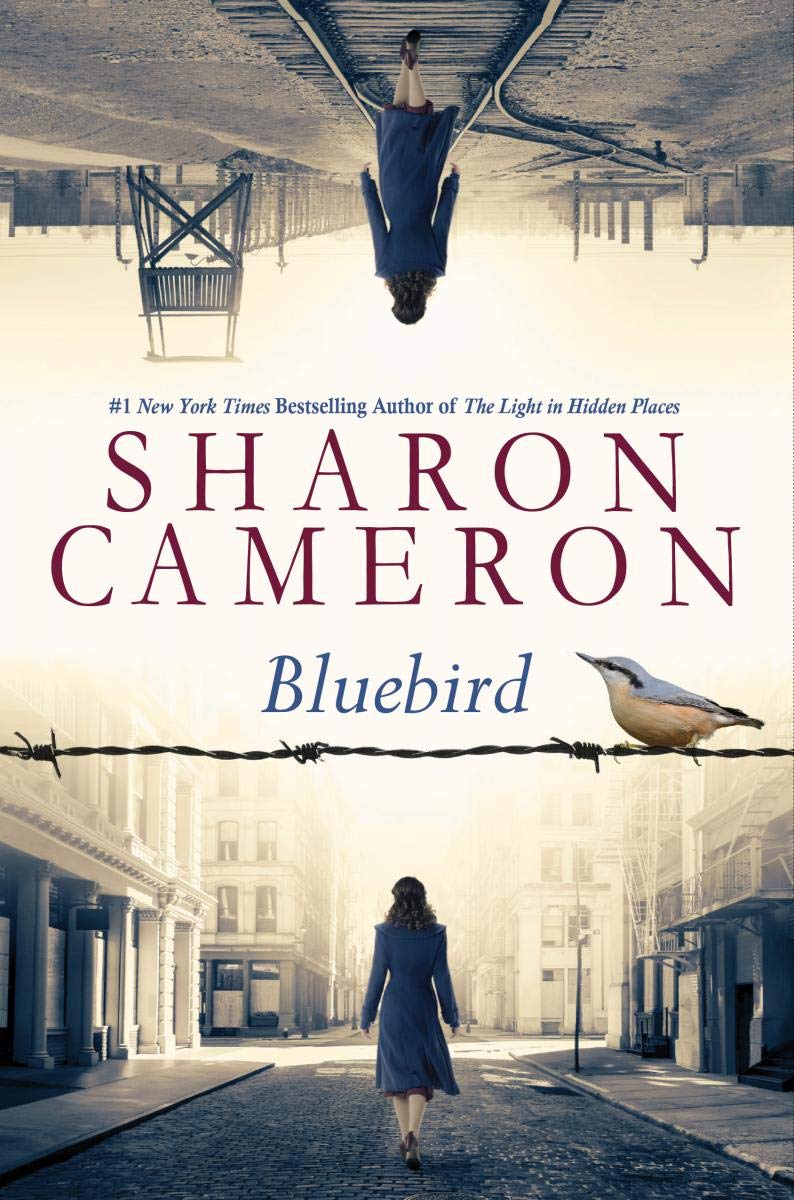
Unputdownable! Sharon Cameron's BLUEBIRD


‎Scholastic Press, 2021
In the normal course of events, I request books to review. And so I was surprised to get a package from Scholastic. Had I asked for a book and forgotten about it? Nope. Inside was a young adult novel that I never would have looked at, much less cracked the covers of, had it not ended up in my mailbox. By mistake? By fate? Who knows. 

Good thing it did, though, because I love a good story. Especially when it is grounded in fact and history. And doubly especially when it is written so well I just have to read another dozen (or 50) pages - even if it is one in the morning! 

The opening chapter introduces Eva, standing on the deck of a ship and gazing at the sea before her and the city approaching. It’s August 1946 and she has left behind a world of burning rubble. She gathers her suitcase and that of Brigit, who does not speak. She gathers their papers, and checks to make sure her secret documents are safely hidden. Then, together they follow their guide down the gangplank and into immigration.

America is bright, and friendly – and Eva and Brigit are here ostensibly to begin a new life. Eva has come for justice. She has come to search for a Nazi physician responsible for conducting horrific medical experiments on prisoners in concentration camps. She has come to uncover secrets, with hope of bringing this person to justice before the US government recruits him for their own dark programs. She has come to dig for the truth about Project Bluebird.

Eva has also come to protect Brigit, and help her recover from the horrible suffering at the hands of soldiers. Chapters alternate between 1946 America and war-torn Germany. We see flashes of Eva’s childhood as a schoolgirl under the Nazi regime. Living in Germany, Eva knew no hardship (her household included servants). But as she begins uncovering clues, dark memories begin to surface and Eva wonders about her place in her family. And now she is being followed by mysterious men.

Eva eventually finds a job and covers the hospital expenses so that Brigit can get treatment. As Brigit regains her memories, we learn how the two girls are connected – and we see how their experiences translate into different views of the world they now find themselves in.

What I like about this book: Sharon Cameron paints a detailed picture of an American city post-war. Her characters are so three-dimensional they could walk out of the book and carry on a conversation with you. But what I really like is the backmatter. Sharon adds a dozen pages of well-researched material that provides historical context and perspective for her story and the era. It should come as no surprise that Germany was not the only one conducting research on human subjects during the war.

Friday, September 27, 2019

The Lady's Guide to Petticoats and Piracy

The Lady's Guide to Petticoats and Piracy 
by Mackenzi Lee 
464 pages, YA
Katherine Tegen Books (Harper Collins), 2018

When I heard someone mention the title of this book, I hoped it might be nonfiction. You know, a tell-all about famous women pirates.

But I was delightfully surprised to find it an adventure tale spun in the eighteenth century starring a young woman who desperately wants to become a doctor. That is SO not socially acceptable for her family’s station, besides which no hospital (or physician) will accept her as a student.

Plus there’s her name, Felicity Montague: a star-crossed name if ever there was. And this intriguing first line: “I have just taken an overly large bite of iced bun when Callum slices his finger off.” We learn that Felicity works in the bakery that Callum owns. And he’s a bit distracted as they wash the dishes, which is how he ends up slicing the tip of his finger off. Felicity, who has been reading medical treatises for so long, is now faced with an actual medical emergency.

And not to put too much of a damper on her relationship with the baker, she reveals that “with a chunk of his finger missing, Callum is the most interesting he has ever been to me.” Then we dive into Felicity’s mind. She is thinking about the 27 bones four tendon, three nerves, two arteries, and other aspects of hand anatomy. Callum, on the other hand, would like Felicity as his wife. She could do worse than marry a baker, he posits…

We know she’s going to leave before she knows it. She’s got a brother in London. Surely he’ll take her in. Before long, Felicity is up to her eyeballs in intrigue. My favorite part is where she runs off to join a pirate expedition to protect sea monsters – a far cry from applying to medical studies. But science is science.

The writing is fun to read! For example: “…traveling with Johanna and Sim will be like trying to wrangle kittens into the bath…” This is the kind of writing that leaves the sting of sea salt on your face and your hair tangled in knots by the wind.

And then – there’s Back Matter. As many of you know, I love back matter, and Mackenzi Lee does not disappoint (though I will point out the distinct lack of end notes). She talks about women characters in historical fiction and then addresses the aspirations of her three women characters. And she shares stories of real-life women in history who inspired each of them. And so we learn about women in medicine, scientist, and piracy in the seventeenth and eighteenth centuries.

Review copy discovered @ my library.

Friday, July 19, 2019

Taking Cover

Taking Cover, One Girl’s Story Of Growing Up During The Iranian Revolution
By Nioucha Homayoonfar
160 pages, ages 12 &  up
National Geographic Children’s Books, 2019

“I knew I was in trouble when the white jeep made a U-turn. Driven by the Zeinab Sisters (or the Black Crows, as I called them), it raced toward me and screeched to a stop.”

This book opens like an action movie: a young girl is snatched off the street, pushed into the back of a car, and taken to an apartment building that’s under construction. There she’s locked in a room.

For what? Showing the tiniest bit of skin. A sliver of her wrist. A crime, in the eyes of the “Moral Police” and the religious leaders who, after the revolution, control Iran. Post-revolution, the country has become a place where women and girls have lost the rights to work, attend school, have an opinion.

Though it sounds like a dystopian novel, this is a true story of one girl’s life – Nioucha – and what happened to her country after the fall of the Shah.

But Nioucha didn’t always live in Iran. She spent her early life in Pittsburgh, PA until she was five years old. That was when her father wanted to move back to his home country, back to relatives and a vibrant civilization that he missed.

Things were fine, at first. But when Nioucha was eight years old the Shah went into exile and the country moved in a different direction. Where she was once free to run and play and go to school, now her world is circumscribed by rules. Her loss of rights begins simply: she must wear a scarf. Girls must attend a separate school from boys. There is mandated religion class. She can’t be seen in public with a boy who is not related.

This is a book about how easy it is to lose your freedom. Lose your voice. So Nioucha uses her words and stories to give voice to those who are still taking cover. And maybe to warn us about just how easily we could lose the rights we take for granted.

Thanks for dropping by today. On Monday we'll be hanging out at Marvelous Middle Grade Monday with other  bloggers. It's over at Greg Pattridge's blog, Always in the Middle, so hop over to see what other people are reading.  Review copy provided by the publisher.

Friday, March 15, 2019

Fake News

There is so much talk about "fake news" in the media that it's time to take a closer look. Michael Miller does in this new book.


Fake News: Separating Truth from Fiction
by Michael Miller
112 pages; ages 12-18
Twenty-First Century Books (Lerner), 2019

Fake news is real and it matters, writes Michael Miller. The term “fake news” has been applied to stories that pose as news but are untrue and deliberately designed to mislead. But in recent years some people – especially those in power – are using the label “fake news” to cast doubt on legitimate news stories. Especially when those stories are critical of their policies.

But fake news isn’t always political. There are false medical as well as stories aimed at businesses. Maybe you heard that you could cure diabetes by eating carrots, that an X-box console killed a teen, or that a particular brand of bottled water contained “clear parasites” that no one could see.

Fake news isn’t new; it’s been around since the time of the Romans, when a senator read a false document accusing a military general of being a traitor. And, of course, fake news was a “vital part of spreading anti-Semitism in Germany before and during World War II,” writes Miller.

Why should teens care about fake news? Because a democratic society depends on educated voters, and relies on a free press to hold elected leaders accountable to the public. A free press is so important to democracy that the founding fathers gave it specific constitutional protection: the First Amendment.

Miller devotes an entire chapter to how real news works: how journalists do their jobs, how they document facts, and how they correct mistakes. He reveals the “many faces” of fake news, from tabloids to faked online news sites, propaganda, and satire. Yes – satirical, funny stories in the Onion are not “real news”.

He talks about how fake news is created for profit and for political ideology, and how social media comes into play. Miller dives into why people believe in fake news, bias confirmation, and even how political affiliation affects who is more susceptible to believing fake news. And he addresses the question: when fake news results in violence, can we ban it?

In the last two chapters, Miller describes how you can tell fake news from real news, and what you can do to fight fake news. The most important take-aways: get your news from reputable sources (he lists least-biased sources); read before you share; and when a news story is breaking, wait for information to be gathered rather than jumping on the first bandwagon that goes by. And though Miller urges kids to “debunk misinformation with facts”, there’s research that indicates biased people are fact-resistant.

As all good journalists do, Miller provides source notes and a bibliography. He also includes lists of books, websites and other media for further study. If I gave stars, this book would get a handful! Review copy provided by the publisher.

Friday, March 8, 2019

Cogheart

Cogheart
by Peter Bunzl
368 pages; ages 12 & up
Jolly Fish Press, 2019 (US edition)

Action! Adventure! Danger and Daring! What a great kick-off for the new series of Cogheart Adventures .

Thirteen-year-old Lily Harman is stuck at Miss Octavia Scrimshaw’s Finishing Academy for Young Ladies. She would rather be anywhere else, especially if it involved adventures and piracy, like the stories she reads in her penny dreadfuls – the Victorian equivalent of comic books. Instead, she’s condemned to classes on deportment and posture and the Art of Making Polite Conversation (in French, no less).

Then her father, a famous inventor, disappears on what should have been a routine zeppelin flight. Suddenly Lily’s life is turned upside down. Her father’s housekeeper Madame Verdegris, becomes her legal guardian and brings her back home. Lily is happy to be away from the pretentious school. She is happy to be reunited with Mrs. Rust, a mechanical servant who cooked so many of Lily’s meals.

But something strange is going on. Madame Verdegris is selling some of her father’s mechanicals off for salvage, and strange men metal-eyed men lurk in the shadows.  Then there’s the clockmaker’s son, Robert, who has rescued Lily’s mechanical pet fox, Malkin. Why were metal-eyed men chasing – and shooting – at her fox?

I love the wild adventure that takes Lily and Robert across the rooftops of town. I love the mechanicals – and how each has its own winder. They are as precise as clockwork. I love Mrs. Rust’s wonderful lexicon of alliterative idioms. “Cogs and chronometers!” she exclaims. “Smokestacks and sprockets!”

And I love how the secret of the Cogheart is revealed. I’d say more, but there are metal-eyed men lurking in the shadows, so I must be off. I look forward to more exciting adventures in this series.

Thanks for dropping by today. On Monday we'll be hanging out at Marvelous Middle Grade Monday with other  bloggers. It's over at Greg Pattridge's blog, Always in the Middle , so hop over to see what other people are reading. And drop by one of his earlier posts where he reviews Cogheart. Review from Advanced Reader Copy provided by Blue Slip media.

Friday, January 4, 2019

Unpresidented ~ a biography of Donald Trump

Before I get to the review of this wonderful new piece of nonfiction I've got a quick reminder for writers. Whether you're working on picture books, chapter books, sci-fi, nonfiction, YA or MG -  if you're brainstorming ideas, then head over to StoryStorm at Tara Lazar's blog. For the month of January she'll post inspiring words for writers of all genres. StoryStorm started January 1, but registration is open through Monday, January 7. Register here. Thirty ideas in thirty-one days. That's doable.

And now... onto some great nonfiction writing!

Unpresidented: A Biography of Donald Trump
by Martha Brockenbrough
432 pages; ages 12 - 18 & older
Feiwel & Friends, 2018

Weighing in at 400-plus pages and more than an inch thick, this biography doesn’t waste words on frivolities. Author Martha Brockenbrough dedicates her newest book to the Parkland generation (“You know what to do”) and then dives into a very readable – and critical – biography of a sitting president.

But first she takes time to clarify journalism’s role in history. In particular, how journalists and other nonfiction writers uncover facts and – more importantly – take the time to verify them. In particular, Brockenbrough writes about the spread of false information, and how we know that Trump does, indeed, spread lies. She clarifies what fairness and balance mean in the context of telling truths, and then tosses in this caveat: it’s difficult to write accurately about Trump because “he often speaks inaccurately about himself.”

I like the structure of the book: beginning with the election, flashing back to his immigrant parents, and then to Donald J’s childhood. Born into wealth, he started life lucky, writes Brockenbrough. But he lost his mother at a young age and, as he grew older, he became a bully. He caused so much trouble that his father sent him to a military academy, hoping the experience would make him shape up.

 Brockenbrough follows Donald through his business ventures where his driving goal was to do whatever it took to win. Those brash – and questionably ethical – tactics followed him into entertainment and then into his candidacy for the highest office of the land.

“Trump appeared to be looking at the campaign the way a salesman looks at a product he wants to move,” writes Brockenbrough. “What do people want to hear?”

Brockenbrough writes about the Russia connections, the debates with Hillary Clinton, FBI investigations and hacking. She shows how unprepared he was to win and how little he did to prepare himself for the transition of power after the election. Brockenbrough does a marvelous job comparing and contrasting Trump and Robert Mueller, and details the ways the 45th president is using his office to enrich himself. She lays out clear evidence for his assault on democracy and a free press.

Provable facts matter, says Brockenbrough. “It’s one thing to make a partisan argument based on different political philosophies. But it’s another thing to ignore or misstate facts to protect a political party or its leader.” Once you leave facts in the dust, you’re on your way to fascism.

Brockenbrough provides a hefty section of back matter: a timeline of Trump’s life, his presidency, thumbnail bios of key campaign staff and political advisors – names you’ve heard in news reports and many of whom are under indictment. There are more than 50 pages of endnotes documenting quotes, and a handy index with entries including “racism” and “Russian election interference”.

I appreciate that the title of this book came about in the most organic fashion possible: from a tweet by Trump. And though it is considered a YA book, I think many adult readers will find it a handy reference.

You can find out more about Martha Brockenbrough and her books at her website.

On Monday we'll join the roundup over at the Nonfiction Monday blog where you'll find even more book reviews. Review copy is from my personal library. 

Friday, November 25, 2016

Girl on a Plane

Girl on a Plane 
by Miriam Moss
288 pages, ages 12 & up
HMH Books for Young Readers, 2016

Fifteen-year old Anna is a "Forces" child. Her dad, in the army, has been stationed in Bahrain. Now, after spending summer vacation with her family, Anna is traveling back to her English boarding school.

The year is 1970 and hijackings have been in the news. Anna is worried that her plane might be hijacked, but her mom assures her that it hardly happens. At the gate, mom gives her one last hug, telling Anna to "stay safe". Anna walks across the tarmac to the waiting plane. It is 10:30 am and she's thinking of the seven-hour flight to London.

Anna's not the only kid on the plane; plenty of other military dependents are heading home to schools. The boy next to her is carrying his treasured terrapin in a tin. Another, older boy sits nearby. Mothers with children are heading home.

Then a man with a gun in his hand screams at everyone to sit down. The plane has hijacked by the Palestinian Liberation Front. They will land in Jordan, he says. On the "Revolutionary Airstrip" somewhere in the desert. They are hostages.

As noted on the cover, this book is based on the true story of a hijacking. Miriam Moss was a passenger on that plane, heading home to boarding school in the UK. But this is a work of fiction, she emphasizes in her notes at the back of the book. Yes! There is Back Matter! (you know I love back matter, especially in historical fiction novels). Moss writes about her search for the Revolutionary Airstrip and her journey back to Jordan to visit the site where she spent three hot days as a hostage. She also answers questions about which parts of the story are true, and which are fictional.

You can read an excerpt from the first chapter here. You can read more about the hijackings here and watch a video about the events here. Review copy provided by the publisher.

Friday, November 18, 2016

Flip the Bird & author interview

Flip the Bird
by Kym Brunner
368 pages; ages 12 & up
HMH Books for Young Readers, 2016

Mercer Buddie wants two things in life: a girlfriend, and the chance to show his father that he is serious about becoming an apprentice falconer. But on the day he and his master-falconer dad set out to capture a juvenile Red-tailed hawk, 14-year old Mercer screws up. He had one job to do: remember the mouse.

Time is ticking as they stop by a pet store to get a replacement mouse - bait for the trap that will humanely snare the hawk (and allow the mouse to be released into the woods). Will the hawk still be there when Mercer and his dad and brother arrive? And how long does it take to buy a mouse anyway? Turns out - when the girl of your dreams is in the pet store - it can take too long.

Mercer's dad is a demanding falcon master. He also runs a wildlife rehabilitation center, and is constantly impressing upon Mercer the need to do things correctly, so he doesn't lose his license (and livelihood). Mercer's older brother is working his way toward master-level. And the girl of his dreams? She's a member of HALT - a fanatical animal rights group that opposes mistreatment of animals including keeping hawks in cages. Shades of Romeo and Juliet...

Mercer tries to keep his hawk (named Flip) and his dad's rehabilitation center secret, but eventually the two worlds collide. When HALT members vandalize the center and release the birds, Mercer realizes he needs to take responsibility and do what's right.

I love the tidbits of falconry history and lore scattered throughout the book - like that people have been hunting with falcons since 2,000 BC! I loved the description of the mews, and crafting the hoods and leashes, and the training that Mercer and Flip shared.
So I just had to ask author, Kym Brunner Three Questions:

Sally: What inspired this story?

Kym: I went to a dinner show at Medieval Times, and near the end they had a falconry demonstration. I remember thinking, Wow! I never knew you could train a hawk to fly around and come back to you on command! I came up with the idea of a time-travel story of a modern kid going back into medieval times - and then found out I'd have to do a ton of research for medieval times AND for falconry. Eeek! So.... I decided to write a contemporary story about falconry.

Sally: You have so much authenticity in the story. What kind of research did you do?

Kym: I knew I wanted a story that revolved around falconry, but wasn't sure what the plot would be. So I took falconry lessons - six or more seven-hour apprentice lessons at SOAR (Save Our American Raptors). The master falconer told us a story about how they were once scheduled to do a demonstration at a forest preserve and animals rights demonstrators showed up. They made so much noise that the falconers had to cancel the event. When I asked about going on a hunt with a group of falconers, the SOAR leaders (George and Bernadette Richter) connected me to Troy, a falconer who lived in my neighborhood. Troy was extraordinarily helpful. He let me study his mews, and go on a couple hunts. Later, he read my manuscript to check for accuracy.

If I had one wish it would be that I could convey how dedicated falconers are to these majestic birds, and how fragile the relationship is between bird and prey. There are no guarantees; may the best bird - or prey - win.

Sally: I love the "Romeo/Juliet" aspect of the story. How did that evolve over the writing?

Kym: At first I thought about having a random group of protesters mess things up for Mercer and his family. But then a wonderful "what if..." question popped into my mind. What if, instead of being a random protester, the ones responsible for causing grief to Mercer's family business ended up being the parents of the girl he was hot for? The more I thought about it, the more I realized what a quandary that would be. I once dated a guy in high school who had a motorcycle - something my parents had forbidden me to ride. But this guy was cute and mysterious... so we met at the end of the block so my parents wouldn't know that he had a bike. I think being in love can override a lot of rational thought... and that's exactly the turmoil I hoped to portray in Flip the Bird.

If you'd like to learn more about falconry, here are two sites you might find interesting:

NY state regulations and a falconry exam study guide - check your own state for licensing regulations and examination requirements
the North American Falconers Association. 


Review copy provided by publisher.

Friday, September 23, 2016

In the Shadow of Liberty

In the Shadow of Liberty
by Kenneth C. Davis
304 pages; ages 10 - 14
Henry Holt, 2016

"Most of us learn something about the US presidents," writes Kenneth Davis. "But this book is about some people who are not so famous."

Davis introduces us to five enslaved people who lived with and worked for four famous founding fathers: George Washington, Thomas Jefferson, James Madison, and Andrew Jackson. These enslaved people were bought and paid for by the writers of the Declaration of Independence, the very same men who declared that all men are created equal and fought for their own freedom from another master, the king.

William "Billy" Lee, Ona Judge, Isaac Granger, Paul Jennings, and Alfred Jackson witnessed extraordinary events in America's history. Because they were "owned" by men we consider great presidents, we know their names and part of their stories, says Davis. Because of their connections to these presidents, there are records about who they were and how they lived - records that help us understand what being enslaved meant in early America.

It is fitting that this book hits the shelves this week, as September 22, 1862 is the day that President Abraham Lincoln issued a preliminary Emancipation Proclamation. Under the War Powers act, Lincoln warned that he would order the freedom of all slaves in any state that did not end its rebellion against the Union by January first 1863.

Davis begins his history with a look at how slavery began, and the importation of slaves to the colonies. By 1700, he notes that enslaved people are being imported into Virginia at the rate of 1,000 per year. Each subsequent chapter focuses on the story of one enslaved person and his (or her) connection with a president.

Billy Lee was George Washington's valet, a personal manservant who attended Washington at home and on the battlefield. He was entrusted to deliver notes and letters, he rode in hunts, he accompanied Washington when the Founding Fathers signed the Declaration of Independence. Davis points out that Washington, having seen black soldiers fight against the British, began to question slavery. "The contradiction between the ideals he had fought for and the enslavement of people like Billy Lee was now obvious," writes Davis. And yet, when Ona Judge escaped to find her freedom, Washington posted a reward for her return.

At the end of each chapter is a timeline of slavery in America. These points in history - British banning the slave trade (1804), Thomas Jefferson signing a ban on importing slaves (1807) put the personal stories into a national and international context. Historic photos, cartoons and illustrations from the archives add to our understanding of the history. I appreciate the chapter notes, bibliography, and index.

"The history we learn is often about dates, battles, famous speeches, and court decisions," writes Davis. "But in the end, history is not just about wars and constitutional amendments, facts we memorize. It is about people. This book tells the real story of real people—all of them born in slavery’s shackles—who were considered the property of some American heroes." You can read an excerpt from the book here.

On Monday  we're joining the roundup over at the Nonfiction Monday blog where you'll find even more book reviews Review copy provided by the publisher.

Friday, August 5, 2016

23 Minutes

23 Minutes
by Vivian Vande Velde
176 pages; ages 12 - 16
Boyds Mills, 2016

Fifteen-year-old Zoe has a secret power: she can travel back in time to relive events she wants to change. There are only a couple caveats: she can only travel back in time 23 minutes, and whenever she changes things it never ends well. Plus people think she's crazy.

So when she steps into a bank to get out of the rain - and finds herself in the middle of a robbery gone wrong - Zoe tries to help. By going back in time.

There are two things that I really like about this book: the consistency of this magical power; and that small changes have unexpected results. While Zoe has this talent/superpower, she's not sure what all the rules are. So when someone dies in the bank robbery, she thinks that maybe she can go back in time to save a life. On round two, she calls the police - only this time it ends up worse.

She tries again. And again. And each time some little thing results in a horrible ending. And then there's that third caveat: she has a limited number of attempts to try to get things right.

What I like about Zoe is her grit. She could give up - this is too much for a 15-year-old kid. Especially one as messed up as she is. She might be unlucky, but she's no coward.

Review copy provided by publisher.


Friday, June 24, 2016

Desert Dark

Desert Dark
by Sonja Stone
336 pages; ages 12 & up
Holiday House, 2016

If you're looking for a tale of mystery and suspense, adventure and survival, love, coming of age, and the universal battle of good versus evil, then this book is for you. Think: Harry Potter mixed with Bourne Identity....

Sixteen-year old Nadia Riley is a genius with puzzles, and when her calculus teacher challenges her to solve a puzzle, she does it within a minute. It's an equation that she sees as a polyalphabetic cipher... a code puzzle like the ones she's been doing all her life.

When Nadia is offered a spot at  Desert Mountain Academy, she jumps at it. But the elite, government-funded boarding school turns out to be a covert CIA program that trains students for Black Ops.

Nadia's schedule includes the usual classes as well as Arabic, martial arts, and target practice. There are also campus-wide competitions called "survival courses" that feel a lot like Outward Bound. Toss in a crush on the team leader and a news leak about a double agent on campus, and you've got the perfect recipe for disaster. Or murder.

This is a fun book to read, a page-turner that will keep you burning the midnight oil til you flip the last page. Wondering when it will be turned into a movie... Review copy from publisher.

Friday, June 17, 2016

Paper Hearts

Paper Hearts
by Meg Wiviott
352 pages; ages 12 & up
Margaret K. McElderry Books, 2015

I'm reading as fast as I can to get to the bottom of my book basket. That's where I re-discovered this gem that was published in the fall.

Paper Hearts is a story about Zlatka and her best friend, Fania. It's about how Zlatka stole and bartered for paper and scissors so she could make a birthday card for her friend. It is a story about an act of defiance, a statement of hope, and a crime punishable by death - because in Auschwitz, in 1944, making a birthday card for your friend was illegal.

The tale is told in verse, a style of storytelling I am coming to appreciate, as the language gets to the point and leaves room for imagination to fill in the spaces. Here is part of a scene set in a prison:

Seven of us
Jammed in a cell
Big enough for one.
A girl with blonde braids
And a gold cross
Got down on her knees,
Crossed herself,
And swore to God
She was not a Jew.
No one listened.
Not even God.
 What I like love about this book: the abundance of awesome back matter! There is a picture of Fania's paper heart (which is on display at the Montreal Holocaust Memorial Centre). There is a glossary, so you can look up Hebrew words, German words, and camp slang. There is a bibliography, should you want to explore more. And there's a wonderful section about the true story that Paper Hearts is based on, and what changes the author made for artistic reasons.

Review copy from the publisher.

Friday, May 20, 2016

Bubonic Panic blog tour & GIVEAWAY

This is the last stop on the week-long blog tour ~ and I'm so pleased to present...

Bubonic Panic, When Plague Invaded America
by Gail Jarrow
196 pages; ages 10 & up
Calkins Creek, 2016

"The killer was a master of stealth. It moved undetected, sneaking from victim to victim and always catching its targets by surprise."

How can you resist reading on? In this, her third in a series of books on deadly diseases, Gail Jarrow skillfully blends medical mystery, history, and a dose of political nonsense.

Bubonic plague went by many names: The Pestilence; the Great Mortality; Black Death; and The Plague. It was marked with high fever, headaches, weakness, achiness, chills - sometimes nausea and diarrhea. Corpses piled high. Nobody knew who - or what- the killer was. Doctors tried their usual remedies, from bleeding with leeches (1600s) to sterilizing victim's homes - or burning them (1800s). By the 1894 outbreak in Hong Kong, doctors thought it might be germs, and they began looking for the culprit. Sure enough, it was a bacteria.

But identifying the deadly microbe was only part of the battle. Scientists and public health officials had no idea how it was transmitted- plague victims often caught the disease even though they had no contact with another victim. Could it be rats?

People living in rat-infested buildings got sick. But people who handled rats that were dead longer than a day didn't catch this disease. Could it be fleas, wondered scientists? And - in a world where ships traveled across the globe - how could health officials keep infected rats, fleas, and people from introducing plague into the local population?

It was only a matter of time until plague reached the shores of the US, in Hawaii and San Francisco. While doctors and scientists worked to learn more about the disease and develop vaccines, local politicians fought against quarantines. Shutting down ports was bad for business, and if word got out that there was plague in town then tourists wouldn't visit and the economy would suffer. When news finally did leak out, papers across the country ran headlines warning that tourists were fleeing "plague stricken" San Francisco. When quarantines were instituted, enterprising lawyers sued the town claiming discrimination. The quarantine barricade curved to include a Chinese grocery store but not the neighboring business owned by a white man, he said.

I caught up with author Gail Jarrow last week and asked her three questions about her book and the plague.

Sally: What inspires you to write?

Gail: I loved reading when I was a kid, and once I learned that I could put my thoughts on paper, I fell in love with writing.

Sally: Plague is still around - last year the media reported that a teen in Oregon was infected.

Gail: Yes, but plague is only found in the arid parts of the western US. It's not just found in rats, but also in other rodents - burrowing animals that live in colonies, like prairie dogs and ground squirrels. In shared burrows, fleas don't have to hop very far to get on a new host.

Sally: Why was it so hard to figure out how to treat Bubonic plague?

Gail: For many years people thought it was spread by a germ. The "germ theory" was fairly new, and when they cleaned up homes and burned seriously infected areas, they reduced the rat population. The resulting decrease in plague cases made it look like it was a germ that was the culprit.

Gail's other books in the "deadly diseases trilogy" are about Pellagra and Typhoid. Learn more about Gail and her projects at her website. As for her next project, it's about hoaxes and gullibility. "We need to be more skeptical about the news we hear and read," she says.

If you missed the other stops on the book tour, here they are:

On Monday, May 16 the Nonfiction Detectives hosted a post.
Tuesday, May 17 it was KidLit Frenzy
Wednesday, May 18 the tour stopped at Unleashing Readers
Thursday, May 19th's stop was at Teach Mentor Texts


GIVEAWAY RULES: If you'd like a chance to win a brand-new hot-off-the-press copy of Bubonic Panic, then please do both of these things:
  1. Leave a comment on this blog, and
  2. Send an email to me at sueheaven[at]gmail[dot]com. No email means no entry....
Giveaway ends on Thursday, May 26.

Today's review is part of the STEM Friday roundup. Drop by STEM Friday blog for more science books and resources. Review ARC provided by publisher.


Friday, February 5, 2016

Two books by Transgender Teens


This winter I read a couple of memoirs that really made me think about gender and sexual identity. Both, written by teens who grew up within miles of each other, are coming-of-age stories set in the south.

As I was reading, one thought kept pushing to the front: gender-questioning kids - and their parents - need to see these books. Both of these books raised as many questions as they answered. Both Katie and Arin shoot straight from the hip and get to the heart of their stories. I truly think that these books can save kids' lives - but only if they have the opportunity to read them. If we are truly going to embrace diversity in children's and young adult literature, then stories like these must find a place on the shelf.
  
Rethinking Normal: a Memoir in Transition
by Katie Rain Hill
264 pages; ages 12 & up
Simon & Schuster, 2014

What happens when you're born into the wrong body? For Katie, that realization came at a young age. She realized that a serious mistake had been made: she was a girl who had been born in the body of a boy. As a toddler, she knew something was "off", but at that age a kid's gender isn't a serious concern. If little boys to play with dolls and little girls roughhouse, adults don't think too much about it.

But add a couple years, and other kids start to notice. Katie, named Luke by her parents, didn't fit in. She had a graceful walk, a girlish voice, and no interest in football - and that didn't go over well in Okay, Oklahoma. Now Katie was judged and bullied, and it made her life miserable to the point where she wished she was dead.

When she started high school, and after reading an article about another transgender girl, Katie finally found the courage to talk with her mom. I think the line that broke my heart is when her mom asked, "Can't you just be gay?" Fortunately for Katie, her mom became an ally, and supported her (now) daughter's desire to be called "she" and dress like a girl. There is a lot of heartache in Katie's story, and a lot of poor decisions, miscommunication, and just plain not knowing where to go - things that would be true in any coming-of-age story. But when your coming-of-age also means realizing you are a completely different person.... that is a deeper story.

One of the transgender friends Katie becomes close to is Arin, born into a girl's body he never felt comfortable in. Arin tells his story in:

Some Assembly Required: the Not-So-Secret Life of a Transgender Teen
by Arin Andrews
256 pages; ages 12 & up
Simon & Schuster, 2014

Arin, beginning life as Emerald, preferred playing tag and other active, outside games. But by the age of three, he was enrolled in dance classes. "My tap movements were more like stomps," he recalls. As for leotards and tutus and bunny ears and fishnet stockings - he loathed them all. His letters to Santa listed wishes for a backpack, legos, a pocket knife... but gift boxes held frilly skirts and Barbie dolls because that's what people expected a little girl to want.

It's hard for a young child to understand why he feels different... it's not like Arin knew he was a guy. But one day, in fourth grade, he forgot running clothes and needed to do a mile run for gym class. A cousin lent Arin some of his: skintight tank top and black shorts. When Arin slipped them on it was like putting on a superhero suit - no zippers or buttons or other fastidious nonsense. Just simple running clothes.

What really horrified Arin, though, was the talk all moms give their fifth-grade daughters. When he heard what would happen every month, he burst into tears... that was something that happened to girls. Not him.

Like Katie, Arin looked for answers on the internet and read articles about other transgender teens. That's how he learned about Katie. And it was those articles, shared with his mother, that helped her finally understand that the daughter she called Emerald didn't feel like a girl at all.

Both Katie and Arin speak from the heart, and their books are eminently readable personal accounts. They do not mince words or dance around hard topics: they tackle issues of body image, dating, gender reassignment surgery and hormone therapy. They write about their feelings. And they write about their relationship with each other - a romance that hit the media as a story about "America's first teen trans couple".

Both books conclude with sections on tips for talking to transgender people, and resources for families including books, movies, and helpful websites.

On Monday we'll be joining the roundup over at the Nonfiction Monday blog where you'll find even more book reviews. Review copies provided by the publisher.


Monday, November 30, 2015

The Devil's Dreamcatcher

The Devil's Dreamcatcher
by Donna Hosie
272 pages; ages 15 & up
Holiday House, 2015

This is the sequel to The Devil's Intern - which you may remember involved a lot of paper shuffling and a time turner. And a guy named Mitchell Johnson.

This time we're following Medusa Pallister, currently a trainee patisserie chef with aspirations to become an intern in Hell's accounting office. Because it would get her out of the kitchen. And because it would mean reporting to Septimus, the Devil's right-hand man - a former Roman general and pretty hot guy. Getting the job would also mean working with the other intern, Mitchell Johnson, someone she thinks she remembers from 1967... an apparition she thought was an angel.

She actually saw two more apparitions - they turn out to be Elinor and Alfarin, members of Team DEVIL. When Medusa becomes part of the team she thinks she'll finally get some answers. Instead, she gets big problems: the Devil's dreamcatcher has been stolen and the team must find it before his most horrific thoughts are loosed upon the world.

To do the job, they need to coordinate with Team ANGEL, from Up There. And they are not to be trusted. There are files to read and memorize, strategies to iron out, and the mission which seems impossible. There are also banshees, skin walkers, and unspeakables - plus death-defying feats and lots of complications.

Perfect for people who like the TV series "Dead like Me", Gina Damico's trilogy about young reapers: Croak, Scorch, and Rogue, and spy thrillers. Review copy provided by publisher.

Monday, November 16, 2015

Tagged

Tagged
by Diane C. Mullen
288 pages; ages 12 - 16
Charlesbridge, 2015

"I'm getting my tag up. all over my Minneapolis hood." Everyone notices the St. B, Liam thinks ~ even the empty walls wait to see what he has to say.

Fourteen-year-old Liam is, as he puts it, a kid who lets his Sharpie do the talking: on concrete benches, on the sides of dumpsters, on the plexiglass cases in the rail station. Liam feels most comfortable when he's tagging. Graffiti art is how he expresses himself and he dreams of painting something big, that will take up an entire wall.

But it's been a rough year. He's been kicked out of the private school (where he had a scholarship) and was threatened with a gun for painting graffiti over another gang's sign. Worried that he might turn out like his older brother, Liam's mom sends him to a small town in Michigan to live with her friend who is an art teacher and sculptor.

Liam loves the opportunity to do art, but he is unimpressed by the quiet small-town life. When he sprays his tag around Lakeshore, people are upset and Liam needs to make amends. He wants to be remembered as an artist - not some punk picked up by the police.

What I like about this book are the short chapters, written mostly in dialogue. It's written in prose but has the feel of a novel in verse. I also like that Mullen explores graffiti as an artistic form, and includes asides about Picasso and Basquiat (who I'd never heard of before reading this novel).

This is a great book for any kid who loves art, and maybe for art teachers as well. Review copy from the publisher.

Monday, November 3, 2014

The Devil's Intern

Before I get into today's review, I have a winner to announce! Way back a week or so ago I hosted the last stop on the blog tour for Murphy, Gold Rush Dog. The lucky winner (chosen at random by pulling names from an empty chocolate tin) is Evelyn. Congratulations. And now for something completely different...

The Devil's Intern
by Donna Hosie
288 pages; ages 15 & up
Holiday House, 2014

A bit late for Day of the Dead, but still in keeping with the season.... this is a fun, snarky, satirical look at life - and life after death. Or, as the folks in Hell call it: death.

How can you pass up a story that begins:
"How did you die?"
     That's the first question you'll be asked in Hell. Four years ago it was certainly the first question I was asked.

Mitchell Johnson, seventeen years old, was hit by a bus. An inglorious end to his budding career as a rock star - or whatever he might have become. And that, he points out, is the problem: he never got a chance to live. If he could go back in time, he would change whatever it was that caused him to walk in front of that bus. He would cheat death and live to be an old man.Instead, he's in Hell, and working as the Devil's intern - which is actually a pretty cushy job considering the alternatives. He could be working in the kitchens or on any of the other levels.

Turns out, Hell is awash in bureaucratic red tape. And they are up to their knees in forms. Worst of all, the heating bills are breaking the budget and they are strapped for cash. Luckily the Devil has a credit card and a special arrangement with brokers on Wall Street: they get special privileges once they're dead in return for low-interest loans.

When Mitchell learns there is a special watch-like device that will allow people to travel through time, he decides to revisit his death site and straighten things out. But he needs a buddy to go along, because using the viciseometer - that's what the time device is called - has side effects that might strand you somewhere you don't want to be. Instead of one buddy, though, Mitchell ends up traveling with three friends and all - er, things get complicated.

Full disclosure: I liked the TV series "Dead like Me". I also like Gina Damico's trilogy about young reapers: Croak, Scorch, and Rogue. And the idea of civil servants buried in piles of paper work in the governmental offices of Hell tickles my funny bone. Review copy provided by publisher.

Monday, March 17, 2014

A Hot Mystery for National Wildlife Week ~ Flash Point


Flash Point
by Sneed B. Collard III
256 pages; age 11 & up
Peachtree Publishers 2011 (reprint edition)

Wildfires have been burning all around Heartwood, Montana, since August and Luther can’t remember the last time he saw blue sky. The air is so bad that coach has canceled football practice and some of the guys from the team invite Luther to join them at the burger joint. But he’s got a job, and besides, he didn’t go out for the team this year.

His job: caring for birds at the raptor center. Hawks and eagles that some folks – including kids on the team – think of as nuisance birds. Targets.

While wildfires threaten his home and his stepfather’s livelihood – just about everyone’s job is touched by the timber industry – Luther struggles to resolve his own conflicts. His love for the raptors gives him a different view of forestry policies, pitting him against former team mates.
He finds a kindred spirit in Alex, a girl new to the school and also a social “outsider”. Things heat up when someone starts shooting the birds from the raptor center and suspicious fires start breaking out too close to town.

This award-winning book is a great mystery for young adults who want something that reflects their world. It’s also a good book to read during National Wildlife Week, which starts today. If you’re looking for ways to get involved in learning about wildlife, check out this Science NetLinks project from the American Association for the Advancement of Science (AAAS). You’ll find books,videos, apps and more.

Review copy provided by publisher.

Monday, February 24, 2014

Famous Last Words

Famous Last Words
by Jennifer Salvato Doktorski
288 pages; ages 12 - 18
Henry Holt & Co, 2013

Sixteen-year-old Samantha D'Angelo has a "dead-end" job - she's spending her summer internship writing obituaries at the local newspaper. She could be swimming, or hanging out at the beach with her friends. Instead, she interviews next-of-kin and close friends of the deceased, hoping that someone (perhaps the editor) will notice her vivid prose.

Until she starts investigating the mayor and possible corruption. What's up with the coffee shop that never seems to have any customers?And how can she get Tony, one of the feature writers and "sexiest man alive" to notice her?

This is a fun, breezy romantic comedy that includes: stolen ideas, garage bands, and way too many coffee runs. A great book for the kid with journalistic aspirations who wants to know what life at a  small newspaper office is like. And the chapter titles are pretty fun... they all relate to the newspaper biz in some way.
 Today is Marvelous Middle-Grade Monday - and you'll find more good middle-grade and YA literature over at Shannon Messenger's blog. Review copy provided by publisher.


Monday, December 9, 2013

The Theory of Everything

The Theory of Everything
by J.J. Johnson
320 pages; ages 12 - 16
Peachtree Publishers, 2012

Oy! I have been carrying this book around in my bookbag far too long. Because I love it. Because it's a book that is honest. Because ... how can you resist a book with a pie chart on the back cover that claims "this book contains 20% snark, 9% bizarre coincidences, 3% random musings and 7% manual labor at a Christmas tree farm". I think that's the thing that got me to open the covers - the working at a Christmas tree farm. Because my kids have planted them, and trimmed them, and watched them grow (or, in other years, be eaten by deer).

This is a story of Sarah who lost her best friend, Jamie, in a freak accident. But that was a year ago and now it's time to get back to normal, right? After all, grieving is a process and there's seven steps and by the time a year's passed, one should be finished.

But not Sarah. Her grades are plummeting; her relationships have gone sour; her voice has been replaced by a "snark box". Until ... she reaches out to Jamie's twin brother who just might be the only person to really understand what she's lost. Sarah also finds answers while working on a Christmas tree farm... because sometimes, the best way to find your way back to yourself is through sweat and blisters.

The story itself is good enough reason to crack open this book. But what makes it fun are the Venn diagrams and line graphs and flow charts and bar graphs and timelines - they open up a different window through which to view relationships. Not to mention it gives you some ideas for the next time your math teacher tells you to graph something.

Review copy provided by publisher.