Showing posts with label engineering. Show all posts

Friday, October 29, 2021

Need Something Fixed?


The Girl Who Could Fix Anything: Beatrice Shilling, World War II Engineer 
by Mara Rockliff; illus. by Daniel Duncan 
48 pages; ages 5-9
Candlewick, 2021  

theme: Engineering, women in science, biography 

Beatrice Shilling wasn’t quite like other children. She preferred tools to sweets.

Because tools can take things apart. They can put things together. They can fix things that are broken.

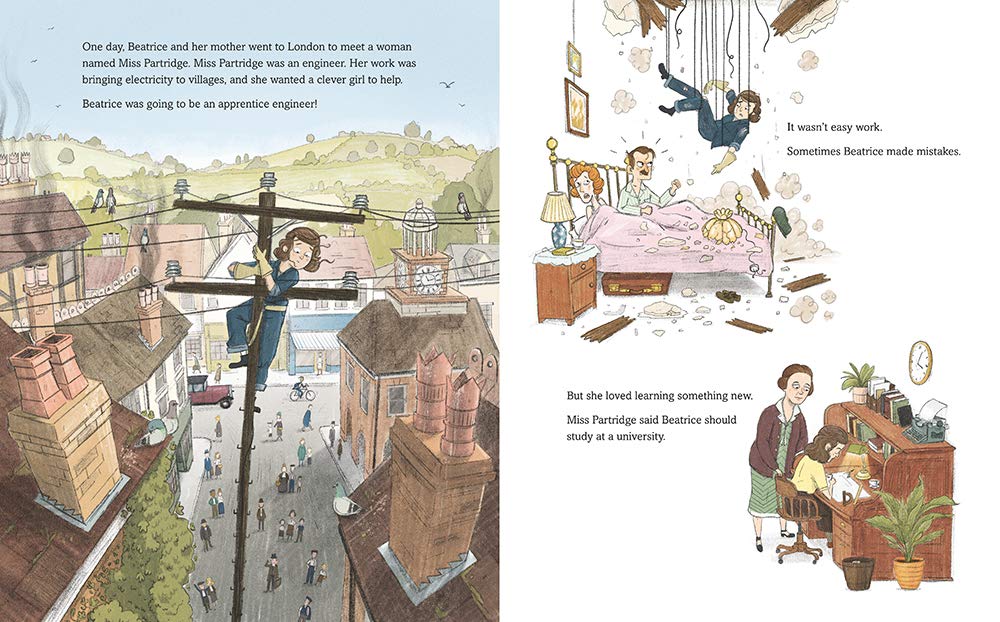
Beatrice wanted to be an engineer, and was fortunate to meet a mentor who encouraged her to study at the university. Where she wasn’t quite like the other students. And when she graduated, there weren’t any jobs for women engineers. But finally, one company gave her a chance. Which was a good thing, because she figured out how to solve a serious problem with fighter planes.

What I like about this book: I am always looking for books about women in STEM fields – and engineering is one of those fields where women are underrepresented. I also love reading stories about strong girls who solve problems. Plus, there is back matter: more juicy details about Beatrice’s life. And – the end pages are wonderful ~ diagrams of engine parts and bolts and other fun things.


Beyond the Books:

Make a tool kit. An unused tackle box or lunch box work well. Here are the basics you’ll need: safety goggles, a variety of screwdriver sizes in both flat and Phillip’s head, a hammer, needle nose pliers, wire cutters, tweezers, and a crescent wrench. Also a plastic tray for collecting screws and washers while working on a project – we use take-out containers.

Take apart some things that no one is using. Some fun things to take apart are old computer keyboards, old computer mouse, broken electronic toys, toaster, radio, VHS or DVD player, old printer. Make sure you remove batteries and snip off the cord before unscrewing the first screw. For safety reasons, don’t take apart anything with glass, sharp edges, or tubes that can break.

Today we're joining Perfect Picture Book Friday, an event where bloggers share great picture books at Susanna Leonard Hill's website. Review copy provided by the publisher.

Friday, July 2, 2021

When it's Hot Enough to Fry an Egg on the Sidewalk...


This book was published three years ago, but because of the heat wave in the northeast, it seems like a perfect pick for today. It got so hot in Oregon that roads buckled and Portland shut off the streetcars because heat was melting the cables. Scorching temperatures soared to 116 F in some places – hot enough to fry an egg on the sidewalk!

Iqbal and His Ingenious Idea: How a Science Project Helps One Family and the Planet 
by Elizabeth Suneby; illus. by Rebecca Green 
32 pages; ages 5-10
‎Kids Can Press, 2018

theme: STEM, sustainability, problem-solving

Iqbal lives in Bangladesh and it’s the monsoon, when “gusts of rain whip across your face and make you squint your eyes.” At home, Iqbal’s mother cooks the meals over an indoor fire. The smoke irritates her lungs, causing her and the baby to cough.

Iqbal wants to win the prize at the science fair so he can use the prize money to buy his mother a gas cookstove. He’s got a month to come up for a project that fits with the theme of sustainability.

What I like about this book: This is a fun story to read, while broaching a serious topic at the same time. We see Iqbal trying to come up with ideas. He sketches gadgets with gears, he conceives of contraptions, he dreams of devices. Could he build a smokeless cooker? With help from his teacher, they get ideas from the internet, and Iqbal designs a solar cooker from things most people have in his village: broken umbrellas. He lines his umbrella with foil, borrows a soot-blackened cookpot, and is ready to test his stove. All he needs is a sunny day to test it.

Beyond the Books:

Can you really fry an egg on the sidewalk? Probably not. Eggs need to reach a temperature of 158 F to cook through – hard to do on a white surface. A better idea would be to fry an egg on the hood of a car sitting under the hot sun (remember: eggs will run, and car hoods are curved). One Arizona girl had a brilliant idea: put the greenhouse effect to use and fry an egg inside a car on a hot day. You can watch her video here. It’s also a good reminder of why you don’t leave pets – or people – inside cars.

Make your own solar cooker. Here’s how to turn a pizza box into a solar oven, and here’s how to turn any kind of box into a cooker.  You can also use an old umbrella and lots of shiny foil, like Iqbal. A good test is to use your oven to make s’mores.

We’ll join Perfect Picture Book Friday once they resume. It’s a wonderful gathering where bloggers share great picture books at Susanna Leonard Hill's website. Review copy found on the library shelves.

Friday, December 13, 2019

Stories from Miss Bunsen's School for Brilliant Girls

Light as a Feather [series: Miss Bunsen's School for Brilliant Girls]
by Erica-Jane Waters
128 pages; ages 7 - 9 years
Albert Whitman & Company, 2019

Miss Bunsen’s School for Brilliant Girls is a new chapter book series that celebrates STEM STEAM. Pearl, Millie, and Halinka are a tight trio of friends who tackle all kinds of challenges throughout the series.

In Light as a Feather they are trying to design and build a flying machine for the Annual Girls of Science Games Day. A famous astronaut has issued a challenge: to build their flying craft from environmentally-friendly materials. The winning team gets to spend a week at her space center, plus a trip into space aboard a shuttle.

I like how the three friends work as a team, and their plan to use recycled metal from drink cans and re-purpose other materials. When a fire breaks out and destroys their machine, they rebuild, making do with old tomato cans, rubber hoses, wire whisks, and a few other intriguing “found” items. But will their craft remain airborne long enough? And can they pedal it fast enough to win?

This is the second book in the series about the trio of best friends who attend a funky old school. The school is old, underfunded, and perpetually plagued by squirrels.

The first book in the series, If the Hat Fits features an invention/engineering competition. If they win, the money could help keep the school open.

And there’s a third book coming out next spring: Penny for Your Thoughts. The blurb from the publisher says that Pearl, Millie, and Halinka put their problem-solving skills to the test in a maze competition. But… they find themselves trapped in a strange maze, and Miss Bunsen has to give up her book of secrets in order to set them free. They will need to keep their wits to solve their way out of the puzzle.


Review copy provided by the publisher.

Friday, March 8, 2019

Cogheart

Cogheart
by Peter Bunzl
368 pages; ages 12 & up
Jolly Fish Press, 2019 (US edition)

Action! Adventure! Danger and Daring! What a great kick-off for the new series of Cogheart Adventures .

Thirteen-year-old Lily Harman is stuck at Miss Octavia Scrimshaw’s Finishing Academy for Young Ladies. She would rather be anywhere else, especially if it involved adventures and piracy, like the stories she reads in her penny dreadfuls – the Victorian equivalent of comic books. Instead, she’s condemned to classes on deportment and posture and the Art of Making Polite Conversation (in French, no less).

Then her father, a famous inventor, disappears on what should have been a routine zeppelin flight. Suddenly Lily’s life is turned upside down. Her father’s housekeeper Madame Verdegris, becomes her legal guardian and brings her back home. Lily is happy to be away from the pretentious school. She is happy to be reunited with Mrs. Rust, a mechanical servant who cooked so many of Lily’s meals.

But something strange is going on. Madame Verdegris is selling some of her father’s mechanicals off for salvage, and strange men metal-eyed men lurk in the shadows.  Then there’s the clockmaker’s son, Robert, who has rescued Lily’s mechanical pet fox, Malkin. Why were metal-eyed men chasing – and shooting – at her fox?

I love the wild adventure that takes Lily and Robert across the rooftops of town. I love the mechanicals – and how each has its own winder. They are as precise as clockwork. I love Mrs. Rust’s wonderful lexicon of alliterative idioms. “Cogs and chronometers!” she exclaims. “Smokestacks and sprockets!”

And I love how the secret of the Cogheart is revealed. I’d say more, but there are metal-eyed men lurking in the shadows, so I must be off. I look forward to more exciting adventures in this series.

Thanks for dropping by today. On Monday we'll be hanging out at Marvelous Middle Grade Monday with other  bloggers. It's over at Greg Pattridge's blog, Always in the Middle , so hop over to see what other people are reading. And drop by one of his earlier posts where he reviews Cogheart. Review from Advanced Reader Copy provided by Blue Slip media.

Friday, January 18, 2019

Walls are no obstacle in these books

Sometimes walls are an obstacle. Sometimes they're not. Here are three different takes on walls in recent picture books.

themes: friendship, problem-solving

Douglas, You're a Genius
by Ged Adamson
40 pages; ages 3-7
Schwartz & Wade, 2018

Nancy and Douglas were playing ball in the backyard, when Nancy hit one too hard.

The ball disappears through a hole in the fence. Oh, no! And then it comes back. Thank you!

Douglas wants to know who is over there, on the other side. So they lay track and send a message by train. And then they wait.

And wait.

What I like about this book: When the message comes back it's ... escrito en español. Now they really want to find out who lives on the other side of the wall. Nancy comes up with all kinds of plans - some involving trampolines, bungee cords, even a kite. Then Douglas has an idea, and it was the most genius plan of all!

I also like the brilliant plans, drawn on graph paper, and how the characters work together as an "engineering team". And I like the Spanish glossary at the front, so readers can familiarize themselves with some of the phrases used, such as "queremos conocerte" (we want to meet you).

I started wondering how many kids' books feature walls. Turns out this is becoming a theme in some picture books. I really like Brick by Brick, by Giuliano Ferri (Minedition, 2016).


Giuliano is an author-illustrator who lives in Italy. But no translation was needed for this book, because Brick by Brick has no words. At the heart of the story is this question: what happens if a brick falls out of the wall?  And then you and your friends take out more bricks... and what could those bricks be used for instead of building a wall?

From the jacket: "...walls can become bridges when everyone pitches in." And that, right there, is What I like about this book.

In picture books, walls can show up in totally unexpected places, and sometimes overnight.

The Only Way is Badger
by Stella J. Jones; illus. by Carmen Saldaña
26 pages; ages 5-8 years
Tiger Tales, 2018

Deep in the forest something wasn't right. Overnight, a wall had appeared.

Plus there were posters tacked to the trees. They had messages such as "Be More Badger!" and "Badgers are Best!" Of course, Badger is the one who put up the posters. And now he's in charge of making sure that the animals who live on his side of the wall are sufficiently badgerly.

What I like about this book: Badger thinks his way is best, so he devises tests to weed out animals that aren't badgerish enough. Can't dig like badger? To the other side of the wall with you! Too big to fit in a badger den? Over the wall with you, too! But soon... there's no one left on badger's side of the wall. Plus it's deadly boring. So badger climbs up, up, up, and peeks over the wall to the other side. And then he makes the best sign of all (which I will NOT reveal) - suffice it to say that badger learns to appreciate his diverse friends.

Beyond the Book:


Some walls create habitats. In some places in the northeast I find old stone walls meandering through the woods or along the edges of fields. The stones are so old that they are covered by lichens and mosses. Sometimes grasses and other plants have taken foothold, and insects and other tiny creatures have built their homes in the nooks and crannies of the wall.

Over, Under, and Around... When I was a kid, everyone in our neighborhood had wooden privacy fences along the border of their back yards. Like Douglas and Nancy, we always wanted to find ways to the other side - even though we already knew everyone on the block. We thought of crazy ideas, too: bouncing someone over using a teeter-totter was one. Put your best engineering skills to use and design a way to get to the other side of a wall. Hint: drawing on graph paper makes it more fun!

Can you use walls to make art?  Street art - painted murals and mosaics - are a highlight of my visit to Ithaca, NY. Check out this review of Hey Wall: A Story of Art and Community posted by Patricia Tilton.

If you are looking for artistic inspiration check out the artwork of these illustrators:
Ged Adamson
Giuliano Ferri 
Carmen Saldaña 

 We're joining Perfect Picture Book Friday. It's a weekly event where bloggers share great picture books at Susanna Leonard Hill's website. Review copies discovered at the library.

Monday, December 7, 2015

Hello Ruby: Adventures in Coding & Author Interview


Hello Ruby: Adventures in Coding 
by Linda Liukas
112 pages; ages 4-8
Feiwel & Friends, 2015

Imagine a picture book with chapters, combined with an activity book, all with the focus of inspiring young children to play around with tools of computer programming. At the core of this book is the philosophy that play is integral to learning, and that coding is a way to express yourself through play - like crayons or LEGO blocks.

This is no coding guide. Instead, Hello Ruby introduces fundamentals of the kind of thinking that kid coders need: how to break big problems into small problems; how to look for patterns; and how to write step-by-step directions (useful not only in sharing recipes but also in telling a computer what to do).

Ruby, the character in this book, is a small girl with a huge imagination and lots of cool friends. She builds things using her imagination, and that sometimes means making maps, gathering information, and testing out different solutions to problems.

The second half of the book is a collection of activities designed for parents and children to explore together. This is where the actual “coding” comes in. For example, how would you instruct Ruby in making her bed? You see, coding is how you tell a computer what things to do, and what order to do them in. This back section is where you play with logic, meet Booleans, and decode a secret language. Perfect for cold winter afternoons! 

Nothing helps you learn about coding faster than trying it yourself. Head on over to Ruby's website to play some games... some of them require nothing more than a pencil and your imagination. And when you've finished there, check out the resources over at Archimedes Notebook. 

I wanted to know more about how Hello Ruby came about. Author Linda Liukas graciously answered Three Questions. 

Sally: How did you get started in computer programming? And what did you love about it that made you want to do it? 

Linda: I was 13 and madly in love with Al Gore, the then vice-president of US. I had all this teenage girl passion and energy and wanted to make a website for him in Finnish. At the time there was no Tumblr or Facebook, so the only way for me to express all my feelings was by learning HTML and CSS. This has probably influenced my later programming career: for me, coding has always been about creativity, expression and practical application. 

Our kids should learn to bend, join, break and combine code in a way it wasn't designed to - just as they would with crayons and paper or wood and tools. I want to show how coding can be as creative a tool as music or drawing or words. You create something out of nothing, with pure words and thought structures. Learning programming teaches you to look at the world in a different way. 

Sally: Why did you want to write "Hello Ruby" as a picture book? 

Linda: Such a huge part of our daily lives is spent in front of a screen. I believe there's a lot of value in parents and children exploring and interacting offline. That's why Hello Ruby is aimed for 5-7 year olds to be read together at bedtime with the parent, kids who don't necessarily read or write yet on their own. And there's a wealth of knowledge about computers and computing concepts we can teach to the little ones before even opening the terminal. 

Sally: Are there some games parents can play with really young kids before they get on computers? I'm thinking things like putting blocks into patterns (color & shape), but can you think of others? 

Linda: I think computing principles are everywhere around us, and the book familiarizes kids with fundamentals of programming, computational thinking and the attitudes that are important for any future programmer. These include things like the ability to decompose a problem, spot patterns, think algorithmically, debug problems and work together. My hypothesis is that when a kid learns to spot computational thinking in everyday situations, they’ll also be able to learn abstract programming languages more easily. 


Today we're joining the roundup over at the Nonfiction Monday blog where you'll find even more book reviews. Review copy provided by the publisher.

Friday, May 22, 2015

Clink ~ and illustrator interview

Clink
manufactured by Kelly Dipucchio and Matthew Myers
32 pages; ages 4-8
Balzer & Bray, 2011

theme: friendship, robots

opening:   As far as robots go, Clink has his fair share of problems. He was rusty (even his dust had rust). He was squeaky (even his creaks made squeaks). And a day didn't pass without something falling off.

Clink is an "old-school" robot. He doesn't make cookies, fix hair, or do the laundry. He burns toast... and nobody, it seems, wants a robot that burns toast. Except one boy for whom Clink is "just right".


What I like about this book: Clink is fun to read. He is a klutz and he needs more than cosmetic repair, but he's got a good robot heart. I love the kid who takes him home... we see him and Clink in the garage workshop, with notes tacked to the walls: "New Head Ideas for Clink" and "Radio stations Clink can play".

I also love the end pages; they are blueprints for a "Clink Domestic Automaton (patent no. 0169432-Z)". White drafting and notes on a blue background, with side views, front views, rear views.

I love the end pages so much that I just had to ask illustrator Matthew Myers about them. He was kind enough to answer Three Questions:

Sally: How did the blueprint-like end pages evolve?

Matthew: Since Clink was my first book, I had no idea what was possible. Donna Bray, our editor, asked if there was anything I wanted to do for end papers. "What are those?" I asked. Blueprints seemed like a natural choice, since I had illustrated the book by then and had supposed Clink was created in 1938 (see title page of the original packaging). The general notes are from the engineer - tips on how best to utilize the robot. I imagined a stoic engineer writing these notes in all earnestness.

Sally: What sort of research did you do for your illustrations?

Matthew: Robots are so much a part of my visual vocabulary that I didn't really need to do any research. I grew up in the 60s, and clunky robots were on TV all the time. I grew up with tools, so Milton's workshop is not a stretch for me. My dad was always building things, so of course I wanted to pound and saw and drill, too.

Sally: What sort of media did you use for your illustrations?

Matthew: I drew the blueprints with pen and then tidied up in Photoshop. All the others are oil paint on illustration board. I work larger than final illustration (about 120%) so when the art is reduced to fit the book it looks crisper. You can check out how I work over on my website, myerspaints.com

Beyond the book: Check out the book trailer. Then have fun with these robot-related activities.

Draw a robot: If you love robots, draw a design for one. You could make a set of blueprints that show the systems and parts, or just draw (and paint) what your robot would look like. Make sure to include some user-tips from the engineer.

Make a Robot Suit: All you need is a large paper grocery bag, a box for a helmet, some buttons, bottle caps, and stuff to glue on, scissors, crayons and markers, duct tape (of course) and maybe some foil. Get ideas for a paper bag vest here, and robot helmet here.

Make a Balancing Robot out of cardstock. You can download a free printable design. Then color, cut out, and add some pennies for weights. Balance your robot on your finger, your nose, the tip of a pencil, a clothesline...

Make a Mini-Robot out of stuff from the junk drawer. This is for kids (and parents) who like to mess around with batteries, motors... directions and inspiration here

Today is PPBF (perfect picture book Friday), an event in which bloggers share great picture books at Susanna Leonard Hill's site. She keeps an ever-growing list of Perfect Picture BooksReview copy from the library.