Showing posts with label women history. Show all posts

Friday, October 29, 2021

Need Something Fixed?


The Girl Who Could Fix Anything: Beatrice Shilling, World War II Engineer 
by Mara Rockliff; illus. by Daniel Duncan 
48 pages; ages 5-9
Candlewick, 2021  

theme: Engineering, women in science, biography 

Beatrice Shilling wasn’t quite like other children. She preferred tools to sweets.

Because tools can take things apart. They can put things together. They can fix things that are broken.

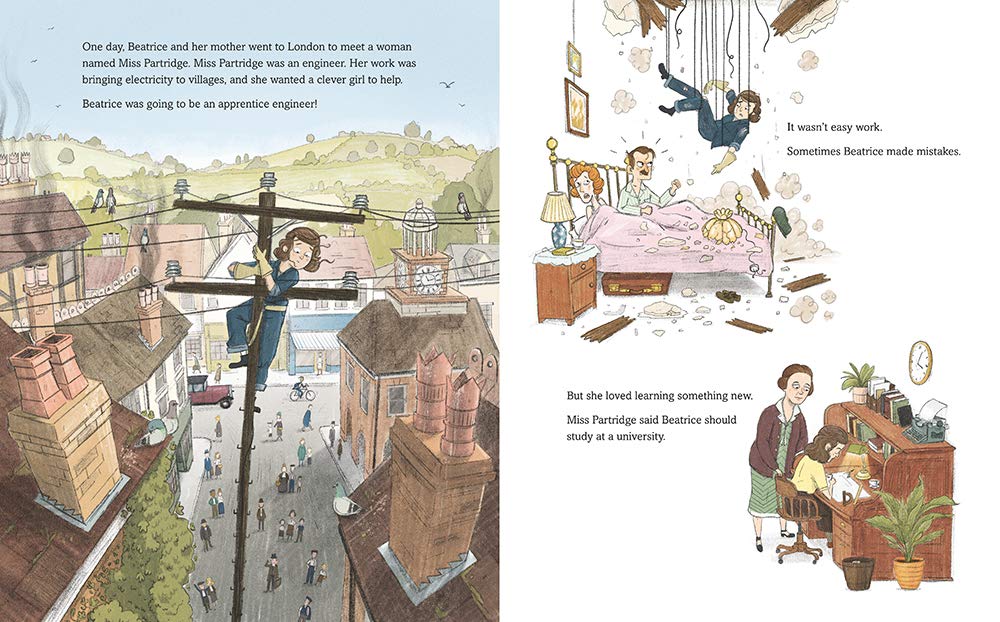
Beatrice wanted to be an engineer, and was fortunate to meet a mentor who encouraged her to study at the university. Where she wasn’t quite like the other students. And when she graduated, there weren’t any jobs for women engineers. But finally, one company gave her a chance. Which was a good thing, because she figured out how to solve a serious problem with fighter planes.

What I like about this book: I am always looking for books about women in STEM fields – and engineering is one of those fields where women are underrepresented. I also love reading stories about strong girls who solve problems. Plus, there is back matter: more juicy details about Beatrice’s life. And – the end pages are wonderful ~ diagrams of engine parts and bolts and other fun things.


Beyond the Books:

Make a tool kit. An unused tackle box or lunch box work well. Here are the basics you’ll need: safety goggles, a variety of screwdriver sizes in both flat and Phillip’s head, a hammer, needle nose pliers, wire cutters, tweezers, and a crescent wrench. Also a plastic tray for collecting screws and washers while working on a project – we use take-out containers.

Take apart some things that no one is using. Some fun things to take apart are old computer keyboards, old computer mouse, broken electronic toys, toaster, radio, VHS or DVD player, old printer. Make sure you remove batteries and snip off the cord before unscrewing the first screw. For safety reasons, don’t take apart anything with glass, sharp edges, or tubes that can break.

Today we're joining Perfect Picture Book Friday, an event where bloggers share great picture books at Susanna Leonard Hill's website. Review copy provided by the publisher.

Friday, January 17, 2020

Warrior Queens

Warrior Queens: True Stories of Six Ancient Rebels Who Slayed History 
by Vicky Alvear Shecter ; illus by Bill Mayer
160 pages; ages 9 - 12
Boyds Mills Press, 2019

The ancient queens Vicky Shecter writes about didn’t go looking for trouble. Trouble came looking for them – usually invaders who wanted their land and riches. But these ladies pushed back. Hard. “They fought in chariots, on ships, and even on elephants,” writes Shecter.

So who were these queens? One was Hatshepsut, a powerful female pharaoh who ruled Egypt about 3500 years ago. Married at 13, widowed by 16, she proved to be a plucky leader – and one who kept the economy strong by building roads and monuments. And, when required, went to war to strengthen the borders of her country.

About 1400 years later, Amanirenas ruled a powerful African kingdom in Nubia (what’s now Sudan), just south of Egypt. Queen Amanirenas ruled a rich land, where women were respected and had power. Then Roman emperor Caesar Augustus invaded Egypt. Seeking even more treasure, the Romans attacked five Nubian cities. Queen Amanirenas was not amused. She led her warriors on a counterattack, taking back her cities and destroying Roman military outposts as well.

Eighty years later, in ancient Britain, Queen Boudicca led a rebellion against the Roman army. Her Celt tribe had been living in uneasy peace with the Romans, but when Boudicca’s husband died, the Romans stomped into her village. They wanted everything – money, food, horses. When Boudicca challenged them, they dragged her into the village center and whipped her. As the Romans destroyed Celtic culture, Boudicca planned her attack. She and her blue-painted warriors swarmed the biggest Roman city. They freed the slaves, looted the city, and left nothing but smoldering rubble. She went on to destroy an entire Roman legion and burn Londinium to the ground.

Shecter includes plenty of sidebars on topics ranging from forensic anthropology to religion and ancient medicine. Each chapter includes chapter notes that fill in the details. Back matter includes endnotes, a bibliography, and index.

Thanks for dropping by today. On Monday we'll be hanging out at Marvelous Middle Grade Monday with other  bloggers. It's over at Greg Pattridge's blog, Always in the Middle, so hop over to see what other people are reading. Review ARC provided by the publisher.


Friday, December 20, 2019

Vivian Kirkfield Helps Make Voices Heard

My colleague and friend, Vivian Kirkfield, has a new book coming out next month. Making Their Voices Heard is an inspiring story about the friendship of two amazing women, jazz singer Ella Fitzgerald and movie star Marilyn Monroe. I invited Vivian to share her thoughts about how they stepped outside the norms society had set for them. 

Take it away, Vivian!

Thank you so much, Sue, for inviting me over today. Ella Fitzgerald and Marilyn Monroe made their voices heard onstage and in the fight for gender equality and against discrimination. I feel so honored to tell their story.

Back in the 1950s, most women didn’t have much control over their lives. It wasn’t until the Equal Credit Opportunity Act of 1974 that a woman could get a credit card or a mortgage without having it co-signed by a male relative. Literally and figuratively, women were put in a box – a bit like Barbie dolls on department store shelves. They were expected to act and dress a certain way, and carry out certain roles like being a mother, secretary, nurse, or teacher. Even female entertainers had to stay within the confines of society’s strictures.

And then, along comes Ella Fitzgerald. Although she had a difficult childhood, once she won the Amateur Night at the Apollo Theatre, Ella believed in her talent – her gift for singing jazz. It gave her the strength to fight for what was right and remain true to herself. When she was bumped from a Pan Am flight on her way to Australia for a concert tour in 1954, she sued the airline for racial discrimination…and won! This was before Rosa Parks refused to give up her seat to a white passenger on a bus. It was before Martin Luther King, Jr’s “I Have a Dream” speech. Ella was breaking down the walls that society had erected around her.


Marilyn Monroe also had a sad and difficult childhood. Growing up in an orphanage, she’d stand on her bed and act out scenes from movies before bedtime. Many choices she made were because of the box society had put her in. She agreed to get married at age 16 to avoid being returned to an orphanage. And after signing with a movie studio, Marilyn was in more of a box than ever before. The studio told her what color lipstick to wear and what parties to go to.

But Marilyn had a mind of her own. She went overseas to entertain the troops in Korea.  She visited jazz clubs in New York City – at a time when jazz clubs were places most white women did not go to. And she loved Ella Fitzgerald. Marilyn listened to Ella’s records to prepare for a big singing role in the movie, “Gentlemen Prefer Blondes.” When critics gave her rave reviews, and studio bosses agreed to give her more control over her script choices, Marilyn bought a ticket to Ella’s next show so she could thank her in person.

After the show, Marilyn and Ella shared their hopes and dreams and plans of what might be. Ella revealed that she’d been unable to get a booking at one of Hollywood’s top clubs. The owner didn’t want ‘jazz’ music at his nightclub, and he didn’t want a plain-faced, overweight black woman performing for his guests. But, after a phone call from the wildly popular Marilyn, and because Marilyn had agreed to sit in the front row every night, the club owner agreed to give Ella a week’s booking.

Many of us know of Ella Fitzgerald as one of the greatest, if not the greatest, female jazz singers. In the first year of the Grammys, 1959, Ella won Best Female Pop Vocal Performance and Best Improvised Jazz Solo…another example of how she broke down the barriers. And many remember Marilyn Monroe as the sexy blonde bombshell – but how many know that she was the first female movie star to start her own movie production company?

I hope my book will help children realize how important it is to stand up for what is right and to make your voice heard…to stand by your friends…and to be inclusive when choosing those friends. I’m honored that I got the opportunity to write this story and I’m thrilled that it has become a real book that will inspire parents and children alike.

Thank you so much, Sue, for giving me the opportunity to visit with your blog readers.


The next couple of months will be busy and exciting for Vivian. On Saturday, January 18 she has an 11am book launch at Barnes & Noble bookstore in Nashua, NH. On January 24 she’s participating in an Author Night at her granddaughter’s school in Chicago, and in March she’s heading to New York City for a book event Books of Wonder. You can keep up with her at her website and by following her  on Facebook , Twitter, and other social media.

Once the holidays are over, we'll be joining Perfect Picture Book Friday, an event where bloggers share great picture books at Susanna Leonard Hill's website

Friday, October 25, 2019

Away with Words

Away with Words: The Daring Story Of Isabella Bird
by Lori Mortensen; illus by Kristy Caldwell 
36 pages; ages 6-10
Peachtree Publishing, 2019

theme: adventure, women’s history, biography

Isabella Bird was like a wild vine stuck in a too-small pot. She needed more room. She had to get out. She had to explore.

But… Isabella suffered from illnesses. Maybe fresh air would do her good? Her father put her atop his horse and together they rode through the country side. Isabella dreamed of becoming an explorer. Later, she went on a sea voyage to Nova Scotia, hoping the sea air might help. She explored North America by steamboat, train, and horseback.

And when she returned home to England, she wrote about her adventures. Later, she set out again, climbing a volcano, hiking through Tibet … even causing consternation in a Chinese town. Each time she returned to share her adventures with readers eager to expand their horizons – even some readers who thought women should stay at home!

What I like about this book: I’m a sucker for adventure. Plus I’d read a couple of Isabella Bird’s books a few years ago. So it was fun to see some of her words on the pages of this picture book. Like other travelers of the time, Isabella kept a journal and sketched pictures. She noted distances traveled and wrote about the people she met.

I also like the way the illustrator portrayed Isabella and her travels, and the use of panels on the page. And there’s back matter: more about Isabella in an author’s note, a timeline of her travels, citations for quoted material, and a bibliography for armchair explorers who want to follow in Isabella’s footprints.

Beyond the Books:

Read more about Isabella Bird over at Amy Poehler's Smart Girls
https://amysmartgirls.com/meet-isabella-bird-19th-century-travel-writer-cbf309f3776c

Be an explorer! Take a sketchbook and pens, colored pencils, and a water bottle (and maybe a snack) and head off on an adventure. It might be to a park you’ve never visited before, or the very back of your yard where tall grass grows and there might be tigers… Draw pictures of plants you discover. Talk to someone and write down what you learn. Have fun!

Today we're joining Perfect Picture Book Friday, an event where bloggers share great picture books at Susanna Leonard Hill's website. Review copy provided by the publisher.

Friday, April 5, 2019

Sweet Dreams, Sarah


Sweet Dreams, Sarah
by Vivian Kirkfield; illus by Chris Ewald
32 pages; ages 7-11
Creston Books, 2019

themes: nonfiction, women in history, inventor

Before the Civil War, Sarah obeyed her owner. 
Hurry up. 
     Eyes down. 
          Don’t speak.

But Sarah dreamed of a different life: a family and work she loved. When the war ended, she moved north with “hope in her heart, and dreams swirling in her head.” She married and helped run the family furniture store. And dreamed of creating something new: a bed that folded up when it wasn’t being used.

What I like about this book: I like how Vivian Kirkfield shows us Sarah’s perseverance:  when things don’t work the way she wants them to, she tweaks her design and rebuilds. She applies for a patent. Gets rejected. Tries again. What a great example of the drive and commitment it takes to create something new.

I like that Sarah builds more than a bed that folds into a desk. She builds a life of freedom, where she can realize her dreams.


I like the back matter: an author’s note about Sarah Goode and what a patent is. There’s also a timeline so we can put her life and invention into broader historical context. And… ta-da! There’s a timeline of black women patent holders from Sarah Goode (1883) to Janet Bashen (2006, web-based software program).


Beyond the book:

Meet some other black women inventors - click here.

Invent something! Have you ever thought, "gee, someone should make a _____________?" Inventors are the ones who say, “this would be better if....” Here's a video from Kid President about his inventions.

Can kids be inventors? You bet. Here's 10 inventions dreamed up by kids.

We're joining Perfect Picture Book Friday. It's a weekly event where bloggers share great picture books at Susanna Leonard Hill's website. Review copy provided by the publisher.
Friday, October 27, 2017

Hurrah for Heroines!

The Book of Heroines: Tales of History's Gutsiest Gals
by Stephanie Warren Drimmer
176 pages; ages 8-12
National Geographic Children's Books, 2017

This book is chock-full of Leading Ladies, Daring Dames, Gritty Girls, Peace Heroines, Legendary Ladies, and a few outstanding non-human heroines. These strong girls don't wear capes or have superpowers. But they do share seven qualities, writes Stephanie Drimmer.

How to Identify a Heroine:
  1. Heroines step up when help is needed.
  2. They are brave. They do the right thing no matter how scared they are.
  3. They're confident, even when folks say "you can't do that." 
  4. They put others first.
  5. Heroines do the right thing.
  6. They face risk - which means they act even when doing so means they might be called names, or face danger.
  7. And when the going get tough, they don't quit.
So who are these real-life heroines Drimmer profiles? One is Eleanor Roosevelt who became the First Lady when F.D.R. was elected President in 1932. She held press conferences and wrote a column about her opinions on social and political issues. She used her position to give a  voice to people who didn't have one: women, children, African Americans, and the poor. She challenged stereotypes.

One section highlights women who led nations: Golda Meir, Angela Merkel, Margaret Thatcher, Cleopatra. Another introduces athletes. Within the pages are stories of code breakers, warriors, journalists, business leaders, pilots, and explorers. There are profiles of courageous peace-makers, like Malala Yousafzai and Rigoberta Menchu Tum. And there are scientists and inventors.

These women pushed against barriers, saved lives, and discovered new worlds. They're the sort of heroes you'd like any child to meet. Review copy from publisher.

Friday, September 30, 2016

Biographies of Strong Girls

I love stories about strong girls. Here are two that are true ~ one about a pilot, one about a baseball legend.

 theme: biography, nonfiction 

Fearless Flyer: Ruth Law and her flying machine
by Heather Lang; illus. by Raul Colon
40 pages; ages 5-8
Calkins Creek, 2016

Who can resist a story that begins, "The loop ... the spiral dive ... the dip of death!" coupled with the drawings of biplanes careening through the air.

 What I like about the book: Ruth is an independent woman with a dream: to fly her plane across the country. The year is 1916 and people say it can't be done by a woman. But if anyone can do it, Ruth can. She added gas tanks, installed metal guards to protect her legs from the frigid wind, and gathered her maps. Then one dark November morning she took off.

I like the occasional quotes from Ruth: "When your engine suddenly stops while you're 2,000 feet in the air, it's some comfort to know that if anything can be done, you can do it." I like that there's back matter: more about Ruth, a bibliography, resources, and source notes for the quotes.

Explore beyond the book with this video of Ruth Law in her flimsy flying machine.
Check out Ruth's "pilot story" from the Smithsonian's Postal Museum collection.


The Kid from Diamond Street: the extraordinary story of baseball legend Edith Houghton
by Audrey Vernick; illus. by Steven Salerno
40 pages; ages 4-7
Clarion Books, 2016

Edith Houghton used to say, "I guess I was born with a baseball in my hand," and if you'd seen little Edith playing in the 1920's, you'd probably have believed it. 

It didn't matter that there was no such thing as Little League - if there was a sandlot game going on anywhere near her house, she'd be in the middle of it. Edith was so good that she was playing professional baseball at the age of ten!

What I like about the book: It's a fun read of American history and a tale of women's professional baseball. Edith had to roll up the waistband of her Philadelphia Bobbies pants to make 'em fit, but she was passionate about the game. The book takes us on their trip to Japan (the principal agreed that Edith would get more out of this "field trip" than staying in her classes).

Go beyond the book and listen to an interview with Edith Houghton here.
And check out a wonderful photo and story about Edith in the Philadelphia Inquirer  here

Today is PPBF (perfect picture book Friday), an event in which bloggers share great picture books at Susanna Leonard Hill's site. She keeps an ever-growing list of Perfect Picture Books. Review copies provided by publishers.

Friday, September 9, 2016

Dorothea's Eyes

Dorothea's Eyes
by Barb Rosenstock; illus. by Gerard DuBois
40 pages; ages 8-12
Calkins Creek (Boyd's Mills), 2016

theme: imagination, nonfiction, history

Dorothea opens her grey-green eyes.
   They are special eyes.
       They see what others miss...

So begins a biography of one of my favorite photographers, Dorothea Lange. Before she ever owned a camera she knew she wanted to be a photographer - even though girls weren't supposed to be photographers. Even though it was hard for her to walk. She skips school to wander around the city, peering into crowded tenements, seeing with her eyes and her heart how people live - "happy and sad mixed together".

What I like about this book: It is about Dorothea! I like how Barb Rosenstock shows Dorothea growing into a photographer. And how her childhood - and her heart - drew her to take photographs of poor people, immigrants, migrant farmers... the invisible people in our society. I like that Dorothea's story can inspire young people to follow their dreams. Most of all, I like that "Dorothea's eyes help us see with our hearts."

Beyond the book: Check out the book trailer at Barb Rosenstock's website. You can also download an Educator's Guide.

Tour this gallery of Dorothea's photographs.

Take a camera on a field trip. Look at the everyday people in your town like Dorothea would - try to see with your heart. What photos do you come home with? 

Next week is National Arts in Education week. Every day next week I'll have art activities or a book review for you. Drop by and join us.
Today is PPBF (perfect picture book Friday), an event in which bloggers share great picture books at Susanna Leonard Hill's site. She keeps an ever-growing list of Perfect Picture Books. On Monday  we're joining the roundup over at the Nonfiction Monday blog where you'll find even more book reviews Review copy provided by the publisher.

Monday, September 15, 2014

Goldie Takes a Stand

Goldie Takes a Stand: Golda Meir's first crusade
by Barbara Krasner; illus. by Kelsey Garrity-Riley
32 pages; ages 5-9
Kar-Ben publishing, 2014

When I was growing up, Golda Meir was the Prime Minister of Israel. I remember thinking: if a woman can lead Israel, why can't we have a woman president?

So I was excited to get my hands on a review copy of this new book about "Goldie". Author Barbara Krasner writes about an event that happened when Golda was in the fourth grade.The year was 1908 - and Golda's family had just emigrated to the US a couple years earlier.

Golda and her friend, Regina, formed the "American Young Sisters Society" in order to raise money to buy textbooks for students who couldn't afford them. Golda tries a couple of things - neither of which works - and then decides she needs a public meeting, and ends up speaking in a large rented hall.

While the events Krasner writes about are factual, she adds dialog, telling the story from Golda's point of view. She includes biographical information and a list of places to visit at the back, as well as resources for people who want to learn more about Golda Meir. 

Review copy provided by the publisher.

Sunday, June 29, 2014

Lady Dai and the Ancient Chinese Treasures of Mawangdui

At Home in Her Tomb: Lady Dai and the Ancient Chinese Treasures of Mawangdui.
by Christine Liu-Perkins; illus by Sarah S. Brannen
80 pages; ages 9-14
Charlesbridge, 2014

"For more than two thousand years, people had gazed across the plains at a pair of hills rising like a giant saddle from the earth," begins Christine Liu-Perkins. These aren't ordinary hills, but burial mounds of ancient royalty. But who?

When the tomb was opened, scientists found the mummy of Lady Dai of Mawangdui. Her body was so well preserved that they were able to perform an autopsy on her, and learned that she died of a hear attack. They also found 138 muskmelon seeds in her digestive tract - remains from her last meal.

This book takes readers into the tomb of Lady Dai, along with the archeologists - and forensic scientists - who excavated the site. It's filled with photos and drawings of the things she carried with her to the next life. There's plenty of back matter for folks who want more:  a timeline, glossary, author's notes and sources.

To learn more about this archeological treasure, and see photos and a video, check out this article.

Hop over to Nonfiction Monday where you'll find lots more great nonfiction books at the Nonfiction Monday blog. Review copy provided by publisher.

Monday, June 23, 2014

Babe Conquers the World

Babe Conquers the World: the legendary life of Babe Didrikson Zaharias
by Rich Wallace and Sandra Neil Wallace
272 pages; ages 9-14
Calkins Creek/ Boyds Mills, 2014

When Babe grew up it was rare for young girls to play sports. But she lucked out - her elementary school principal realized that Babe needed to sweat and jump and run and allowed her to play sports with the boys. After school, Babe headed to the sandlot for baseball. Without women athletes to serve as role models, Babe fashioned her own way into sports.

In high school Babe played basketball, baseball, tennis... and when the 1928 Olympics opened track-and-field events to women, Babe followed the news. Her school didn't have a girl's track-and-field team, but there were rows of hedges all along the avenue. Heck - she even wanted to play football. For her, playing sports was a way to be equal.
Rich and Sandra follow Babe's life from her first big break on a women's semi-pro basketball team to the 1932 Olympics, her foray into golf and professional athletics, and even a stage show. They infuse her story with warmth and help us see Babe as a whole person, not just the world class athlete. In true journalist fashion they include all kinds of extras at the back: a timeline, FAQs, source notes and more.


This is Nonfiction Monday. You'll find lots more great nonfiction books at the Nonfiction Monday blog. It's also Marvelous Middle-Grade Monday - and you'll find more good middle-grade and YA literature over at Shannon Messenger's blog. Review copy provided by publisher.

Sunday, June 15, 2014

the Pure Grit of American WWII nurses

Pure Grit: How American World War II nurses survived battle and prison camp in the Pacific
by Mary Cronk Farrell
160 pages; ages 10 - 16
Abrams, 2014

In the late 1930s, young women enlisted for peacetime duty as US Army and Navy nurses. More than a hundred were stationed at several base hospitals in the Philippines, providing routine care to military families. Everything changed when, on December 7, 1941, the Japanese bombed Pearl Harbor and everything changed. As Japan invaded the Philippines, the nurses had to learn to treat battlefield wounds. When the Philippines finally fell to Japan, the nurses were captured as prisoners of war.

We might never have heard their stories if Mary Cronk Farrell hadn't gone back to read an email from her cousin. Her cousin had written a paper for nursing school about military nurses captured in WWII - enough to tickle Farrell's curiosity and she started researching.

But, back to the war. By Christmas eve it was clear that hospitals were in danger. So the nurses put what they could on a bus and "moved" their hospital into the jungle of Bataan - a deserted cluster of sheds with palm-thatch roofs at a former training camp. Without electricity they had to figure out how to sterilize medical instruments (they used Bunsen burners and pressure cookers).

Farrell focuses on the personal stories of the nurses, weaving in the war history. She shares their letters, diaries, and fills the pages with archival photos. There's a treasure of back matter: a glossary, timeline, endnotes and bibliography highlighting books suitable for young readers. If you've got a kid who needs a topic for a history paper, put this book in her hands. Check out interviews with the author here and here.

Check out what other bloggers are reviewing over at Nonfiction Monday. Today is also Marvelous Middle-Grade Monday round-up. Drop by to see what other bloggers are reviewing.
 ARC provided by publisher.

Monday, June 2, 2014

Dare the Wind

It's not "women's history month", but for the next month of Mondays you'll find stories about strong women in this space... starting with

Dare the Wind
by Tracey Fern; illus. by Emily A. McCully
40 pages; ages 5-10
Farrar, Straus  & Giroux, 2014


"Ellen Prentiss had always felt the sea tug at her heart, strong as a full-moon tide. Her papa said that was because she was born with saltwater in her veins."

Ellen, who grew up in Marblehead, MA in the early 1800s, would rather sail than stitch samplers. Her father, a captain of a coastal trading schooner, taught her how to sail and - more importantly - how to navigate. Growing up, Ellen practiced navigating her father's schooner, racing the fishing fleet across the bay.

She married a sea captain an sailed alongside, as navigator. Then her husband was given command of a fast, new clipper ship: the Flying Cloud. Their maiden voyage was from New York to San Francisco - 15,000 miles around Cape Horn - to deliver passengers and Cargo to the Gold Rush. If they made the trip faster than any ship had done, they'd get a bonus and bragging rights. Ellen was ready to dare the wind.

This is a great tale of adventure and courage on the high seas. It's also about the importance of math - and navigation - and using a scientific approach to solving problems.... because Ellen's routes strayed from the traditional shipping routes.

Curious kids will enjoy learning more about Ellen Prentiss in the author's notes, and following her journey mapped on the endpapers.

This is Nonfiction Monday. You'll find lots more great nonfiction books at the Nonfiction Monday blog. Review copy provided by the publisher.

Sunday, March 10, 2013

NF Monday - Women in History: Phillis Wheatley


Welcome to Nonfiction Monday, a round-up of cool books readers are reading and bloggers are reviewing. Check below for links to reviews.

As for me, I'm continuing my celebration of Women's History month and women writers. Today, a look at a young poet who, despite all odds, discovered her strong voice.

A Voice of Her Own: The Story of Phillis Wheatley, Slave Poet
By Kathryn Lasky; illus by Paul Lee
40 pages, ages 8 – 12
Candlewick Press 2003

“At first there was blackness. Complete blackness. Then the blackness dissolved into darkness, and the world in the creaking hold of the slave ship slid with shadows…” So Kathryn Lasky introduces us to a seven-year old slave without a name until she is sold to the Wheatley family in Boston in 1761.

“We’ll call her Phillis,” says Susannah Wheatley, naming the slip of a girl after the ship in whose hold she’d traveled. It turned out that Phillis has a passion for learning, and her owners encouraged her to read, write, learn Latin, Greek, geography, math. But what Phillis loved best was poetry; so she wrote.

She documented the Stamp Act, the Boston Massacre … the tumultuous beginnings of a country seeking independence. She read her poetry in fancy parlors for teas, traveled abroad, gained freedom and, in 1774, saw her book of poetry published. But most importantly, she reclaimed something that had been taken away from her and slaves everywhere: a voice of her own.

This book is sure to inspire young writers looking for a voice of their own. It's also perfect for Marvelous Middle-Grade Monday - where you'll find other books for the mid-grade age, both fiction and non. Review copy provided by publisher.
 
Nonfiction Monday Roundup

Leave a comment; I'll check throughout the day & post links:


 Over at True Tales & Cherry on Top, Jeanne reviews Emily & Carlo.


At NC Teacher Stuff, Jeff reviews Ocean Counting.


Tara at a Teaching Life reviews Master George's People.


 Laura Purdie Salas posted a review of Too Hot? Too Cold?


Mary Ann celebrates Women's History with Annie and Helen at Great Kids Books.


Loree Burns reviews Ocean Sunlight.


Over at Kidlit Celebrates, Alexandra celebrates women in history with a collection of nonfiction addressing the question of what made them who they became?


Ms Yingling is reading ICE.


Check out Mrs Harkness and the Panda over at Perogies & Gyoza.


 Ami's posted three great picture books on black history over at A Mom's Spare Time.


Jennifer is ready for spring with a review of It's Our Garden at Jean Little Library.


Tammy posted three books about forensic science at Apples with Many Seeds.


Over at All About the Books, Janet's reviewed Cars on Mars.


Got kids interested in their rights? Guide them to A Kid's Guide to America's Bill of Rights at Liz's kid lit about politics site


Lynn and Cindy review The Price of Freedom over at their blog, Bookends.


Check out nature's Zombie Makers over at Proseandkahn .


Stacking Books reviews Even an Ostrich Needs a Nest.
Last-minute addition:  Bomb: The Race to Build and Steal the World’s Most Dangerous Weapon, reviewed at Challenging the Bookworm


Friday, March 8, 2013

Women in History: Nellie Bly


It Can't Be Done, Nellie Bly! A Reporter's Race Around the World
by Nancy Butcher; illus by Jen Singh
144 pages, ages 7-10
Peachtree 2003

I confess, I wanted to read this book because I remember sneaking into the school library to read Jules Verne’s Around the World in Eighty Days sometime in fourth grade. Traveling around the world seemed like such an adventure … something I would have done at the drop of a hat.

I also wanted to read this book because I’m a reporter – and Nellie Bly is my hero. Instead of writing about conventional women’s topics (tea parties, charity events) she wrote about social problems of her day: poor work conditions, lack of decent housing, crooked politicians.

But mostly I wanted to read this book because it’s a grand adventure. In 1889 Nellie Bly took off on a round-the-globe trip to see if a person could, indeed, make it in 80 days or less. No one had done it, outside of Verne’s fantasy. She had to convince her newspaper that this would be a worthwhile investment, and promised to send stories along the way – without cell phone or blogs!

She traveled light, packing only a small satchel and wearing a sturdy travel dress for the nearly three-month venture. She journeyed by ship, train and foot, timing her connections down to the minute and almost missing some. Then, unbeknownst to her, another newspaper decided to send its own reporter to try to beat Nellie Bly home.

A reporter, a race against time, and a pet monkey… what’s not to like? And at the end of the book, author Nancy Butcher provides some additional reading and more details about Nellie’s life and the race. Review copy provided by publisher.