Showing posts with label writer. Show all posts

Friday, November 17, 2017

The Journey that Saved Curious George

The Journey that Saved Curious George
by Louise Borden; illus. by Allan Drummond
96 pages; ages 7 - 10
Houghton Mifflin Harcourt, 2016 (reprinted)

Eight-year-old Hans A. Reyerback loved to visit the zoo. He would imitate the sounds of animals, and loved to draw the animals. After serving in the German Army (WWI) he traveled to Brazil where he wore a broad hat and watched monkeys along the Amazon.

Margaret Waldstein loved art and studied photography. When Hitler came to power, life changed in Germany so she eventually traveled to Brazil. She was seeking new work and adventure and had heard that an old family friend (Hans) was living in Rio.

They teamed up as artists, eventually married, and traveled to Paris. They planned to visit for 2 weeks; they stayed for 4 years. In 1939 they began working on a story about a very curious monkey. That year war broke out. Paper was scarce and typesetters had joined the army. And war was marching closer! They had to flee Paris on bicycles, sleeping in barns, and narrowly escaping the bombing.

As refugees, waiting for visas, they were questioned by officials: what were the papers they were carrying? Were they spies? No, just writers.... Four months later they arrived in New York City and after another year they published the first book of many about Curious George.

What I like about this book: Adventure! Danger! Escape from Nazis! and Curious George! It's got history and mystery and biography all rolled into one exciting story. 

Review copy provided by publisher.

Friday, October 20, 2017

John Ronald's Dragons

John Ronald's Dragons, a J.R.R. Tolkien Story
by Caroline McCallister; illus. by Eliza Wheeler
48 pages; ages 4-8
Roaring Brook Press, 2017

themes: biography, imagination, dragons

John Ronald was a boy who loved horses. And trees, And strange sounding words.

But most of all, John Ronald loved dragons.

If you have a kid who loves dragons, you'll understand this. John Ronald grew up hearing stories about knights and dragons. He and his cousin made up their own language, but he never found dragons. Even when he went to war - and that's where he certainly could have used the help of dragons! So John Ronald went into teaching. And then one day, while grading papers, he started writing: "In a hole in the ground there lived a hobbit."

What I like about this book: It's fun to read. I like that John Ronald had no idea what a hobbit was, but followed him into a story that led him over mountains, beyond the ridges, east of the sun and west of the moon to the land where ... DRAGONS! I also like that the author and illustrator include notes at the end explaining more about Tolkien's life and inspiration for the illustrations.

Beyond the book:

Learn about hobbits! If you haven't read any of JRR Tolkien's books, at least read The Hobbit.Pay attention to their homes, what they wear, food they eat. These are important details.

How many kinds of Dragons are there? Like other reptiles, there is great diversity. You may want to make a poster showing all the various kinds of dragons there are or have been in the world.

Get to know dragons in the real world. Here's a National Geographic article that tells about seven existing "dragons".

Do dragons dance? Chinese New Year celebrations include dragon dances. If you were creating a dragon dance, what would it look like?

Today is PPBF (perfect picture book Friday), an event in which bloggers share great picture books at Susanna Leonard Hill's site. She keeps an ever-growing list of Perfect Picture Books. Review ARC from publisher.

Friday, March 24, 2017

Some Writer! The story of E.B. White

Some Writer! The Story of E.B. White
by Melissa Sweet
176 pages; ages 7-10 (and older!)
HMH 2016

Elwyn Brooks White loved words. And it's a good thing he did, because lots of those words ended up in marvelous books, like Charlotte's Web and Stuart Little - words I read and reread as I imagined that I, too, might have a little mouse and a red car or a canoe...

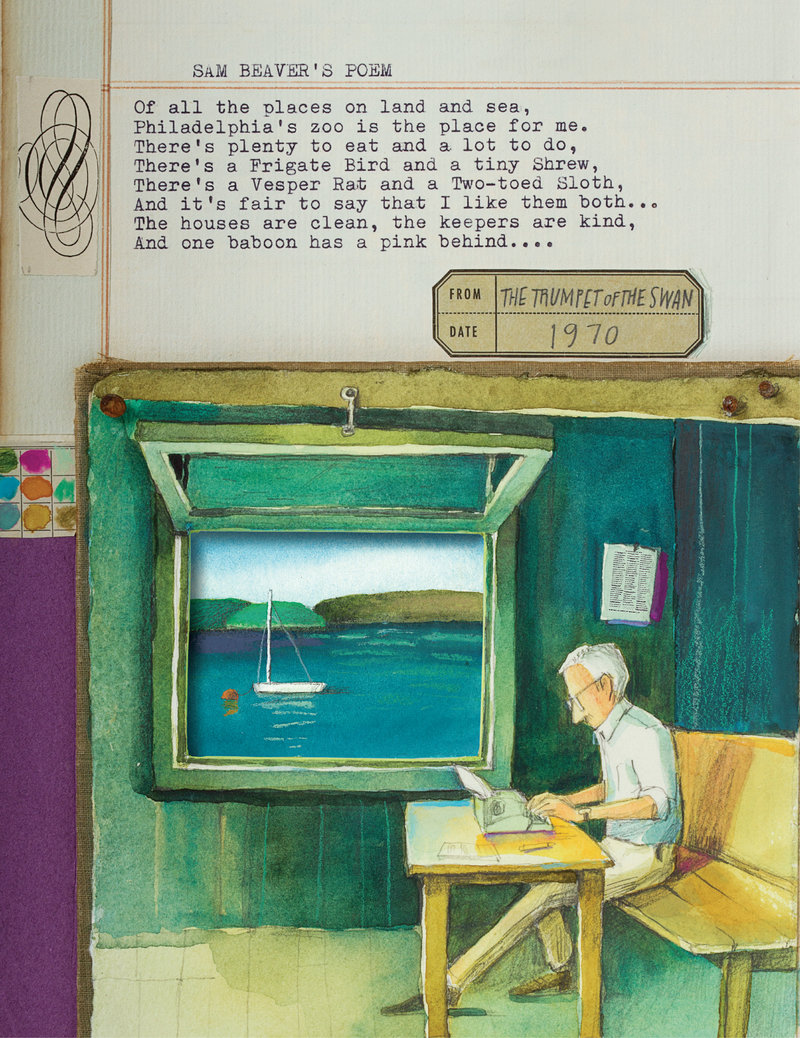
So it is fun, fun, FUN to read this wonderful biography by Melissa Sweet. It is full of words, too - and bright collages that give the book the feel of a scrapbook. There are tales of vacations in Maine, writing stories for contests, working as a counselor at Camp Otter.

EB White traveled about, wrote for the New Yorker, and then started scribbling notes that would grow into Stuart Little. "One October evening Andy [E.B.'s nickname] watched a spider spin an egg sac and deposit her eggs," writes Melissa Sweet. He detached the egg sac, put it into a box, and took it back to New York where he left it on his dresser. A few weeks later he noticed hundreds of tiny spiders climbing out of the box and spinning webs about the room. Later, back at his farm in Maine, he got to wondering whether a spider could save a pig...

Sweet includes a rough draft of Charlotte's Web that opens, "Charlotte was a grey spider who lived in the doorway of a barn." He struggled with the opening, jotting down different ways into the story, and then set the story aside for a year.

And then, Sweet notes, "he cut to the action ..." to the lines we know so well:
"Where's Papa going with that ax?"

What I love about this book is how Sweet weaves the story of E.B. White with illustrations that capture specific moments in his life. She even makes grammar fun! E.B. White is famous for his writing advice to Omit Needless Words. He's also famous for explaining the difference between affect and effect (I know this because I have looked it up in The Elements of Style) and when to use an exclamation point.

Sweet also has fun introducing readers to the times in which E.B. wrote. Opposite the Table of Contents she explains how a manual typewriter works.
And of course there is back matter: an afterword by Martha White (E.B. was her grandfather) with family photos, a timeline of his works, a selected bibliography of works by E.B. White as well as works by others that curious kids might want to check out. And - yay! - there is an index for impatient folks who want to know right this minute where to find something about chickens or pigs or the nitty-gritty stuff of Stuart Little.  

You can find out more about Melissa Sweet at her website.
On Monday we're joining the roundup over at the Nonfiction Monday blog where you'll find even more book reviews. Review copy provided by the publisher.


Friday, January 10, 2014

Cool Melons Turn to Frogs


Cool Melons - Turn To Frogs! The Life And Poems Of Issa
by Matthew Gollub; illus. by Kazuko G. Stone
40 pages; ages 4 - up
Lee & Low Books, 1998

Theme: biography, poetry (haiku)

This is the story of Issa, born in 1763 on a farm in central Japan. He began writing poetry as a young child, inspired by his love of nature. At one point in his life he spent seven years walking across Japan, composing poetry along the way. He wrote more than 20,000 haiku and never lost his love for the little things.

Opening: “Issa was born long ago in a small mountain village in Japan. In the spring, plum blossoms washed through the air, and Issa heard farmers sing as they planted rice.” In the mountains, the four seasons change, filling Issa’s days with discoveries. His observations made their way into poetry – haiku that becomes part of his life story in this book. An illustration of a young boy: 
A child intent
     on plucking jewels
     of dew in the morning grass. 

Later, as a  young man on a journey of discovery he jots his observations down as poems: 
A withered tree
     blooms once again-
     butterflies holding fast. 

 Once, writes Gollub, Issa saw watermelons left outside in a tub to chill. He felt sorry that someone would eat them up, and wished that they could hop away. 
Cool melons –
turn to frogs! 
if people should come near.

What I like love about this book: the delicious combination of text, haiku and artwork. In addition to lovely watercolor paintings, Kasuko Stone paints calligraphy down the margins. This book is fun to read and inspires one to grab a pencil and a camera and head outside to see what treasures the world holds. 

Beyond the book: Explore haiku by…
creating haiku postcards. These are short haiku descriptions of places you’ve been; cool fungi/rocks/bugs/flowers/animals you’ve seen; a weather report for the day; seasonal observations (migrations, leaves falling).

going on a haiku hike. Grab some index cards and write short haiku observations of things you see. This is a great activity for building science observation skills.

carrying a haiku in your pocket. Find a cool haiku that you like and copy it. Maybe use a calligraphy marker so it looks cool. Put it in your pocket and, when you see someone you want to share it with, give it away.

writing a cookie fortune in haiku. Fortune cookies may have been invented by a Japanese American who enclosed thank you notes in his grilled rice wafers.

combining haiku with drawings or photography. That art form, called haiga, began as paintings that embodied the sensibilities of haiku.

linking three or more haiku “verses” together in a longer poem.

Today's review is part of PPBF (perfect picture book Friday), an event in which bloggers share great picture books at Susanna Leonard Hill's site. She keeps an ever-growing list of Perfect Picture Books. On Monday I'm joining other bloggers for Nonfiction Monday - check out that blog for more great books. Review copy from my personal library.

Sunday, March 10, 2013

NF Monday - Women in History: Phillis Wheatley


Welcome to Nonfiction Monday, a round-up of cool books readers are reading and bloggers are reviewing. Check below for links to reviews.

As for me, I'm continuing my celebration of Women's History month and women writers. Today, a look at a young poet who, despite all odds, discovered her strong voice.

A Voice of Her Own: The Story of Phillis Wheatley, Slave Poet
By Kathryn Lasky; illus by Paul Lee
40 pages, ages 8 – 12
Candlewick Press 2003

“At first there was blackness. Complete blackness. Then the blackness dissolved into darkness, and the world in the creaking hold of the slave ship slid with shadows…” So Kathryn Lasky introduces us to a seven-year old slave without a name until she is sold to the Wheatley family in Boston in 1761.

“We’ll call her Phillis,” says Susannah Wheatley, naming the slip of a girl after the ship in whose hold she’d traveled. It turned out that Phillis has a passion for learning, and her owners encouraged her to read, write, learn Latin, Greek, geography, math. But what Phillis loved best was poetry; so she wrote.

She documented the Stamp Act, the Boston Massacre … the tumultuous beginnings of a country seeking independence. She read her poetry in fancy parlors for teas, traveled abroad, gained freedom and, in 1774, saw her book of poetry published. But most importantly, she reclaimed something that had been taken away from her and slaves everywhere: a voice of her own.

This book is sure to inspire young writers looking for a voice of their own. It's also perfect for Marvelous Middle-Grade Monday - where you'll find other books for the mid-grade age, both fiction and non. Review copy provided by publisher.
 
Nonfiction Monday Roundup

Leave a comment; I'll check throughout the day & post links:


 Over at True Tales & Cherry on Top, Jeanne reviews Emily & Carlo.


At NC Teacher Stuff, Jeff reviews Ocean Counting.


Tara at a Teaching Life reviews Master George's People.


 Laura Purdie Salas posted a review of Too Hot? Too Cold?


Mary Ann celebrates Women's History with Annie and Helen at Great Kids Books.


Loree Burns reviews Ocean Sunlight.


Over at Kidlit Celebrates, Alexandra celebrates women in history with a collection of nonfiction addressing the question of what made them who they became?


Ms Yingling is reading ICE.


Check out Mrs Harkness and the Panda over at Perogies & Gyoza.


 Ami's posted three great picture books on black history over at A Mom's Spare Time.


Jennifer is ready for spring with a review of It's Our Garden at Jean Little Library.


Tammy posted three books about forensic science at Apples with Many Seeds.


Over at All About the Books, Janet's reviewed Cars on Mars.


Got kids interested in their rights? Guide them to A Kid's Guide to America's Bill of Rights at Liz's kid lit about politics site


Lynn and Cindy review The Price of Freedom over at their blog, Bookends.


Check out nature's Zombie Makers over at Proseandkahn .


Stacking Books reviews Even an Ostrich Needs a Nest.
Last-minute addition:  Bomb: The Race to Build and Steal the World’s Most Dangerous Weapon, reviewed at Challenging the Bookworm


Friday, March 8, 2013

Women in History: Nellie Bly


It Can't Be Done, Nellie Bly! A Reporter's Race Around the World
by Nancy Butcher; illus by Jen Singh
144 pages, ages 7-10
Peachtree 2003

I confess, I wanted to read this book because I remember sneaking into the school library to read Jules Verne’s Around the World in Eighty Days sometime in fourth grade. Traveling around the world seemed like such an adventure … something I would have done at the drop of a hat.

I also wanted to read this book because I’m a reporter – and Nellie Bly is my hero. Instead of writing about conventional women’s topics (tea parties, charity events) she wrote about social problems of her day: poor work conditions, lack of decent housing, crooked politicians.

But mostly I wanted to read this book because it’s a grand adventure. In 1889 Nellie Bly took off on a round-the-globe trip to see if a person could, indeed, make it in 80 days or less. No one had done it, outside of Verne’s fantasy. She had to convince her newspaper that this would be a worthwhile investment, and promised to send stories along the way – without cell phone or blogs!

She traveled light, packing only a small satchel and wearing a sturdy travel dress for the nearly three-month venture. She journeyed by ship, train and foot, timing her connections down to the minute and almost missing some. Then, unbeknownst to her, another newspaper decided to send its own reporter to try to beat Nellie Bly home.

A reporter, a race against time, and a pet monkey… what’s not to like? And at the end of the book, author Nancy Butcher provides some additional reading and more details about Nellie’s life and the race. Review copy provided by publisher.