Showing posts with label WWII. Show all posts

Friday, December 10, 2021

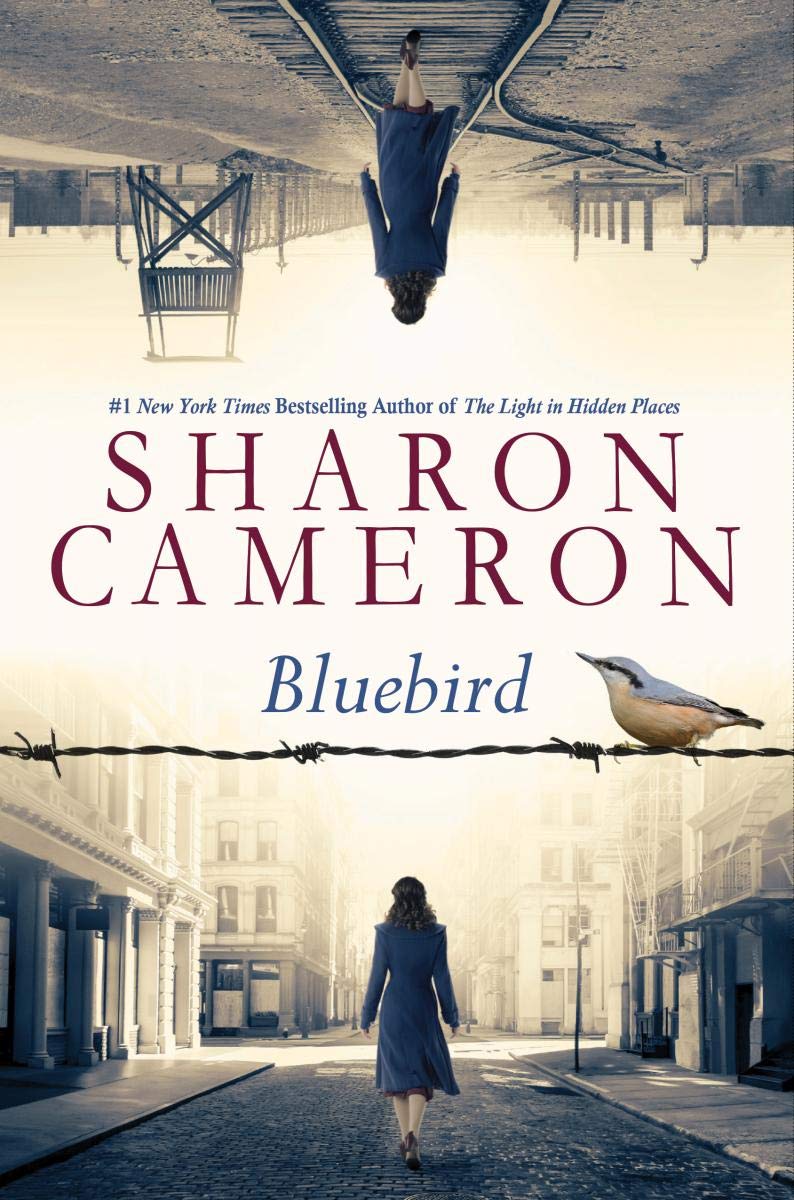
Unputdownable! Sharon Cameron's BLUEBIRD


‎Scholastic Press, 2021
In the normal course of events, I request books to review. And so I was surprised to get a package from Scholastic. Had I asked for a book and forgotten about it? Nope. Inside was a young adult novel that I never would have looked at, much less cracked the covers of, had it not ended up in my mailbox. By mistake? By fate? Who knows. 

Good thing it did, though, because I love a good story. Especially when it is grounded in fact and history. And doubly especially when it is written so well I just have to read another dozen (or 50) pages - even if it is one in the morning! 

The opening chapter introduces Eva, standing on the deck of a ship and gazing at the sea before her and the city approaching. It’s August 1946 and she has left behind a world of burning rubble. She gathers her suitcase and that of Brigit, who does not speak. She gathers their papers, and checks to make sure her secret documents are safely hidden. Then, together they follow their guide down the gangplank and into immigration.

America is bright, and friendly – and Eva and Brigit are here ostensibly to begin a new life. Eva has come for justice. She has come to search for a Nazi physician responsible for conducting horrific medical experiments on prisoners in concentration camps. She has come to uncover secrets, with hope of bringing this person to justice before the US government recruits him for their own dark programs. She has come to dig for the truth about Project Bluebird.

Eva has also come to protect Brigit, and help her recover from the horrible suffering at the hands of soldiers. Chapters alternate between 1946 America and war-torn Germany. We see flashes of Eva’s childhood as a schoolgirl under the Nazi regime. Living in Germany, Eva knew no hardship (her household included servants). But as she begins uncovering clues, dark memories begin to surface and Eva wonders about her place in her family. And now she is being followed by mysterious men.

Eva eventually finds a job and covers the hospital expenses so that Brigit can get treatment. As Brigit regains her memories, we learn how the two girls are connected – and we see how their experiences translate into different views of the world they now find themselves in.

What I like about this book: Sharon Cameron paints a detailed picture of an American city post-war. Her characters are so three-dimensional they could walk out of the book and carry on a conversation with you. But what I really like is the backmatter. Sharon adds a dozen pages of well-researched material that provides historical context and perspective for her story and the era. It should come as no surprise that Germany was not the only one conducting research on human subjects during the war.

Friday, July 23, 2021

Two Books Explore Life Under Hitler

Two books about life under Hitler came out earlier this year. At the time, I was busy reading escapist stories of adventure, fantasy, and science fiction – you know, typical pandemic fare. But this spring I dug through my book basket and plucked these two out to read. 

Ensnared in the Wolf's Lair: Inside the 1944 Plot to Kill Hitler and the Ghost Children of His Revenge 
by Ann Bausum
‎144 pages; ages 10-14
National Geographic Kids, 2021

Anne Frank wasn’t the only one writing in her diary in 1944. Sometime during the summer of that year, “a 12-year-old German girl named Christa von Hofacker picked up her pen and began to write in her own diary.” Like Anne Frank, Christa wrote to try to make sense of her world. Her father was entangled in an assassination attempt against Hitler, deemed a traitor, and vanished into the Nazi criminal court system. Days later Gestapo agents took away her mother and older brother and sister. And then it was Christa’s turn to be uprooted – sent on a three-day, 500-mile journey to a youth retreat center. Now it was a detention center for children of German men and women who were resisting Hitler’s regime. The overseers took away family photos and were given new names. They weren’t allowed to enroll in local schools, attend church, or visit the nearby community. Instead they were hidden and denied outside contact.

In this book, Ann Bausum explores Hitler’s rise to power, the German resistance attempts to limit that power, and his demise. During the first part of the book, she shows how easy it was for Hitler to control the message and reality of what people heard and saw. His regime was built on lies and fears. But a few brave people, some in his government, worked to overthrow him. When that attempt failed, Hitler not only went after members of the resistance, but also their families and children. 

A great mix of history, adventure, and insight into how a charismatic fascist leader can create a world of alternate facts. “…he connected with people on an emotional level that made it easy for them to dismiss logical counterarguments … his message was simple and it was compelling: You’ve been wronged, and I can make things right.” Serious, but essential reading for this time.


I Survived the Nazi Invasion, 1944 (graphic novel)
by Lauren Tarshis; illus. by Álvaro Sarraseca 
160 pages; ages 8-12
Graphix (Scholastic), 2021

It’s been two months since the Nazis have taken papa away, and now Max and his sister, Zena, are on their own. They live in a Jewish ghetto in Poland, and are hungry. When Max sneaks under the fence to gather berries, he’s spotted by a guard and marched back into camp. When his sister is threatened, Max makes a lunge, a gun goes off, and chaos ensues – but Max and Zena run for the forest. They meet Jewish resistance fighters who take them to a safe camp, but soon grenades are exploding, planes are flying overhead, and soldiers are marching through the woods.

The story is told through comic panels, with text and dialog. It gets information and emotion across with a minimum of words, leaving plenty of room for a reader to imagine.


Thanks for dropping by today. On Monday we'll be hanging out at Marvelous Middle Grade Monday with other  bloggers. It's over at Greg Pattridge's blog, Always in the Middle, so hop over to see what other people are reading. Review copies provided by the publishers.


Friday, November 17, 2017

The Journey that Saved Curious George

The Journey that Saved Curious George
by Louise Borden; illus. by Allan Drummond
96 pages; ages 7 - 10
Houghton Mifflin Harcourt, 2016 (reprinted)

Eight-year-old Hans A. Reyerback loved to visit the zoo. He would imitate the sounds of animals, and loved to draw the animals. After serving in the German Army (WWI) he traveled to Brazil where he wore a broad hat and watched monkeys along the Amazon.

Margaret Waldstein loved art and studied photography. When Hitler came to power, life changed in Germany so she eventually traveled to Brazil. She was seeking new work and adventure and had heard that an old family friend (Hans) was living in Rio.

They teamed up as artists, eventually married, and traveled to Paris. They planned to visit for 2 weeks; they stayed for 4 years. In 1939 they began working on a story about a very curious monkey. That year war broke out. Paper was scarce and typesetters had joined the army. And war was marching closer! They had to flee Paris on bicycles, sleeping in barns, and narrowly escaping the bombing.

As refugees, waiting for visas, they were questioned by officials: what were the papers they were carrying? Were they spies? No, just writers.... Four months later they arrived in New York City and after another year they published the first book of many about Curious George.

What I like about this book: Adventure! Danger! Escape from Nazis! and Curious George! It's got history and mystery and biography all rolled into one exciting story. 

Review copy provided by publisher.

Friday, January 6, 2017

Aim ~ historical fiction for the middle grades

Aim
by Joyce Moyer Hostetter
288 pages; ages 9-12
Calkins Creek, 2016

Fourteen-year-old Junior Bledsoe would like nothing better than to play baseball, but he can't make practices because he's got to take care of the farm chores when Pop goes off drinking. His pop's not a bad guy - he fixes folks' cars and never takes money for it - but he's got his own problems.

Junior's got his own problems, too, including his new roommate - granddaddy. Granddaddy loves baseball, too, and listens to games on the radio - except when he's listening for news of the war. So far, the US has managed to stay out of it, but for how long?

Then there's school. Junior wants to do something more useful than practice penmanship. And he's tired of getting picked on. Things change when Pop dies, and Junior quits school to take care of the farm. But he wants more. He wants to be of use. And he wants to find out whether someone had a hand in his Pop's death. What starts as an attempt to make friends with the bully leads Junior into a series of bad decisions.

What I like about this book is the way Joyce Hostetter pulls you into the world her characters inhabit. She brings Hickory, North Carolina to life in such a way that you'll be checking the map to see if it really exists (it does) and whether you can hop a train to get there (you can't). 

We'll be hanging out on Marvelous Middle Grade Monday with other  bloggers over at Shannon Messenger's blog. Hop over to see what other people are reading.
Review copy provided by the publisher.

Friday, June 17, 2016

Paper Hearts

Paper Hearts
by Meg Wiviott
352 pages; ages 12 & up
Margaret K. McElderry Books, 2015

I'm reading as fast as I can to get to the bottom of my book basket. That's where I re-discovered this gem that was published in the fall.

Paper Hearts is a story about Zlatka and her best friend, Fania. It's about how Zlatka stole and bartered for paper and scissors so she could make a birthday card for her friend. It is a story about an act of defiance, a statement of hope, and a crime punishable by death - because in Auschwitz, in 1944, making a birthday card for your friend was illegal.

The tale is told in verse, a style of storytelling I am coming to appreciate, as the language gets to the point and leaves room for imagination to fill in the spaces. Here is part of a scene set in a prison:

Seven of us
Jammed in a cell
Big enough for one.
A girl with blonde braids
And a gold cross
Got down on her knees,
Crossed herself,
And swore to God
She was not a Jew.
No one listened.
Not even God.
 What I like love about this book: the abundance of awesome back matter! There is a picture of Fania's paper heart (which is on display at the Montreal Holocaust Memorial Centre). There is a glossary, so you can look up Hebrew words, German words, and camp slang. There is a bibliography, should you want to explore more. And there's a wonderful section about the true story that Paper Hearts is based on, and what changes the author made for artistic reasons.

Review copy from the publisher.