Showing posts with label historical fiction. Show all posts

Friday, December 10, 2021

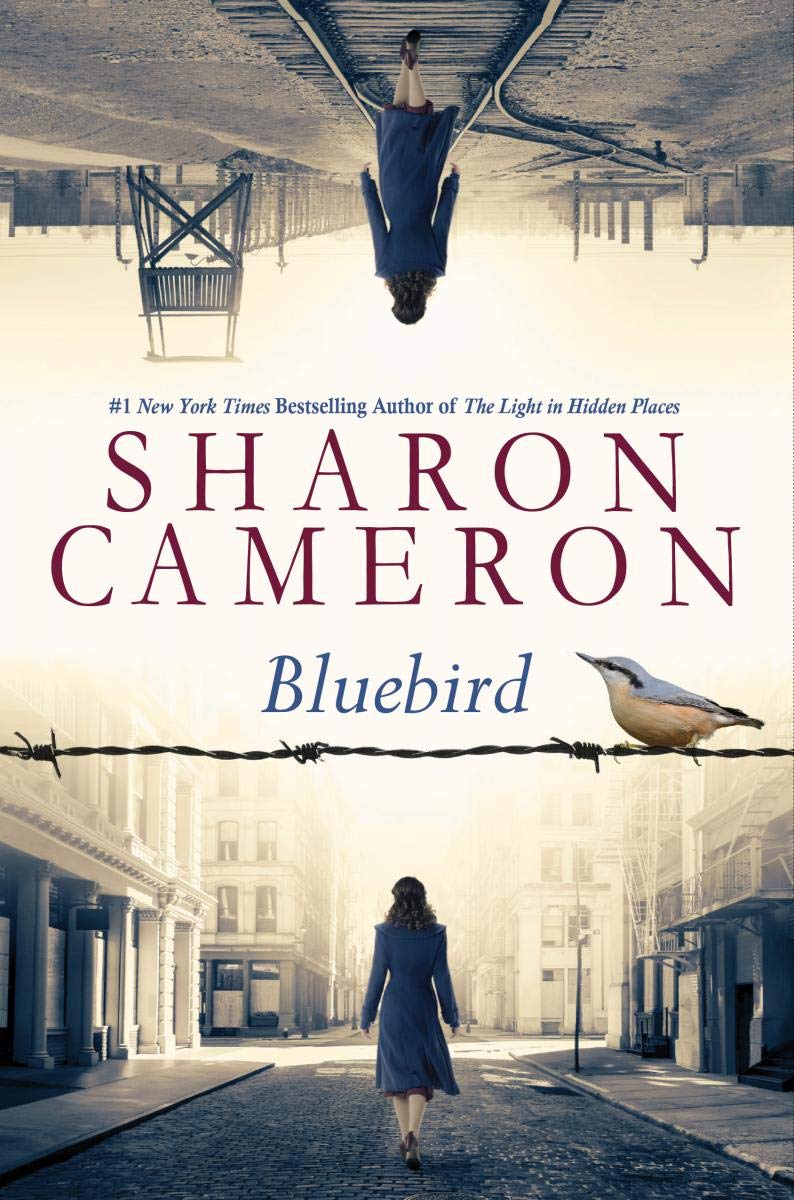
Unputdownable! Sharon Cameron's BLUEBIRD


‎Scholastic Press, 2021
In the normal course of events, I request books to review. And so I was surprised to get a package from Scholastic. Had I asked for a book and forgotten about it? Nope. Inside was a young adult novel that I never would have looked at, much less cracked the covers of, had it not ended up in my mailbox. By mistake? By fate? Who knows. 

Good thing it did, though, because I love a good story. Especially when it is grounded in fact and history. And doubly especially when it is written so well I just have to read another dozen (or 50) pages - even if it is one in the morning! 

The opening chapter introduces Eva, standing on the deck of a ship and gazing at the sea before her and the city approaching. It’s August 1946 and she has left behind a world of burning rubble. She gathers her suitcase and that of Brigit, who does not speak. She gathers their papers, and checks to make sure her secret documents are safely hidden. Then, together they follow their guide down the gangplank and into immigration.

America is bright, and friendly – and Eva and Brigit are here ostensibly to begin a new life. Eva has come for justice. She has come to search for a Nazi physician responsible for conducting horrific medical experiments on prisoners in concentration camps. She has come to uncover secrets, with hope of bringing this person to justice before the US government recruits him for their own dark programs. She has come to dig for the truth about Project Bluebird.

Eva has also come to protect Brigit, and help her recover from the horrible suffering at the hands of soldiers. Chapters alternate between 1946 America and war-torn Germany. We see flashes of Eva’s childhood as a schoolgirl under the Nazi regime. Living in Germany, Eva knew no hardship (her household included servants). But as she begins uncovering clues, dark memories begin to surface and Eva wonders about her place in her family. And now she is being followed by mysterious men.

Eva eventually finds a job and covers the hospital expenses so that Brigit can get treatment. As Brigit regains her memories, we learn how the two girls are connected – and we see how their experiences translate into different views of the world they now find themselves in.

What I like about this book: Sharon Cameron paints a detailed picture of an American city post-war. Her characters are so three-dimensional they could walk out of the book and carry on a conversation with you. But what I really like is the backmatter. Sharon adds a dozen pages of well-researched material that provides historical context and perspective for her story and the era. It should come as no surprise that Germany was not the only one conducting research on human subjects during the war.

Friday, February 21, 2020

Flight for Freedom

Flight for Freedom: The Wetzel Family's Daring Escape from East Germany
by Kristen Fulton; illus.by Torben Kuhlmann
56 pages; ages 5-8
Chronicle Books, 2020

theme: bravery, family, biography

In the days when Germany was divided by a wall, life was very different.

On one side, children watch TV and eat pizza. On the other, children wear uniforms and – if they are lucky – get to eat a banana once a year. Peter lived on the wrong side. The side with scratchy uniforms, no cartoons, and no fruit. Then one night, he discovered a picture of a hot air balloon hidden beneath his parent’s mattress. His parents had a plan!

What I like about this book: Kristen shows us how Peter’s family scrimps and saves to buy materials to build a hot air balloon. She shows how they work secretly into the dark night. She shows the urgency –  they have one chance to try an escape – and the difficulty of both constructing the balloon and of choosing this path of resistance.

And there’s back matter galore! There’s an entire spread devoted to construction, materials, and engineering of the balloon. She’s included a page about escape attempts, and a note about how this story came about.

I met Kristen at a Highlights Foundation workshop about a year after she finished writing Flight for Freedom. I remember her dedication to finding the “golden nugget” of a story, and how she encouraged other writers to write the hard stuff and stick to the facts. I called her up last week and she graciously answered Three Questions:

Sally: What inspired this story?

Kristen: I was looking for my first nonfiction idea, you know, something to write about. I was perusing back issues of Time magazine and came upon a paragraph about a family escaping from East Germany in a hot air balloon. I immediately emailed Peter, using Google translator, and we corresponded. Eventually I traveled to Germany and talked to the family. I also visited the museum where the balloon is on display. Seeing the location and balloon really helped me feel the story in the way a character might feel it.

I also had an opportunity to see a section of the Berlin Wall on display at the Smithsonian. There were bits of graffiti on one side, and the other just had scratches and felt cold. That was the East German side. People couldn’t go near the wall because it was guarded by soldiers.

Sally: You finished Flight for Freedom back in 2012, and here we are, eight years later. Is that a long timeline for publishing?

Kristen: It is. The editor who initially acquired it ended up moving to another publisher. Fortunately, Ariel Richardson at Chronicle loved the original manuscript and that’s where the book found its home. The longest wait was for the illustrator; I really wanted Torben to do the artwork.

Sally: What advice do you have for writers?

Kristen: Do your research. When you think you have enough, keep on going. If you’re writing a picture book, do as much research as you think you’d need to write a chapter book – you want to have enough that you can choose what you put into the story.

Then focus. In this book I focused on just one family and the balloon. With picture books, less is more because the illustrator will fill in the other half of the story with their art.

And, very important, stay true to the facts. Don’t change anything and don’t make anything up. Even when the research isn’t going your way, don’t fudge the truth.

Beyond the Books:

You can see the escape balloon and flimsy basket in this video, taken at the museum in Germany.

Read the Time article that inspired Kristen’s story here, and then another over at the Washington Post here.

Thank you for joining us today, Kristen. You can find out more about her books at her website.
We’ll join Perfect Picture Book Friday in a couple weeks -  once the Valentine story contest ends. PPBF is a gathering of bloggers who share their reviews of picture books at Susanna Leonard Hill's website. Review copy provided by the publisher.


Friday, November 10, 2017

Two Wild Adventures, mostly true

themes: adventure, history

The Wildest Race Ever
by Meghan McCarthy
48 pages; ages 4-8
Simon & Schuster, 2016

The first Olympic marathon held in America happened on august 30, 1904, in Saint Louis, Missouri. It was part of the World's Fair exhibition.

Thirty-two runners started that day, representing the US, South Africa, Cuba, France, Greece, and Newfoundland (now part of Canada). The first American Indian to run in Olympic Games was there, from the Seneca Nation. It was hot, and the cars carrying judges, doctors, and reporters stirred up so much dust that racers had a hard time breathing!

What I like about this book: Meghan McCarty tells stories about individual runners - like the guy who stole peaches from a car, and the runner who was chased a mile off course by an angry dog. It's a true story, so there's a couple of pages of back matter - and you know how much I like back matter!

A Voyage in the Clouds
by Matther Olshan; illus. by Sophie Blackall
40 pages; ages 4-8
Farrar Straus Giroux, 2016

This book is subtitled: the (Mostly) true story of the first international flight by balloon in 1785. It tells the story of Dr. John Jeffries, an Englishman, and his pilot, Jean-Pierre Blanchard, a Frenchman, to be the first to fly from one country to another.

There's only one problem: they can't stand each other!
Okay, there are a lot of problems. They lose tools. They lose altitude. They lose their tempers.

What I like about this book: It's FUN! I like the dialog balloons that reveal their bickering. I like that they had to pee over the side to lighten the balloon so they wouldn't crash land. And I really like the notes in the back matter that clarify what's fact in this very imaginative story.

Beyond the Books: 

What would it be like to balloon across the English Channel? Here's a tale about two guys who recreated the trip of Jeffries and Blanchard.

Build a "hot air" balloon using helium party balloons, a plastic grocery bag, and a paper cup. Put two balloons into the plastic bag. Tie a ribbon from each handle of the plastic bag and attach the paper cup. Fill it up with pennies and send it on a journey around the house.

Run - or walk - a marathon. A marathon is a bit over 26 miles. Elite runners can finish in just over two hours; walkers take 8 hours or longer. Why not do your own marathon, but a couple miles a day? Plot out a two-mile loop (if you walk a mile to school, that's perfect). Then draw a race course on a sheet of paper and mark it off into 26 squares. Each day, color in a square for each mile you run or walk. When you finish your marathon, give yourself a gold medal.

Today is PPBF (perfect picture book Friday), an event in which bloggers share great picture books at Susanna Leonard Hill's site. She keeps an ever-growing list of Perfect Picture Books. Review copies from publishers.

Friday, September 22, 2017

The Enemy

The Enemy
by Sara Holbrook
224 pages; ages 10-14
Calkins Creek, 2017

It's 1954 and twelve-year-old Marjorie is hunkered down behind the walls of a snow fort with her friend, Bernadette. She's got a pile of snowballs to pelt the enemy - Bernadette's brother, Artie. But Artie doesn't want to be the "enemy" - a Nazi. He wants to be Al Capone instead.

"This is war," yells Bernadette. "We're the good guys. You're the bad guy. That makes you a Nazi."

Marjorie is coming of age during the cold war, when there are so many enemies: Nazis, communists, the new girl, Inga, and a strange man lurking around the neighborhood. Marjorie wants to know how to determine who are friends, who are enemies, and how to know the difference. Then there's the question of right and wrong, and whether she'll go to jail for hiding "dangerous books" under her bed. Books that may or may not have been stolen from the library and probably should be  burned for their radical ideas. Books like 1984 and The Grapes of Wrath.

And then there's the demand by Bernadette that she sign an oath of loyalty to her friends. Who demands loyalty oaths? While she writes of a bygone era, Sara could be writing a story about today's issues of immigration, intolerance, religious and racial divide.

Sara Holbrook, grew up in post-war Detroit, a city, she says, that was separated by race and ethnicity. She talks about growing up in that era, and about her family, displaced people, returning soldiers, and more in her author's note - and follows up with a great bibliography for curious readers who want to know more.

 On Monday we'll be hanging out on Marvelous Middle Grade Monday with other  bloggers over at Shannon Messenger's blog. Hop over to see what other people are reading. Review copy provided by publisher.

Friday, June 23, 2017

These Books Have Gone to the Dogs!

I love stories about dogs. Even better are books that are written by the dogs themselves - or at least from their point of view. Here are three, recently published by Peachtree Publishers.

Leo, Dog of the Sea
by Alison Hart; illus. by Michael G. Montgomery
165 pages; ages 7-10

Here is the fourth installment in Alison Hart's "Dog Chronicles" series - and another great tale told by a tail-wagging protagonist. Previous adventures feature Murphy, Darling, and Finder.

The year is 1519 and Leo has hopped aboard one of Ferdinand Magellan's ships. Leo's had lots of experience hunting and catching rats on ships, so he thinks this will be one more voyage. What he doesn't know is this ship is headed on a westward journey that circumnavigate the globe.

The journey begins as any good seafaring adventure should: with 60 days of stormy weather, followed by becalmed seas in the equatorial seas. Humans turn against each other, reinforcing Leo's belief that people should not be trusted. And yet... he makes friends.

We see, through a dog's eyes, a journey to Brazil, sailing down the coast to a land of penguins and frozen seas; starving sailors who skin and roast the rats Leo provides; a mutiny - or two; hubris when Magellan involves himself in island politics and meets his untimely demise.

What I like about this book: aside from the excitement of adventure and exploration, is the Back Matter. Yes, Hart includes an author's note about the real history behind the story. "There are no records of a dog on board any of Magellan's ships," she writes. "However, dogs have long been used in Spain to control mice and rats." So there probably were dogs aboard the vessels in Magellan's fleet. She includes a glossary and a diagram of a sixteenth-century ship, further reading, and more.

Dori Hillestad Butler has a delightful new series of chapter books titled "King & Kayla", illustrated by Nancy Meyers. The first two in the series are:
King & Kayla and the Case of the Missing Dog Treats
and
King & Kayla and the Case of the Secret Code
Each is 48 pages, for ages 7-9

How can you not want to read a book that starts out, "Hello! My name is King. I'm a dog. This is Kayla. She is my human."

Kayla is making peanut butter dog treats - King's favorite. But she won't let him have one until they have cooled. She won't even let him lick the bowl!

And then... some treats go missing. King smells an intruder! He tries to tell Kayla, but she doesn't understand him... and accuses him of snitching the cookies! You will want to read it to learn how King proves he's innocent and brings the culprit to justice.

In the Case of the Secret Code, King and Kayla team up to solve the mystery of who is leaving letters around, and what the code means. Moral of the story: if you're delivering secret messages, the dog will sniff you out!

On Monday we'll be hanging out on Marvelous Middle Grade Monday with other  bloggers over at Shannon Messenger's blog. Hop over to see what other people are reading. Review copies provided by publisher.


Friday, May 12, 2017

Putting the focus on photographers

Two books about photographers, contemporaries of each other. One captured light and rocks and trees, the other focused her sights on factories, buildings, and people. One grew up in the west, the other in the east.

Antsy Ansel: Ansel Adams, a life in nature
by Cindy Jenson-Elliott; illus. by Christy Hale
32 pages; ages 5-9
Henry Holt, 2016

theme: nonfiction, biography, art

Ansel was antsy. He never walked - he ran.

He loved being outside - exploring the beach, feeling the wind and salt spray. He didn't fare well trapped in the classroom, but thrived when his father decided to have him learn at home.
When Ansel was 14, he visited Yosemite Valley and fell in love with the light. His parents gave him a camera, and the rest is history. He traveled far and wide taking photos of national parks, and his photos were featured in Life magazine and galleries.

What I like about this book: It is fun to read. Author Cindy Jenson-Elliot delves into her collection of action words to show this young man who couldn't sit still. Run-leap-scramble... off he goes with his camera! I also like the back matter, where she tells more about this iconic photographer. Ansel Adams spent a lot of time studying his subject matter, waiting for the right light to capture it.

Girl with a Camera
by Carolyn Meyer
352 pages; ages 10 - 14
Calkins Creek, 2017

Margaret Bourke-White was born in 1904 - two years after Ansel Adams - in New Jersey. She wasn't popular, and felt unsure of herself, yet knew she would do something great. She spent her youth exploring the outdoors, collecting snakes and bugs, and thought she might become a herpetologist (someone who studies reptiles and amphibians). Then she discovered photography. And the beauty within buildings, from factories to sky scrapers. She knew she wanted to make her living shooting photos.

This fictionalized account of her life draws on Margaret's own writings, as well as archival material and yearbooks. It reads like an adventure, as we read about Margaret's adventures as a photo-journalist for Life magazine: trips to Russia, capturing factories and farms, and a nearly-didn't-make-it trip to the arctic. Author Carolyn Meyer had done a ton of research, and it shows.

Both Ansel Adams and Margaret Bourke-White documented World War II. Ansel took photos of ordinary life in the Manzanar War Relocation Center (Japanese internment camp) in California. Margaret was the first female war correspondent and photographed German forces invading Moscow. At the end of the war she photographed the liberation of the concentration camp at Buchenwald.

Beyond the Books:
Take a camera on a walk with you and take pictures of buildings or trees or rocks or people... whatever interests you. Try taking photos in different light - different times of day - and from different angles.

Explore this gallery of Ansel Adams photos.

Explore this gallery of Margaret Bourke-White photos.

Today is PPBF (perfect picture book Friday), an event in which bloggers share great picture books at Susanna Leonard Hill's site. She keeps an ever-growing list of Perfect Picture Books. On Monday we'll be hanging out on Marvelous Middle Grade Monday with other  bloggers over at Shannon Messenger's blog. Hop over to see what other people are reading. Review copies provided by publishers.

Friday, January 6, 2017

Aim ~ historical fiction for the middle grades

Aim
by Joyce Moyer Hostetter
288 pages; ages 9-12
Calkins Creek, 2016

Fourteen-year-old Junior Bledsoe would like nothing better than to play baseball, but he can't make practices because he's got to take care of the farm chores when Pop goes off drinking. His pop's not a bad guy - he fixes folks' cars and never takes money for it - but he's got his own problems.

Junior's got his own problems, too, including his new roommate - granddaddy. Granddaddy loves baseball, too, and listens to games on the radio - except when he's listening for news of the war. So far, the US has managed to stay out of it, but for how long?

Then there's school. Junior wants to do something more useful than practice penmanship. And he's tired of getting picked on. Things change when Pop dies, and Junior quits school to take care of the farm. But he wants more. He wants to be of use. And he wants to find out whether someone had a hand in his Pop's death. What starts as an attempt to make friends with the bully leads Junior into a series of bad decisions.

What I like about this book is the way Joyce Hostetter pulls you into the world her characters inhabit. She brings Hickory, North Carolina to life in such a way that you'll be checking the map to see if it really exists (it does) and whether you can hop a train to get there (you can't). 

We'll be hanging out on Marvelous Middle Grade Monday with other  bloggers over at Shannon Messenger's blog. Hop over to see what other people are reading.
Review copy provided by the publisher.

Friday, November 25, 2016

Girl on a Plane

Girl on a Plane 
by Miriam Moss
288 pages, ages 12 & up
HMH Books for Young Readers, 2016

Fifteen-year old Anna is a "Forces" child. Her dad, in the army, has been stationed in Bahrain. Now, after spending summer vacation with her family, Anna is traveling back to her English boarding school.

The year is 1970 and hijackings have been in the news. Anna is worried that her plane might be hijacked, but her mom assures her that it hardly happens. At the gate, mom gives her one last hug, telling Anna to "stay safe". Anna walks across the tarmac to the waiting plane. It is 10:30 am and she's thinking of the seven-hour flight to London.

Anna's not the only kid on the plane; plenty of other military dependents are heading home to schools. The boy next to her is carrying his treasured terrapin in a tin. Another, older boy sits nearby. Mothers with children are heading home.

Then a man with a gun in his hand screams at everyone to sit down. The plane has hijacked by the Palestinian Liberation Front. They will land in Jordan, he says. On the "Revolutionary Airstrip" somewhere in the desert. They are hostages.

As noted on the cover, this book is based on the true story of a hijacking. Miriam Moss was a passenger on that plane, heading home to boarding school in the UK. But this is a work of fiction, she emphasizes in her notes at the back of the book. Yes! There is Back Matter! (you know I love back matter, especially in historical fiction novels). Moss writes about her search for the Revolutionary Airstrip and her journey back to Jordan to visit the site where she spent three hot days as a hostage. She also answers questions about which parts of the story are true, and which are fictional.

You can read an excerpt from the first chapter here. You can read more about the hijackings here and watch a video about the events here. Review copy provided by the publisher.

Friday, October 21, 2016

Scar, a Revolutionary War tale

Scar: a Revolutionary War Tale
by J. Albert Mann
144 pages; ages 9-12
Calkins Creek

It's a hot July day in upstate New York in 1779. Noah is alone in the woods, except for a young Mohawk. They both lie wounded, after a bloody battle.

At the age of 16, and despite his lame foot, Noah has taken on the work that would normally have fallen to his father. His father is gone - not to fight the British, but felled by disease. Then a Mohawk band storms their farm, burning everything. Noah and his family hide in the woods. When the villagers gather, they decide to track the Mohawks and fight, against the advice to wait for help to arrive from Washington's army.

Noah volunteers and is paired with a doctor. The march is hard; the battle worse and their unit wiped out. Wounded, Noah tries to find help. That's when he discovers the wounded Mohawk warrior, whom he names "Scar". Noah bandages him and provides water and comfort through the night.

Told in first person, the chapters alternate between July 22, the day of the Battle of Minisink, and earlier events leading to the battle. We discover that Noah has dreams of building a farm, and a girl to share those dreams with. This story brings to life a part of the Revolutionary War we don't hear much about and raises questions regarding what a hero is.

Back matter includes information about the Mohawk chief Joseph Brant and the battle, along with biographical sketches of main characters who are real people. A bibliography provides additional reading for curious young historians.

You can find more information about the battle at the Minisink Valley Historical Society.
We'll be hanging out on Marvelous Middle Grade Monday with other  bloggers over at Shannon Messenger's blog. Hop over to see what other people are reading.
Review copy provided by the publisher.

Friday, June 17, 2016

Paper Hearts

Paper Hearts
by Meg Wiviott
352 pages; ages 12 & up
Margaret K. McElderry Books, 2015

I'm reading as fast as I can to get to the bottom of my book basket. That's where I re-discovered this gem that was published in the fall.

Paper Hearts is a story about Zlatka and her best friend, Fania. It's about how Zlatka stole and bartered for paper and scissors so she could make a birthday card for her friend. It is a story about an act of defiance, a statement of hope, and a crime punishable by death - because in Auschwitz, in 1944, making a birthday card for your friend was illegal.

The tale is told in verse, a style of storytelling I am coming to appreciate, as the language gets to the point and leaves room for imagination to fill in the spaces. Here is part of a scene set in a prison:

Seven of us
Jammed in a cell
Big enough for one.
A girl with blonde braids
And a gold cross
Got down on her knees,
Crossed herself,
And swore to God
She was not a Jew.
No one listened.
Not even God.
 What I like love about this book: the abundance of awesome back matter! There is a picture of Fania's paper heart (which is on display at the Montreal Holocaust Memorial Centre). There is a glossary, so you can look up Hebrew words, German words, and camp slang. There is a bibliography, should you want to explore more. And there's a wonderful section about the true story that Paper Hearts is based on, and what changes the author made for artistic reasons.

Review copy from the publisher.

Friday, May 6, 2016

Finder, Coal Mine Dog

Finder, Coal Mine Dog
by Alison Hart; illus. by Michael G. Montgomery
160 pages; ages 7 - 10
Peachtree Publishers, 2015

This is the third of the "Dog Chronicles" and another great tale told by the tail-wagging protagonist. Yes, as with the others in this series (Darling, and Murphy) the story is told in first-person from the point of view of the dog.

"My nose twitches. I am on the scent of rabbit on the brush and quail in the tall grass. The rabbit trail winds into a mound of thorns. When I poke my head underneath the branches, the perfume of ripe blackberries makes me drool."

Alison Hart creates a universe in which it makes total sense for a dog to be telling a story. But what makes it really cool is that this story is grounded in fact. In history. In a real town (Cherry) in Illinois.

The dog's boy is Thomas. Finder and Thomas live with Uncle Eddy, who hasn't the time nor money to house a dog that doesn't work. Despite his name, Finder isn't very good at flushing out game.

Finder gets lonely when Thomas is sent to work in the coal mine. But - tailwagging joy!- one day Thomas comes home with an idea: Finder can work with him in the mine. Pulling a wagon full of coal through a cramped tunnel way below the surface of the earth is hard work.... but Finder can do it. And when a mine fire breaks out, he discovers he can do even more. This is a tale of historic adventure - and I don't want to spoil the ending for you, but I will say that Finder lives up to his name.

What I especially like about this book and the others in the "Dog Chronicles" is the back matter. Hart tells about the Cherry Mine disaster that inspired this story, and about the animals that lived and worked in the mine with the miners. Hart also introduces us to a modern day mine rescue dog, Ginny. Ginny is the first dog specially trained for underground and surface mine rescue. You can lean more about her in this short video.

 On Monday we'll join the Marvelous Middle-Grade Monday round-up. Check out more great reading here. Review copy from publisher.

Friday, January 29, 2016

Woodford Brave

Woodford Brave
by Marcia Thornton Jones; illus. by Kevin Whipple
192 pages; ages 9-12
Calkins Creek, 2015

Cory Woodford's best friend has deserted him, his father is fighting overseas, and a Nazi spy lives just down the street. Cory needs to be brave, like his father and grandfather. Like his favorite superhero, Mighty Space Warrior. He needs to be Woodford Brave. He writes letters to his dad, drawing cartoons at the bottom of the page - the Space Warrior's Kid. Will his dad notice that he's drawn his own face tucked inside Warrior Kid's Helmet of Power?

This is a fun mystery - is the guy with the suitcase really a Nazi spy? - with a dash of ghost story - is the house down the street really haunted?- some baseball, and a crazy go-cart race that nearly ends in disaster.

The black-and-white comic book illustrations add to the feeling of going back in time. And even though it's fiction, there's an author's note with resources for anyone who wants to lean more about World War II, women's baseball, and the history of comic books. Review copy provided by the publisher.

Friday, January 15, 2016

Three Girls; One Message-in-a-Bottle

Currents
by Jane Petrlik Smolik
336 page; ages 9-12
Charlesbridge, 2015

Bones, Lady Bess, and Mary Margaret have never met and don't know each other, but a bottle bearing a message crosses the ocean - twice- connecting their lives. Bones is a slave, working in Virginia in the fall of 1854. She was too young to remember the day her pappy had been sold to another landowner - "but she remembered everything about how she learned she was the personal property of another human being."

When Bones finds the Slave Birth Records for the plantation, she tears out the page with her name and birth date. Burdened with this incriminating evidence of her actions, she rolls the paper up, puts it into a bottle, adds a heart carved by her pappy, and seals the cork with wax. Then, in the dark of night, she sneaks down to the James River and tosses the bottle as far as she can.

The bottle bobs its way downstream and into the Atlantic where it gets picked up but the Gulf Stream current and pulled across the sea.

In August of 1855 Lady Bess finds the bottle, half buried in sand, on a narrow beach on the Isle of Wight. Could it be from pirates? Lady Bess wants to be an explorer like her father, and she's heard plenty of tales of adventure on the high seas. But no. When she unfurls the paper it says only: Agnes May Brewster. Born: July 1843. Colored slave. When a lad who works for the farm is accused of stealing, Bess discovers who the real thief is and determines to help her friend escape from jail. She gives him the bottle, adding a treasure of her own. Maybe when he reaches London he can find someone who can help solve the mystery of Agnes May.

Instead of reaching London, the bottle ends up traveling with the North Atlantic Drift back across the ocean. Mary Margaret discovers it bobbing against the pilings when she and her da go to the wharf to buy fish. It looks like a genie bottle and when she opens it she finds an engraved gold cross with pearls embedded in it, and the birth record of Agnes May.

Three very different girls whose lives touch each other's because of a bottle. Could a bottle really travel from Virginia to England and back to Boston? In back matter, author Jane Smolik writes about the history of sailors placing messages in bottles. Using ocean current charts, she figured out where a bottle tossed into the James River might land. Then she had to learn what was happening across the world in the 1850s to tie the stories together.

A fun story backed by research, sure to appeal to kids who love exploring history and mysteries. Review copy provided by the publisher.

Monday, October 26, 2015

Freedom's Price ~ Blog Tour

Freedom's Price (Hidden Histories)
by Michaela MacColl & Rosemary Nichols
288 pages; ages 9-12
Calkins Creek, 2015

Freedom's Price is the second book in the Hidden Histories series, and it's every bit as good as the first. In this one, authors Michaela MaColl and Rosemary Nichols dive into the history of the Dred Scott decision and pre-Civil War America. It's a coming-of-age story about a young girl, and maybe a young nation as well.

Eleven-year-old Eliza Scott hates doing laundry. She wants more out of her life than to lug smelly shirts to the river's edge and scrub them... day after day after day. She's tired of being in limbo - not a slave, but not quite free. And she's really tired of living in the town jail wile waiting for the court to decide her family's status.

Her father, Dred, has sued for freedom, and until the court decides their fate, he and his family live in a gray zone. As long as they remain on this side of the river, in this town - they are safe... unless they're kidnapped and sold into slavery. But there are unscrupulous people... and Eliza learns that "almost free" isn't "free", and freedom is no guarantee that one will be accorded respect and civility.

What I like about this book are the questions it raises about race, society, and whether our society has progressed from those pre-Civil War times. I like the way the authors worked in the cholera epidemic and the St. Louis Great Fire of 1849. I also love that there is back matter about the Dred Scott decision. While the book is fictional, the story is true: Dred Scott did sue for freedom and won. That decision was overturned by the US Supreme Court - a decision that not only lit the fuse for the Civil War, but provided the underpinnings of the 14th Amendment: that all persons born or naturalized in the United States are citizens. You can read more about Dred Scott here and here.

This book - this series - is a great way to sneak in history for kids who love stories but "hate" history. It's also a great way to slake the thirst of kids who love history but think they don't like fiction. If I had stars to give out, I would.

Today is Marvelous Middle Grade Monday and we're hanging out with other MMGM bloggers over at Shannon Messenger's blog. Hop over to see what other people are reading.  Review copy provided by publisher.


Monday, May 4, 2015

Like a River ~ Civil War fiction

Like A River
by Kathy Cannon Wiechman
336 pages; ages 9 &up
Calkins Creek, 2015

Fifteen-year-old Leander Jordan's life is full of chores, with a bit of fishing when he can manage, and spending time with a girl he's sweet on. But when he decides to up and join the Union Army, his life changes. He lies about his age, but the guys in the unit can tell he's on the young side. They call him "mama's boy" and tease him about his youthful stature and looks. And when he's wounded in his first battle it isn't even a Rebel bullet what gets him.

Paul Settles heads to war for different reasons, crossing paths with Leander in the army hospital Leander. Paul writes letters home for wounded soldiers who can't write. Paul brings them water. But like Leander, Paul has a secret. And when Leander discovers it, Paul knows it's time to light out for a new unit.

And then there's Given McGlade, who meets up with Paul at the infamous Andersonville prison. These three characters have so much life in them that you forget they aren't real people. That's OK, though, because their experiences were real - to hundreds of people in the 1860s. The starvation and deprivations of Andersonville were real. The sutlers - peddlers that sold food and supplies - to the imprisoned troops were real. The southern mansions-turned-hospitals were real. Attempted escapes and forced marches were real.

Finally, when the POWs were released, many boarded the Sultana to ride the Mississippi north, to home. Wiechman includes that real maritime disaster as well. It's amazing that people made it home from that war. But they did and they had stories to tell - some with endearing endings, like this book.

You can find out more about author Kathy C. Wiechman at her website, and read Kirby Larson's interview with her here.

 Today is Marvelous Middle Grade Monday and we're hanging out with other MMGM bloggers over at Shannon Messenger's blog. Hop over to see what other people are reading. Review copy provided by publisher.

Monday, April 13, 2015

Diary of a Waitress ~ historical fiction

Diary of a Waitress: The not-so-glamorous life of a Harvey Girl
by Carolyn Meyer
348 pages; ages 10-14
Calkin's Creek, 2015

Katherine Amelia Evans, aka "Kitty", graduates from Leavenworth High School in the spring of 1926. She is sixteen-going-on-seventeen and already knows what courses she plans to register for when she heads to college in the fall.

Until Daddy tells her that business isn't going well, and they won't be able to send both her and her older brother. Instead, she can work at the shoe store for a couple years... until things improve.

Kitty has other ideas. She intends to be a journalist. And she'll do anything other than sell shoes. So when she sees an ad for young women to work as waitresses in the Harvey Eating Houses along the Sante Fe Railroad, she decides to apply. Even though the ad expressly says applicants must be at least 18 years old. Even though she has never been a waitress before. Even though it means going somewhere strange and living with rules. Lots of rules (no makeup; no jewelry; black shoes that must be kept polished).

Being a Harvey Girl, it turns out, is hard work. The restaurants are at the train stations, and have both a formal dining room (jackets required) and informal lunch counters. Harvey girls must set the dining rooms up perfectly, with silver service just so, and serve the meals on a schedule so that when the trains come in for a water fill-up, they can feed the passengers and get them back on board in time for the scheduled departure. They must do this even when the customers are cranky and ill-tempered. And they must always have a smile and remain unruffled.

Once trained, Kitty is sent off for a five-month tour-of-duty in a small town in New Mexico. Her job includes room and meals - though she'll eat once the paying customers have been served. She chronicles her adventures in her journal, honing her journalistic instincts and preserving memories to share with her family when she returns home.

What I like about this book is that every so often there's a photo from the archives. I also like the author's note about how this story came to be, and which of the people in the story are real, and which characters are invented. For history buffs there is a bibliography and a list of photo credits.

I'd write more, but I hear that whistle blowing, and that means I've got three minutes to check that the napkins are folded crisply, and the water chilled, before the train chuffs in....

Today is Marvelous Middle Grade Monday and we're hanging out with other MMGM bloggers over at Shannon Messenger's blog. Hop over to see what other people are reading. Review copy provided by publisher.

Monday, March 16, 2015

Rory's Promise ~ historical fiction

Rory's Promise (Hidden Histories)
by Michaela MacColl & Rosemary Nichols
288 pages; ages 9-12
Calkins Creek, 2014

Rory's Promise kicks off a new series for Calkins Creek: the Hidden Histories. And what a fun way to start - with a tale from the Orphan Trains, but set in the wild west.

Twelve-year old Rory Fitzpatrick has been caring for her sister Violet ever since their parents died. They live at the Sisters of Charity Foundling orphanage in New York City, where Rory's been making herself indispensable helping with the younger kids.

When the nuns send Violet to an adoptive family in the Arizona territory, Rory finagles a way to go along. It involve a crazy ride on top of a carriage and stowing away aboard the train, where she meets other orphans bound for families in the plains states.

Rory's read the Wild West stories, so she knows what to expect... until they arrive in the mining town where the adoptive families are waiting. Nothing she's read has prepared Rory for a dirt-street town with no street lights and humble abodes that are just a step up from the tenements of New York. Then there's the racial conflict: the nuns want to place the children in good Catholic homes, but the only Catholics in the town are Mexicans who work in the mines. The wealthy white families demand that these children be placed with families that "look like them".

How Rory keeps her sister safe, and negotiates for safe passage of most of the children makes for an adventure tale worth reading more than once.

Today is Marvelous Middle Grade Monday and we're hanging out with other MMGM bloggers over at Shannon Messenger's blog. Hop over to see what other people are reading.  Review copy provided by publisher.

Monday, March 2, 2015

Ben Franklin's Big Splash ~ A mostly true story

Ben Franklin's Big Splash ~ the mostly true story of his first invention
by Barb Rosenstock; illus. by S.D. Schindler
32 pages; ages 8 and up
Calkins Creek (Boyds Mills Press), 2014

Is this book nonfiction? Is it historical fiction? Does it really matter?

This much is true: Ben Franklin taught himself to swim. Around the age of eleven, he made the first pair of swim fins and tried them out in the Charles River. He even wrote about his invention in a letter to a fellow scientist many years later.

But he never wrote about how he made the fins or the process by which he developed them. That is the part that author Barb Rosenstock imagines.... and she does so with humor and such wonderful language that you will be drawn into this book immediately upon opening it.

"Before the world knew the famous Doctor Benjamin Franklin, his neighbors knew him as Ben, the sturdy, saucy, smelly son of a soap-maker..."  Ben was the kid who would sneak away from work to swim in the river. As Rosenstock puts it:
He STOOD on his hands...
He SLIPPED like an otter
and SLOSHED like a turtle-
SQUIRTING, SPURTING,
and SPOUTING.
Don't you just love the language she uses to describe this skinny kid playing around in the water? While he's swimming, he wonders why he can't swim like a fish.

So he observes the fish. He notices they have fins, where he has hands.... and perhaps that's where he gets his idea for swim fins - wooden paddles that he uses to swim through the water. Like any other scientist, Ben experiences failure, goes back to the drawing board, and tries something different. Question-Research- Hypothesize - Test - Analyze- Conclude - Repeat.... these are the foundations of the scientific method, and Rosenstock shows Franklin going through them all.

Did it happen exactly the way she wrote it? Probably not. That's why she ends with a lengthy author's note telling what is known and what she imagined. At the end there's a timeline of Franklin's life and lists of resources.

Whether it's a "true story" or not, this book offers a glimpse into an unusual childhood invention of a famous inventor. And it does so through fun, imaginative language. With the story focusing on Swim Fins, there's a preponderance of S-words on the page. They are fun to s-s-say...

More to the point, this is a guide for any kid who wants to do science. If Ben could do research, design and test prototypes, collect and analyze data, then anyone reading this book can do the same. You don't need to be stuck in a lab to make discoveries... you can swim in a river.

Today we're joining the roundup over at the Nonfiction Monday blog where you'll find even more book reviews.  Review copy from publisher.

Monday, February 9, 2015

The Girls of Gettysburg ~ and a give-away

The Girls of Gettysburg
by Bobbi Miller
160 pages; ages 8-12
Holiday House, 2014

Take three girls from three very different backgrounds and put them in the center of the decisive battle in the Civil War - that's what Bobbi Miller does. There's Grace, a free black living in fear that soldiers will come north and capture her and her family as "runaway slaves". There's Tillie, the genteel daughter who believes the Rebels wouldn't dare come this far north. And there's Annie, who takes her brother's rifle and dons her father's woolen pants and cotton shirt and sells her service to replace a rich man's son.

Three girls. Three stories. One big battle - and everything changes. While this is historical fiction, it is based on situations and people who lived at that time. There were female soldiers who fought in the Civil War - some in the Battle of Gettysburg. They went undetected until they were carried off the battlefield, wounded or dead.

This book raises lots of questions, and might inspire young readers to look further than what they read in their history texts. Beyond that, it's plain good storytelling, and a fun read to boot.


Today we're hanging out at the Marvelous Middle-Grade Monday round-up. Drop by Shannon's blog to see what other reviewers are talking about. Review copy provided by publisher.

WIN a COPY of this book:  I like this book so much that I'd like to pass on my nearly-new copy to a history-loving reader. To get in the raffle, just do these two things:
1. leave a comment below, and
2. send an email to sueheaven[at]gmail[dot]com - or go to my profile and click on the email there. I will contact the winner by email next week.
caveat: You've got to have a US address to win the book.

Monday, October 27, 2014

Fleabrain Loves Franny & author interview

Before we get all involved in perusing a new book, I want to remind you that there's still time to get in on Friday's Blog Tour & Book Giveaway for Murphy, Gold Rush Dog.

And now, reaching into the bottomless book basket for another mid-grade novel, I find
Fleabrain Loves Franny
by Joanne Rocklin
288 pages; ages 8-12
Amulet Books (Abrams), 2014

The year is 1952, and Franny is stuck in the children's hospital - in an iron lung - because she has polio. She's lucky in many respects:
Sister Ed reads her favorite book (Charlotte's Web)
she's getting better

On the other hand: she's missing out on all the fun things she and her gang do over the summer. And they're afraid to visit her after she's released from the hospital and goes home and is no longer infectious [note: this would be an excellent time to make a distinction between "infectious" and "contagious", especially with concerns about Ebola running rampant. See here and here.]

What Franny wants more than anything is for a spider to spin "some girl" in a web. What she gets is chocolaty-colored scribbles from a flea.

This is a story of friendships made, some remade, of discovery, and of appreciation for the little things in life. There are superheroes. There's a dog, and a horse. There's a bit of magic and some over-zealous application of flea-B-gone. There's a couple different takes on the word "pedestrian" and some insight into the freedom a wheelchair provides (plus how to do wheelies). There is pride, there are falls, there is student protest and, yes, there is even a spider. And for those of us who like a dose of truth with our fiction, there are plenty of pages of authors notes that put this story into the historical context of the polio epidemic and Salk's work to produce a vaccine. Timely reading, as doctors are hard at work on an Ebola vaccine.

Fleabrain was so fun to read I just had to ask Joanne Three Questions:

Sally:  What inspired you to write Fleabrain Loves Franny? 

Joanne: I tend to wake up with "a good idea" for my next book, usually just a phrase that doesn't mean much to anyone but me. The phrase for FLF was "you can stop seeking messages in spider webs." Who would send such a note? Who would be seeking messages in spider webs? I did know that Charlotte's Web was published in October, 1952, after a summer of the worst of the polio epidemics in the U.S. in which 58,000 cases were recorded.  I realized almost immediately that my seeker of messages would be a young wheelchair-bound polio victim, Franny, in love with the newly published book, and seeking her own Charlotte in dealing with her almost kafkaesque experience. I began to do research about the era and the scourge of polio, discovering, too, that many of its victims were avid readers with active fantasy lives, determined to succeed.  Now, I asked myself, who would be the sender of the mysterious message? An erudite, educated writer - a being annoyed and jealous at the adulation of Charlotte, seeking attention and glory as well. Someone unconsciously humorous as well. I needed lots of comic relief. 

Sally: Why a flea? 

Joanne: I knew that a creature jealous of Charlotte would be a fellow bug. Franny's mother was a meticulous housekeeper, especially with an "invalid" living at home. Cobwebs were immediately destroyed (although she did miss one...) so the bug wouldn't be a spider. Flies weren't around all year. But her dog, Alf, was a faithful companion, a good "host" for one flea the flea powder couldn't destroy...I also liked the name Fleabrain, which is often used in a derogatory way, but in this case meant exactly that. 

Sally: What sort of research did you do? 

Joanne: I did a fair amount of research--enough to give an accurate description of physical properties. I actually have a phobia about enlarged photos of bugs and insects, so the research took some courage. During the writing of this book our new cat brought about a flea infestation in our home. My husband was unaffected, but I was covered with itchy welts. When I mentioned to my dermatologist that I happened to be writing a book about a flea, he looked at me strangely and diagnosed "hives", from a possible stress reaction. He was wrong. Anti-flea medication for our cat quickly solved the problem.

Check out the official Fleabrain Loves Franny book trailer 

Today is Marvelous Middle-Grade Monday round-up. Drop by to see what other bloggers are reviewing. This review from an ARC provided by publisher.