Showing posts with label biography. Show all posts

Friday, November 19, 2021

Journalists defend Free Speech


Fearless: The Story of Daphne Caruana Galizia, Defender of Free Speech 
written & illus. by Gattaldo 
32 pages; ages 7-9
‎Candlewick, 2021

theme: courage, biography, free speech,

In a house by the sea, on the island of Malta, lived a little girl named Daphne, together with her mom, dad, and three sisters.

Daphne loved stories ~ especially the story of her great-great-great-great-grandfather who fought against Napoleon. She loved reading books, and carried one with her wherever she went.

“And she loved the freedom of asking questions and then making up her own mind,” writes Gattaldo who, not only wrote this book, but also happened to be one of Daphne’s close friends. Daphne protested injustice and wrote for a newspaper. She was an investigative reporter, uncovering human rights abuses and other wrongdoings. 

What I like about this book: It’s about a courageous woman who tries to reveal truth about those in power. It’s about fighting for justice using a pen instead of a sword. And there is back matter! That's where we learn more about her life, and how those in power worked to silence her.

Beyond the Books:

Write a news story. What’s happening in your town or neighborhood that you think people should know about? Find out the facts and write them up in a newsy story to share with your friends. See if your friends want to help write a neighborhood newsy-letter.

Students, from 6th grade to 12th, are writing and publishing the local newspaper in Pelham, New York. They started doing this when the local paper went out of business. You can see what they write about here.

Today we're joining Perfect Picture Book Friday, an event where bloggers share great picture books at Susanna Leonard Hill's website. Review copy provided by the publisher.


Friday, October 29, 2021

Need Something Fixed?


The Girl Who Could Fix Anything: Beatrice Shilling, World War II Engineer 
by Mara Rockliff; illus. by Daniel Duncan 
48 pages; ages 5-9
Candlewick, 2021  

theme: Engineering, women in science, biography 

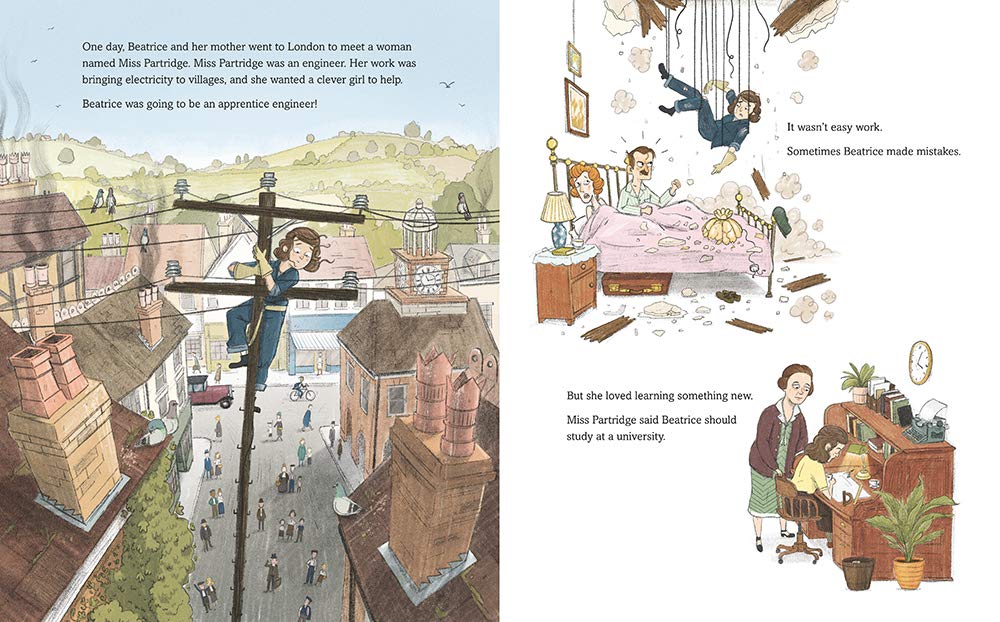
Beatrice Shilling wasn’t quite like other children. She preferred tools to sweets.

Because tools can take things apart. They can put things together. They can fix things that are broken.

Beatrice wanted to be an engineer, and was fortunate to meet a mentor who encouraged her to study at the university. Where she wasn’t quite like the other students. And when she graduated, there weren’t any jobs for women engineers. But finally, one company gave her a chance. Which was a good thing, because she figured out how to solve a serious problem with fighter planes.

What I like about this book: I am always looking for books about women in STEM fields – and engineering is one of those fields where women are underrepresented. I also love reading stories about strong girls who solve problems. Plus, there is back matter: more juicy details about Beatrice’s life. And – the end pages are wonderful ~ diagrams of engine parts and bolts and other fun things.


Beyond the Books:

Make a tool kit. An unused tackle box or lunch box work well. Here are the basics you’ll need: safety goggles, a variety of screwdriver sizes in both flat and Phillip’s head, a hammer, needle nose pliers, wire cutters, tweezers, and a crescent wrench. Also a plastic tray for collecting screws and washers while working on a project – we use take-out containers.

Take apart some things that no one is using. Some fun things to take apart are old computer keyboards, old computer mouse, broken electronic toys, toaster, radio, VHS or DVD player, old printer. Make sure you remove batteries and snip off the cord before unscrewing the first screw. For safety reasons, don’t take apart anything with glass, sharp edges, or tubes that can break.

Today we're joining Perfect Picture Book Friday, an event where bloggers share great picture books at Susanna Leonard Hill's website. Review copy provided by the publisher.

Friday, February 5, 2021

Beatrix Potter Saves the Countryside

Saving the Countryside: The Story of Beatrix Potter and Peter Rabbit 
by Linda Marshall; illus. by Ilaria Urbinati 
40 pages; ages 4-8
little bee books, 2020

theme: biography, environment, illustrator

On the third floor of a London town house, a young girl sketched pictures of her pet rabbit, Benjamin Bouncer.

That’s not all she drew. The girl, Beatrix Potter also sketched frogs and mice, turtles and salamanders and, later, detailed drawings of mushrooms. Beatrix loved nature and art. She also wanted to “do something” with her life, in a time when most women were expected to focus on their family. Beatrix also loved writing stories and ended up penning some of my favorites: Peter Rabbit, The Tale of Benjamin Bunny… and about 20 more. She painted gentle scenes of her English countryside – and took steps to preserve it for the future.

What I like about this book: I love how Linda Marshall focuses on the broader environmental accomplishments of Beatrix Potter. And I love the illustrations by Ilaria Urbinati that are so reminiscent of Potter’s, drawing us into a time of teas and bunnies and cottages and sheep grazing in the meadow.

Beyond the Books:

Sketch an animal living in and around you
– it could be a pet, or the stray cat that hangs out by the garden, a bird or rascally squirrel raiding the feeder. After you’ve sketched it a few times, think about dressing it up in a jacket or vest. Beatrix Potter’s rabbit was her inspiration for Peter Rabbit.

Read a Beatrix Potter story and linger on the illustrations. What do you notice about her characters and her artwork?

Are there any land trusts or nature preserves in your area? If so, try to visit one. How does it contribute to your community?

If you have a backyard, ask for permission to let part of it “go wild” for the summer. Write notes and draw pictures about what you see there. 

Today we're joining Perfect Picture Book Friday, an event where bloggers share great picture books at Susanna Leonard Hill's website. Review copy provided by the publisher.

Friday, November 6, 2020

On Wings of Words


On Wings of Words: The Extraordinary Life of Emily Dickinson
by Jennifer Berne; illus. by Becca Stadtlander
52 pages; ages 5-8
Chronicle Books, 2020

theme: biography, poetry, nature

 Soft moonlit snow draped the Dickinson house in white.

Emily Dickinson explored her world with her eyes and her ears and her thoughts. Bees, butterflies, birds … she found words for everything she discovered. And she wrote it down in poetry. She found words for the dark and scary things, too. She called her poems letters to the world. Some people thought Emily was weird, but she didn’t care – she just kept on scribbling poetry.

What I like about this book: I love the snippets of Emily’s poems lettered on the pages. And how, says author Jennifer Berne, in her poetry you can “hear Emily’s voice echoing through the years” and speaking to all of us who, with pen in hand, look deeply and write about what we discover.

Beyond the Books:

Read some more Emily Dickinson poems here and here.

Go on a poetry hike. When you see something you want to write about, take a few minutes to jot down some words. Emily Dickinson wrote about insects she saw, and birds tugging worms from the ground. Use all your senses - what you see, smell, feel (touch), hear – to write about your nature discovery.

Try writing different kinds of poems. Here’s one place to start.

Today we're joining Perfect Picture Book Friday, an event where bloggers share great picture books at Susanna Leonard Hill's website. Review copy provided by the publisher.

Friday, February 14, 2020

A Honey of a Dog Story...

Honey, the Dog Who Saved Abe Lincoln
by Shari Swanson; illus. by Chuck Groenink
40 pages; ages 4-8
Katherine Tegen Books [Harper Collins], 2020

theme: president, biography, dogs

Young Abraham Lincoln was kneeling deep in the woods when three shrill blasts of a whistle cut through the quiet. His corn was ready at the mill, and he was late.

He was late because he was busy rescuing a frog. From a snake’s mouth. Later, we see him rescuing a dog with a broken leg. A dog who became his best friend and – eventually – rescued Abe!

What I like about this book: I have a soft spot for dog stories. And I love stories that reveal who our presidents were as children. This tale, remembered and shared by one of Lincoln’s childhood friends, shows a kind boy who grew up to be a compassionate president.

I like adventure tales, and this story includes one – when Abe went off exploring a cave and got into trouble. Good thing Honey was there to help.

And I like back matter. Author Shari Swanson includes a timeline of  Abe and “his animal encounters” plus an author’s note that provides more context for this particular slice-of-life tale.

Beyond the Books:

Check out the curriculum resources for educators and activity packs for kids at Shari’s website.

Lincoln had many pets, from pigs to goats. He even pardoned a turkey meant for Thanksgiving dinner. Read more here.

Find a way to celebrate President’s Day. This holiday (celebrated the third Monday of February) celebrates the birthdays of two great American presidents: Abraham Lincoln (born Feb. 12) and George Washington (born Feb. 22).

We’ll join Perfect Picture Book Friday once the Valentine story contest ends. PPBF is a gathering of bloggers who share their reviews of picture books at Susanna Leonard Hill's website. Review copy provided by Blue Slip Media.

Friday, October 25, 2019

Away with Words

Away with Words: The Daring Story Of Isabella Bird
by Lori Mortensen; illus by Kristy Caldwell 
36 pages; ages 6-10
Peachtree Publishing, 2019

theme: adventure, women’s history, biography

Isabella Bird was like a wild vine stuck in a too-small pot. She needed more room. She had to get out. She had to explore.

But… Isabella suffered from illnesses. Maybe fresh air would do her good? Her father put her atop his horse and together they rode through the country side. Isabella dreamed of becoming an explorer. Later, she went on a sea voyage to Nova Scotia, hoping the sea air might help. She explored North America by steamboat, train, and horseback.

And when she returned home to England, she wrote about her adventures. Later, she set out again, climbing a volcano, hiking through Tibet … even causing consternation in a Chinese town. Each time she returned to share her adventures with readers eager to expand their horizons – even some readers who thought women should stay at home!

What I like about this book: I’m a sucker for adventure. Plus I’d read a couple of Isabella Bird’s books a few years ago. So it was fun to see some of her words on the pages of this picture book. Like other travelers of the time, Isabella kept a journal and sketched pictures. She noted distances traveled and wrote about the people she met.

I also like the way the illustrator portrayed Isabella and her travels, and the use of panels on the page. And there’s back matter: more about Isabella in an author’s note, a timeline of her travels, citations for quoted material, and a bibliography for armchair explorers who want to follow in Isabella’s footprints.

Beyond the Books:

Read more about Isabella Bird over at Amy Poehler's Smart Girls
https://amysmartgirls.com/meet-isabella-bird-19th-century-travel-writer-cbf309f3776c

Be an explorer! Take a sketchbook and pens, colored pencils, and a water bottle (and maybe a snack) and head off on an adventure. It might be to a park you’ve never visited before, or the very back of your yard where tall grass grows and there might be tigers… Draw pictures of plants you discover. Talk to someone and write down what you learn. Have fun!

Today we're joining Perfect Picture Book Friday, an event where bloggers share great picture books at Susanna Leonard Hill's website. Review copy provided by the publisher.

Friday, October 18, 2019

Carter Reads the Newspaper

Carter Reads the Newspaper 
by Deborah Hopkinson; illus by Don Tate
36 pages; ages 6-10
Peachtree Publishing, 2019

theme: biography, black history,

Each February we celebrate Black History Month. It’s a time to honor heroes like Harriet Tubman, Rosa Parks, and Martin Luther King, Jr. But there’s one hero we sometimes forget.

That hero is Carter G. Woodson. He didn’t help people escape from slavery. He didn’t protest in the streets or lead bus strikes. Instead, he changed the way people think about history. When told that Black people had no history, Carter was appalled. Of course they did! His parents, born into slavery, had shared their family stories. He listened to stories of Civil War veterans who had fought for their freedom. He read the newspapers and discovered more stories of black men and women – people who were left out of the history books.

So in 1926, Carter began his own fight: to include Black Americans in the history books. He established Negro History Week – which later became Black History Month.

What I like about this book: I always love true stories about empowerment and perseverance. I am drawn to heroes who fight for truth, freedom, and justice. And because I’m a journalist, I’m a bit partial to stories that show the power of information.

I like Don Tate’s illustrations, beginning with the end papers. Open the front and you see sketched portraits of historical Black people: Nat Turner, Phillis Wheatley, Elijah McCoy. Back end pages feature more recent Black Americans: Mae Jemison, Katherine Johnson, Colin Kaepernick.

I like the back matter: resources for learning more, notes from the author and the illustrator, a list of Black leaders pictured throughout the book (with a snippet of bio facts), and a timeline of Carter Woodson’s life and accomplishments.

If you are looking ahead for books to feature this coming February, put this one on your list.

Beyond the Books:

Newspapers provide the first draft of history. So challenge yourself to read the print edition of a local newspaper each week. I read mine at the library.

Ask your parents, grandparents, and great grandparents to share stories of when they were kids. Write your own newsy article about them.

Visit a local history museum, or find a local history book in the library. What was your town like 50 or 100 years ago?

Today we're joining Perfect Picture Book Friday, an event where bloggers share great picture books at Susanna Leonard Hill's website. Review copy provided by the publisher.

Friday, April 5, 2019

Sweet Dreams, Sarah


Sweet Dreams, Sarah
by Vivian Kirkfield; illus by Chris Ewald
32 pages; ages 7-11
Creston Books, 2019

themes: nonfiction, women in history, inventor

Before the Civil War, Sarah obeyed her owner. 
Hurry up. 
     Eyes down. 
          Don’t speak.

But Sarah dreamed of a different life: a family and work she loved. When the war ended, she moved north with “hope in her heart, and dreams swirling in her head.” She married and helped run the family furniture store. And dreamed of creating something new: a bed that folded up when it wasn’t being used.

What I like about this book: I like how Vivian Kirkfield shows us Sarah’s perseverance:  when things don’t work the way she wants them to, she tweaks her design and rebuilds. She applies for a patent. Gets rejected. Tries again. What a great example of the drive and commitment it takes to create something new.

I like that Sarah builds more than a bed that folds into a desk. She builds a life of freedom, where she can realize her dreams.


I like the back matter: an author’s note about Sarah Goode and what a patent is. There’s also a timeline so we can put her life and invention into broader historical context. And… ta-da! There’s a timeline of black women patent holders from Sarah Goode (1883) to Janet Bashen (2006, web-based software program).


Beyond the book:

Meet some other black women inventors - click here.

Invent something! Have you ever thought, "gee, someone should make a _____________?" Inventors are the ones who say, “this would be better if....” Here's a video from Kid President about his inventions.

Can kids be inventors? You bet. Here's 10 inventions dreamed up by kids.

We're joining Perfect Picture Book Friday. It's a weekly event where bloggers share great picture books at Susanna Leonard Hill's website. Review copy provided by the publisher.

Friday, February 15, 2019

Lost in the Antarctic

A couple months ago I read Tod Olson's book, Lost in Outer Space, a story about Apollo 13. It was so fun to read that I knew I had to grab a copy of one of his new titles in the Lost series. It being one of those winters where the polar vortex comes whistling down with below-zero temperatures, this one seemed the perfect choice!

Lost in the Antarctic: the doomed voyage of the Endurance
by Tod Olson
224 pages; ages 8-12
Scholastic, 2019

Weddell Sea, Antarctica. 
October 26, 1915
The ship didn't stand a chance, and Frank Hurley knew it. He'd been in the engine room with the carpenter, trying desperately to keep the water out.

The ship is the Endurance, trapped in a sea of ice 1,000 miles wide. She is being squeezed to death by the ice. With no time to spare, the crew rescues crates of food and pike tents and sleeping bags on the ice. For fourteen months the crew and scientists of this expedition to the Antarctic had made this ship their home. Now, in zero-degree weather, they would leave it and head off onto the ice. And, if they are lucky, to safety.

Lost is the tale of Ernest Shackleton's 1914 expedition. His goal: to cross the Antarctic continent by dogsled - a trek of 1800 miles. But to get to the continent they first had to navigate the Weddell Sea. And they were stuck in the ice.

Like other books in this series, it is a page-turning read. Gleaning stories from journals and letters, Tod Olson gives readers an inside look at an expedition that went sideways. There are maps, photos, packing lists, and enough ice and frigid weather to make you head to the kitchen for a mug of cocoa. He puts it in historical context: England was on the cusp of entering World War I as the Endurance set sail. While young men fought and died in trenches, Shackleton's men fought the elements and, sometimes, each other to survive.

There are moments of shared fun: a soccer game beneath the midnight sun; a race to determine once-and-for-all the fastest sled dog. There are moments of sheer terror: watching the ship sink with their stores of food; a wild slide down a glacier. There is no way you can read this book and not come away with a greater appreciation for central heating and a neighborhood grocery store.

Back matter provides perspective on Antarctica in this age of climate change, a list of sources, and end notes documenting dialog and events. If you're interested in learning more about the Endurance, check out the Weddell Sea Expedition. An international crew of scientists are exploring the Weddell Sea off Antarctica, using underwater robots, drones and other state-of-the-art technology. You can read their expedition blog here. But you may want to put on some gloves and a hat first!

Thanks for dropping by today. On Monday we'll be hanging out at Marvelous Middle Grade Monday with other  bloggers. It's over at Greg Pattridge's blog, Always in the Middle , so hop over to see what other people are reading. Review copy provided by Blue Slip Media.

Friday, February 1, 2019

Waiting for Pumpsie

This book, published a couple years ago, is as timeless as ever. And now, author Barry Wittenstein has created curriculum materials to go along with it. So I can't think of a better way to kick of Black History month than with a story about baseball - plus spring training has already started, so .... batter up!

Waiting for Pumpsie
by Barry Wittenstein; illus.by London Ladd
32 pages; ages 5-8
Charlesbridge, 2017

themes: equality, biography

I'm Bernard, and I'm crazy, crazy, crazy about the Red Sox. Everybody in Boston is. It's just something you get born into.

Set in 1959, more than a decade after Jackie Robinson broke the color barrier, the Sox still field an all white team. The Giants have Willie Mays, Bernard points out to his parents, so how come Red Sox don't have a black player?

Like any other fan, Bernard wants the Sox to win. They're having a dismal season (no news to regular fans....) and fans want to know why the team won't bring up Pumpsie Green from the minors.

If you're a SOX fan, you already know the ending to this story. He plays. They lose - that game.


What I like about this book:
There is great writing to be found within these pages. Like when Pumpsie smacks the ball and "rounds first base and runs like his own uniform can't keep up." It probably doesn't hurt that Barry Wittenstein grew up a fan of the game and wrote for Major League Baseball. There are plenty of verbs in this book. I like the wonderful. illustrations by London Ladd. And I really like that there's back matter. Wittenstein points out that by the time Pumpsie was called up from the minors, Jackie Robinson had already been retired for two years!

But this story is about more than baseball, he says. "It's about moving toward equality and how sports can help change society for the better."

Beyond the book:

Learn more about Pumpsie Green. Look for information in books, and online. One place to find info is the Society for American Baseball Research.

Create a Baseball Card. You can make one for Pumpsie - or your favorite player. Of course, you'll need some stats: information about the team they play for, the positions they play, and their batting record.

You can find more activities about Pumpsie at Barry Wittenstein's website. Look under "downloads"  for the curriculum guide.

And head over to Archimedes Notebook today to check out another book by the same author - about accidental inventions! We're joining Perfect Picture Book Friday. It's a weekly event where bloggers share great picture books at Susanna Leonard Hill's website. Review copy provided by Blue Slip Media.


Friday, January 4, 2019

Unpresidented ~ a biography of Donald Trump

Before I get to the review of this wonderful new piece of nonfiction I've got a quick reminder for writers. Whether you're working on picture books, chapter books, sci-fi, nonfiction, YA or MG -  if you're brainstorming ideas, then head over to StoryStorm at Tara Lazar's blog. For the month of January she'll post inspiring words for writers of all genres. StoryStorm started January 1, but registration is open through Monday, January 7. Register here. Thirty ideas in thirty-one days. That's doable.

And now... onto some great nonfiction writing!

Unpresidented: A Biography of Donald Trump
by Martha Brockenbrough
432 pages; ages 12 - 18 & older
Feiwel & Friends, 2018

Weighing in at 400-plus pages and more than an inch thick, this biography doesn’t waste words on frivolities. Author Martha Brockenbrough dedicates her newest book to the Parkland generation (“You know what to do”) and then dives into a very readable – and critical – biography of a sitting president.

But first she takes time to clarify journalism’s role in history. In particular, how journalists and other nonfiction writers uncover facts and – more importantly – take the time to verify them. In particular, Brockenbrough writes about the spread of false information, and how we know that Trump does, indeed, spread lies. She clarifies what fairness and balance mean in the context of telling truths, and then tosses in this caveat: it’s difficult to write accurately about Trump because “he often speaks inaccurately about himself.”

I like the structure of the book: beginning with the election, flashing back to his immigrant parents, and then to Donald J’s childhood. Born into wealth, he started life lucky, writes Brockenbrough. But he lost his mother at a young age and, as he grew older, he became a bully. He caused so much trouble that his father sent him to a military academy, hoping the experience would make him shape up.

 Brockenbrough follows Donald through his business ventures where his driving goal was to do whatever it took to win. Those brash – and questionably ethical – tactics followed him into entertainment and then into his candidacy for the highest office of the land.

“Trump appeared to be looking at the campaign the way a salesman looks at a product he wants to move,” writes Brockenbrough. “What do people want to hear?”

Brockenbrough writes about the Russia connections, the debates with Hillary Clinton, FBI investigations and hacking. She shows how unprepared he was to win and how little he did to prepare himself for the transition of power after the election. Brockenbrough does a marvelous job comparing and contrasting Trump and Robert Mueller, and details the ways the 45th president is using his office to enrich himself. She lays out clear evidence for his assault on democracy and a free press.

Provable facts matter, says Brockenbrough. “It’s one thing to make a partisan argument based on different political philosophies. But it’s another thing to ignore or misstate facts to protect a political party or its leader.” Once you leave facts in the dust, you’re on your way to fascism.

Brockenbrough provides a hefty section of back matter: a timeline of Trump’s life, his presidency, thumbnail bios of key campaign staff and political advisors – names you’ve heard in news reports and many of whom are under indictment. There are more than 50 pages of endnotes documenting quotes, and a handy index with entries including “racism” and “Russian election interference”.

I appreciate that the title of this book came about in the most organic fashion possible: from a tweet by Trump. And though it is considered a YA book, I think many adult readers will find it a handy reference.

You can find out more about Martha Brockenbrough and her books at her website.

On Monday we'll join the roundup over at the Nonfiction Monday blog where you'll find even more book reviews. Review copy is from my personal library. 

Friday, December 1, 2017

Teddy Roosevelt

Teedie: the Story of Young Teddy Roosevelt
by Don Brown
32 pages; ages 4-7
Houghton Mifflin Harcourt, 2017 (reprinted)

themes: nonfiction, biography, presidents

Ten-year-old Teedie played with his sisters and brother in their fine house on Twentieth Street.

He loved being at home, but he also loved summers in the country when he and the other kids climbed trees, built wigwams, and hunted frogs (unsuccessfully). 

What I like about this book: President Teddy Roosevelt is one of my heroes, so I'm always keeping my eyes peeled for a fun book about his childhood. This one fits the bill. Author Dan Brown shows Teddy (called Teedie by his family) as a youngster plagued by asthma -  in the mid 1800s they didn't have inhalers - and so was tutored at home. He was insatiably curious, collecting skulls and sketching birds. He spent hours lifting weights and rowing to build up his body, and loved riding horses and hunting.

As an adult he did amazing things to make our country a better place to live. "America will not be a good place for any of us to live in if it is not a reasonably good place for all of us to live in," he said. So he fought big business, established national parks and wildlife preserves, built the Panama Canal, and won a Nobel Peace Prize. 

Beyond the Book:
Take a virtual tour of the Theodore Roosevelt National Park in the Badlands of North Dakota. Here's the NPS video.

Play a game of Tic-Track-Toe. Roosevelt was a hunter, so playing this game requires animal track tiles - you can download a template here. And you can visit this website for more National Park activities.

Biographical information (and short video) about TR over at the Ducksters.

Today is PPBF (perfect picture book Friday), an event in which bloggers share great picture books at Susanna Leonard Hill's site. She keeps an ever-growing list of Perfect Picture Books. Review copy provided by publisher.

Friday, November 17, 2017

The Journey that Saved Curious George

The Journey that Saved Curious George
by Louise Borden; illus. by Allan Drummond
96 pages; ages 7 - 10
Houghton Mifflin Harcourt, 2016 (reprinted)

Eight-year-old Hans A. Reyerback loved to visit the zoo. He would imitate the sounds of animals, and loved to draw the animals. After serving in the German Army (WWI) he traveled to Brazil where he wore a broad hat and watched monkeys along the Amazon.

Margaret Waldstein loved art and studied photography. When Hitler came to power, life changed in Germany so she eventually traveled to Brazil. She was seeking new work and adventure and had heard that an old family friend (Hans) was living in Rio.

They teamed up as artists, eventually married, and traveled to Paris. They planned to visit for 2 weeks; they stayed for 4 years. In 1939 they began working on a story about a very curious monkey. That year war broke out. Paper was scarce and typesetters had joined the army. And war was marching closer! They had to flee Paris on bicycles, sleeping in barns, and narrowly escaping the bombing.

As refugees, waiting for visas, they were questioned by officials: what were the papers they were carrying? Were they spies? No, just writers.... Four months later they arrived in New York City and after another year they published the first book of many about Curious George.

What I like about this book: Adventure! Danger! Escape from Nazis! and Curious George! It's got history and mystery and biography all rolled into one exciting story. 

Review copy provided by publisher.

Friday, November 3, 2017

Mountain Chef

Mountain Chef: How one man lost his groceries...
by Annette Bay Pimentel; illus. by Rich Lo
40 pages; ages 6-9
Charlesbridge, 2016

themes: Exploration! Adventure! Food!

Tie Sing was a frontier baby, born high in the mountains in Virginia City, Nevada.

America was a tough place to be Chinese when Tie Sing was growing up. Chinese workers were paid less than white workers, and many people with Chinese names ended up cooking in restaurants or working in laundries. But Tie Sing had BIG dreams. He got a job  cooking for mapmakers as they explored and mapped the Sierras. And he got a reputation as the best trail cook around.

So when a party of Congressmen and others who interested in creating a National Park Service hired him as their trail cook, Tie Sing wanted to fix them meals that would make them remember the beauty of the peaks. No s'mores for this crew; it was English plum pudding with brandy sauce, eggs for breakfast, box lunches, and sourdough starter in the saddle bags for dinner loaves.

What I like about this book: I love camping and hiking, and the National Parks! I enjoyed Annette Pimentel's depiction of Tie Sing - he really worked hard to plan menus and pack ingredients. I like that she shows a typical day in the life of a trail chef. And that she includes the obstacles Tie Sing has to overcome - like when a mule wanders away with the food and he has to improvise a simple (yet elegant) meal. The words and illustrations take us on the journey with Tie Sing.

I also like the back matter - and there is plenty: information about immigration, how Tie Sing kept his food from going bad, and short biographies of the people who went on the expedition. End papers feature maps of the journey.

Beyond the Book:
Make some granola for your next camping trip; it also makes a good "carry along" breakfast for when you're traveling.

Learn more about our National Parks - and if you have the chance to visit one, do it.

Take a virtual hike up Sing Peak - here is a map, and wonderful photos of what you would see if you were hiking there. During a rest break - while you catch your breath - read up on the history of Tie Sing and the adventurous Mather Party.

Today is PPBF (perfect picture book Friday), an event in which bloggers share great picture books at Susanna Leonard Hill's site. She keeps an ever-growing list of Perfect Picture Books. Review copy from the publisher.

Friday, October 27, 2017

Hurrah for Heroines!

The Book of Heroines: Tales of History's Gutsiest Gals
by Stephanie Warren Drimmer
176 pages; ages 8-12
National Geographic Children's Books, 2017

This book is chock-full of Leading Ladies, Daring Dames, Gritty Girls, Peace Heroines, Legendary Ladies, and a few outstanding non-human heroines. These strong girls don't wear capes or have superpowers. But they do share seven qualities, writes Stephanie Drimmer.

How to Identify a Heroine:
  1. Heroines step up when help is needed.
  2. They are brave. They do the right thing no matter how scared they are.
  3. They're confident, even when folks say "you can't do that." 
  4. They put others first.
  5. Heroines do the right thing.
  6. They face risk - which means they act even when doing so means they might be called names, or face danger.
  7. And when the going get tough, they don't quit.
So who are these real-life heroines Drimmer profiles? One is Eleanor Roosevelt who became the First Lady when F.D.R. was elected President in 1932. She held press conferences and wrote a column about her opinions on social and political issues. She used her position to give a  voice to people who didn't have one: women, children, African Americans, and the poor. She challenged stereotypes.

One section highlights women who led nations: Golda Meir, Angela Merkel, Margaret Thatcher, Cleopatra. Another introduces athletes. Within the pages are stories of code breakers, warriors, journalists, business leaders, pilots, and explorers. There are profiles of courageous peace-makers, like Malala Yousafzai and Rigoberta Menchu Tum. And there are scientists and inventors.

These women pushed against barriers, saved lives, and discovered new worlds. They're the sort of heroes you'd like any child to meet. Review copy from publisher.

Friday, October 20, 2017

John Ronald's Dragons

John Ronald's Dragons, a J.R.R. Tolkien Story
by Caroline McCallister; illus. by Eliza Wheeler
48 pages; ages 4-8
Roaring Brook Press, 2017

themes: biography, imagination, dragons

John Ronald was a boy who loved horses. And trees, And strange sounding words.

But most of all, John Ronald loved dragons.

If you have a kid who loves dragons, you'll understand this. John Ronald grew up hearing stories about knights and dragons. He and his cousin made up their own language, but he never found dragons. Even when he went to war - and that's where he certainly could have used the help of dragons! So John Ronald went into teaching. And then one day, while grading papers, he started writing: "In a hole in the ground there lived a hobbit."

What I like about this book: It's fun to read. I like that John Ronald had no idea what a hobbit was, but followed him into a story that led him over mountains, beyond the ridges, east of the sun and west of the moon to the land where ... DRAGONS! I also like that the author and illustrator include notes at the end explaining more about Tolkien's life and inspiration for the illustrations.

Beyond the book:

Learn about hobbits! If you haven't read any of JRR Tolkien's books, at least read The Hobbit.Pay attention to their homes, what they wear, food they eat. These are important details.

How many kinds of Dragons are there? Like other reptiles, there is great diversity. You may want to make a poster showing all the various kinds of dragons there are or have been in the world.

Get to know dragons in the real world. Here's a National Geographic article that tells about seven existing "dragons".

Do dragons dance? Chinese New Year celebrations include dragon dances. If you were creating a dragon dance, what would it look like?

Today is PPBF (perfect picture book Friday), an event in which bloggers share great picture books at Susanna Leonard Hill's site. She keeps an ever-growing list of Perfect Picture Books. Review ARC from publisher.

Friday, October 6, 2017

Two Cool Science Guys

It's not every day I get two well-known science guys to hang out on my blog. So today I'd like you to welcome Alexander Graham Bell and Sir Isaac Newton. Granted, they lived 200 years apart, but book magic brings them alive today.

Themes: nonfiction, science, invention

Alexander Graham Bell Answers the Call
by Mary Ann Fraser
32 pages; ages 6-9
Charlesbridge, 2017

From the beginning, the world all around spoke to Alexander Graham Bell. And he listened.

He listened to the hustle and bustle of traffic on the streets, and the sound of the wind blowing through wheat. And because his father was a speech therapist and worked at home, Alec listened to the sounds and chants of the students. Which may have influenced his work as a teacher for the deaf, and his desire to invent a way for people to communicate over long distances.

What I like about this book: I love that the end papers show the history of the telephone and the informative charts Mary Fraser drops into the text (one shows how the ear works). And I like how she shows him growing up within a family where hearing and deafness were part of their lives. Fraser shows Alec discovering vibrations and then putting his discovery to use to communicate with his mom. What I like most of all is that the invention of the telephone took time and met with failures along the way. But Alec didn't give up.

Newton's Rainbow
by Kathryn Lasky; illus. by Kevin Hawkes
48 pages; ages 4-8
Farrar Straus & Giroux, 2017

On Christmas Day over three hundred years ago, in a village in England, a baby was born too early.

He was so tiny that no one expected him to live. But he did, and he was immensely curious. While a student, he boarded with the village apothecary. The shelves in the shop were crammed full of jars with fluids and powders, spiderwebs, and leeches. This is where he learned chemistry.

One day he was in a jumping competition. Being small, he waited for an extra-strong gust of wind to give him the boost he needed to get the longest jump. So he began his study of physics. He carved sundials, made models, and spent his days thinking - even when he was supposed to do farm work!

What I like about this book: It takes us right inside of Newton's life and times. Kathryn Lasky tells us straight out what's true and what's "story". There was an apple, she says, and it did indeed fall - but probably not on Newton's noggin. She helps us see his thought process as he experiments with light and gravity.

Beyond the books:
Make your own telephone. All you need are plastic cups, string, paperclips, and a sharp pencil. Here's how to do it.

Test sound waves with a spoon and some string (and maybe a ruler, too). Easy-to-follow instructions and even some ideas for further investigation here.

Create a water prism to break sunlight into the colors of the rainbow. All you need is a bowl of water, a small mirror, a sheet of paper, and a sunny window. Here's how to do it.

Check out more biographies of scientists over at Archimedes Notebook.

Today we're joining the STEM Friday roundup. Drop by STEM Friday blog for more science books and resources. We're also joining others over at Perfect Picture Book Friday, an event in which bloggers share great picture books at Susanna Leonard Hill's site. She keeps an ever-growing list of Perfect Picture Books.  Review copies from the publishers.

Friday, May 12, 2017

Putting the focus on photographers

Two books about photographers, contemporaries of each other. One captured light and rocks and trees, the other focused her sights on factories, buildings, and people. One grew up in the west, the other in the east.

Antsy Ansel: Ansel Adams, a life in nature
by Cindy Jenson-Elliott; illus. by Christy Hale
32 pages; ages 5-9
Henry Holt, 2016

theme: nonfiction, biography, art

Ansel was antsy. He never walked - he ran.

He loved being outside - exploring the beach, feeling the wind and salt spray. He didn't fare well trapped in the classroom, but thrived when his father decided to have him learn at home.
When Ansel was 14, he visited Yosemite Valley and fell in love with the light. His parents gave him a camera, and the rest is history. He traveled far and wide taking photos of national parks, and his photos were featured in Life magazine and galleries.

What I like about this book: It is fun to read. Author Cindy Jenson-Elliot delves into her collection of action words to show this young man who couldn't sit still. Run-leap-scramble... off he goes with his camera! I also like the back matter, where she tells more about this iconic photographer. Ansel Adams spent a lot of time studying his subject matter, waiting for the right light to capture it.

Girl with a Camera
by Carolyn Meyer
352 pages; ages 10 - 14
Calkins Creek, 2017

Margaret Bourke-White was born in 1904 - two years after Ansel Adams - in New Jersey. She wasn't popular, and felt unsure of herself, yet knew she would do something great. She spent her youth exploring the outdoors, collecting snakes and bugs, and thought she might become a herpetologist (someone who studies reptiles and amphibians). Then she discovered photography. And the beauty within buildings, from factories to sky scrapers. She knew she wanted to make her living shooting photos.

This fictionalized account of her life draws on Margaret's own writings, as well as archival material and yearbooks. It reads like an adventure, as we read about Margaret's adventures as a photo-journalist for Life magazine: trips to Russia, capturing factories and farms, and a nearly-didn't-make-it trip to the arctic. Author Carolyn Meyer had done a ton of research, and it shows.

Both Ansel Adams and Margaret Bourke-White documented World War II. Ansel took photos of ordinary life in the Manzanar War Relocation Center (Japanese internment camp) in California. Margaret was the first female war correspondent and photographed German forces invading Moscow. At the end of the war she photographed the liberation of the concentration camp at Buchenwald.

Beyond the Books:
Take a camera on a walk with you and take pictures of buildings or trees or rocks or people... whatever interests you. Try taking photos in different light - different times of day - and from different angles.

Explore this gallery of Ansel Adams photos.

Explore this gallery of Margaret Bourke-White photos.

Today is PPBF (perfect picture book Friday), an event in which bloggers share great picture books at Susanna Leonard Hill's site. She keeps an ever-growing list of Perfect Picture Books. On Monday we'll be hanging out on Marvelous Middle Grade Monday with other  bloggers over at Shannon Messenger's blog. Hop over to see what other people are reading. Review copies provided by publishers.

Friday, March 24, 2017

Some Writer! The story of E.B. White

Some Writer! The Story of E.B. White
by Melissa Sweet
176 pages; ages 7-10 (and older!)
HMH 2016

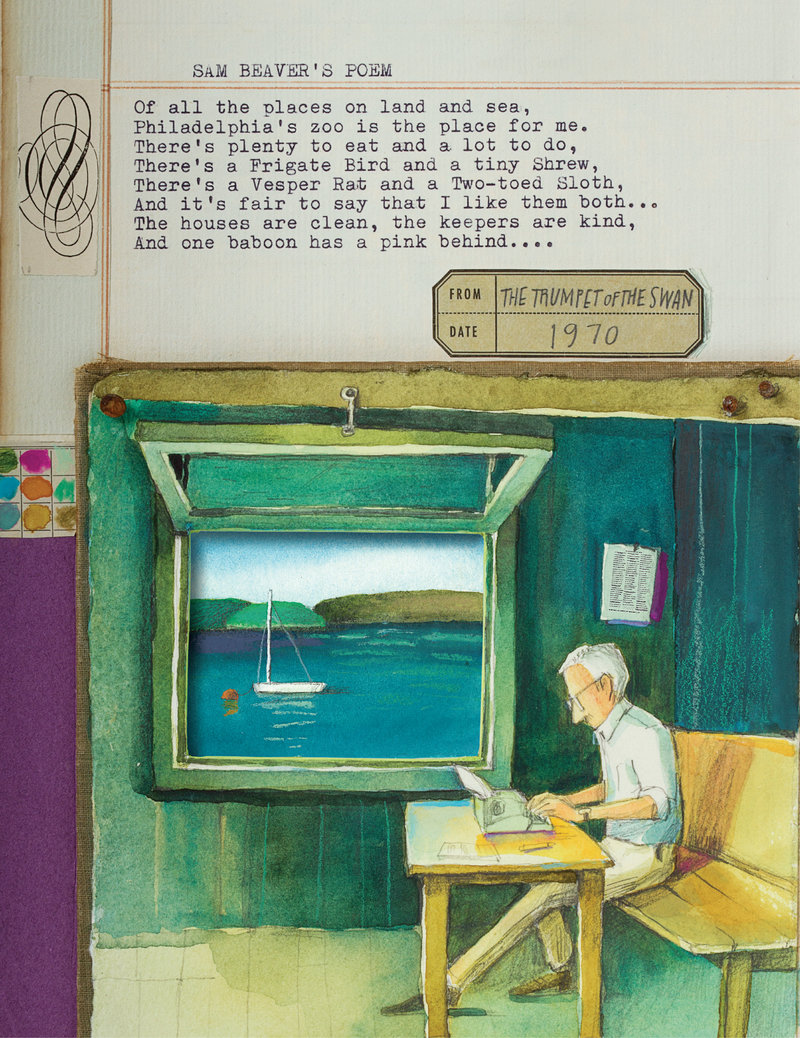
Elwyn Brooks White loved words. And it's a good thing he did, because lots of those words ended up in marvelous books, like Charlotte's Web and Stuart Little - words I read and reread as I imagined that I, too, might have a little mouse and a red car or a canoe...

So it is fun, fun, FUN to read this wonderful biography by Melissa Sweet. It is full of words, too - and bright collages that give the book the feel of a scrapbook. There are tales of vacations in Maine, writing stories for contests, working as a counselor at Camp Otter.

EB White traveled about, wrote for the New Yorker, and then started scribbling notes that would grow into Stuart Little. "One October evening Andy [E.B.'s nickname] watched a spider spin an egg sac and deposit her eggs," writes Melissa Sweet. He detached the egg sac, put it into a box, and took it back to New York where he left it on his dresser. A few weeks later he noticed hundreds of tiny spiders climbing out of the box and spinning webs about the room. Later, back at his farm in Maine, he got to wondering whether a spider could save a pig...

Sweet includes a rough draft of Charlotte's Web that opens, "Charlotte was a grey spider who lived in the doorway of a barn." He struggled with the opening, jotting down different ways into the story, and then set the story aside for a year.

And then, Sweet notes, "he cut to the action ..." to the lines we know so well:
"Where's Papa going with that ax?"

What I love about this book is how Sweet weaves the story of E.B. White with illustrations that capture specific moments in his life. She even makes grammar fun! E.B. White is famous for his writing advice to Omit Needless Words. He's also famous for explaining the difference between affect and effect (I know this because I have looked it up in The Elements of Style) and when to use an exclamation point.

Sweet also has fun introducing readers to the times in which E.B. wrote. Opposite the Table of Contents she explains how a manual typewriter works.
And of course there is back matter: an afterword by Martha White (E.B. was her grandfather) with family photos, a timeline of his works, a selected bibliography of works by E.B. White as well as works by others that curious kids might want to check out. And - yay! - there is an index for impatient folks who want to know right this minute where to find something about chickens or pigs or the nitty-gritty stuff of Stuart Little.  

You can find out more about Melissa Sweet at her website.
On Monday we're joining the roundup over at the Nonfiction Monday blog where you'll find even more book reviews. Review copy provided by the publisher.


Friday, February 24, 2017

Blood Brother: Jonathan Daniels and his sacrifice for Civil Rights

Blood Brother: Jonathan Daniels and his sacrifice for Civil Rights
by Rich Wallace and Sandra Neil Wallace
352 pages; ages 12 & up
Calkins Creek, 2016

So why is a biography of some white guy being featured during Black History month? Because Jonathan Daniels worked for voting rights, and it's still an issue.

Still. An. Issue.

Rich and Sandra Wallace have produced an information-packed (and very heavy) volume that explores the life and times of Jonathan Daniels, a white cleric from New Hampshire who answered the call from Martin Luther King, Jr. to join blacks in their struggle for voting rights. It was dangerous, in the 60s, to challenge the segregated ways of the south.

This book follows Daniels' life from childhood in Keene, NH through college in Virginia Military Institute, through his entrance into service in the ministry. In 1963 Daniels, studying at the Episcopal Theological School, had been serving residents in Providence, RI. He believed that the church should be active in promoting social change, and even joined the March on Washington. When Martin Luther King, Jr, asked for help, Daniels responded.

In addition to being an intriguing biography, the text and photos present documentary evidence of the struggle that black people faced. Even though they had the right to vote, segregation and southern laws prevented them from casting ballots. The Wallaces put history into context using multiple points of view.

The photos and primary documentation is invaluable. They also include a note on their research and forensic analysis of a photo. Also provided are a timeline, bibliography, resources for those who want to investigate further, and source notes for quotes. Check out their website for more resources. The only thing I wish had been done differently is to present text on white pages; black print on blue is difficult to read.

On Monday we'll join the roundup over at the Nonfiction Monday blog where you'll find even more book reviews. We'll also be hanging out on Marvelous Middle Grade Monday with other  bloggers over at Shannon Messenger's blog. Hop over to see what other people are reading. Review copy provided by the publisher.