Showing posts with label perfect picture book friday. Show all posts

Friday, November 26, 2021

Home Alone.....


Henry at Home 
by Megan Maynor; illus. by Alea Marley 
40 pages; ages 4-7
Clarion Books, 2021

theme: family, growing up, school

As long as there had been Henry and Liza, they were together.
Liza and Henry.
Henry and Liza.

They shared friends, adventures, and the marvelous Twisty Tree. But one day, Liza got a backpack and new pencils and fresh crayons and her very own pair of scissors. She was getting ready to go to school – and Henry was NOT happy about that! Because, up to this point, they had Done Everything Together. When the bus roars away, Henry roars, too!

What I like about this book: I like the close relationship between Henry and his sister. I like how Megan shows his jealousy that Liza gets to go to school, but he has to stay home. But what I really like is how Henry discovers that he can do his favorite things on his own. And when Liza returns from school, he has something special he can share with her.

Beyond the Books:

How do you feel when an older sister, brother, cousin, friend, gets to start a new adventure and you’re left behind? Draw a picture or tell a story about how you feel. Do you roar? Stomp your feet? Hang out on the swings at a park and create new ways of swinging?

If you go to school, what are your favorite school supplies? Do any of them have a smell that you associate with going to school? I confess, I love the smell of new crayons!

Think of something you can do with a younger or older sibling that you only see after school. Maybe it’s a favorite game. In our house it was listening to an audio book and coloring.

Today we're joining Perfect Picture Book Friday, an event where bloggers share great picture books at Susanna Leonard Hill's website. Review copy provided by the publisher.

Friday, November 19, 2021

Journalists defend Free Speech


Fearless: The Story of Daphne Caruana Galizia, Defender of Free Speech 
written & illus. by Gattaldo 
32 pages; ages 7-9
‎Candlewick, 2021

theme: courage, biography, free speech,

In a house by the sea, on the island of Malta, lived a little girl named Daphne, together with her mom, dad, and three sisters.

Daphne loved stories ~ especially the story of her great-great-great-great-grandfather who fought against Napoleon. She loved reading books, and carried one with her wherever she went.

“And she loved the freedom of asking questions and then making up her own mind,” writes Gattaldo who, not only wrote this book, but also happened to be one of Daphne’s close friends. Daphne protested injustice and wrote for a newspaper. She was an investigative reporter, uncovering human rights abuses and other wrongdoings. 

What I like about this book: It’s about a courageous woman who tries to reveal truth about those in power. It’s about fighting for justice using a pen instead of a sword. And there is back matter! That's where we learn more about her life, and how those in power worked to silence her.

Beyond the Books:

Write a news story. What’s happening in your town or neighborhood that you think people should know about? Find out the facts and write them up in a newsy story to share with your friends. See if your friends want to help write a neighborhood newsy-letter.

Students, from 6th grade to 12th, are writing and publishing the local newspaper in Pelham, New York. They started doing this when the local paper went out of business. You can see what they write about here.

Today we're joining Perfect Picture Book Friday, an event where bloggers share great picture books at Susanna Leonard Hill's website. Review copy provided by the publisher.


Friday, November 5, 2021

Need Mittens? Get a Sheep!


If You Want to Knit Some Mittens 
by Laura Purdie Salas; illus. by Angela Matteson 
32 pages; ages 4-8
Boyds Mills Press, 2021

theme: friendship, patience, humor

1. Get a sheep. Seriously.

According to Laura Purdie Salas, there are eighteen steps to knitting mittens. The first one is obvious: get a sheep. Once you get that sheep, you’ve got to feed her, and keep her warm and dry. And then you’ve got to give her a buzz cut, wash the wool …. So Many Things To Do until you can finally knit your mittens. And throughout it all there is this sheep – who sometimes helps – and maybe your dad, who also might help, and quite possibly some chickens.

What I love about this book: I love tongue-in-cheek guide books, especially when they provide real instructions while the illustrations show what is “really going on”. In this book, the instructions for how to get from sheep-to-knitting needles are on point … and, except for the sheep (and the actual knitting) I have done them all. Wash wool. Dry it. Card it. Dye it. 

These things take time. Especially when you decide, at the last minute, that you want to dye your wool the color of sunshine and the Natural Dye Book says you need marigolds and you haven’t planted any marigolds – yet. So… there is a lot of waiting that also goes into making mittens. But all that waiting is worth it because that’s how you discover the meaning of true friendship.

Beyond the Books:

Finger knit a flower. You don’t need knitting needles to learn some knitting basics. All you need is some pretty yarn, this tutorial, and some patience. If you get addicted to finger knitting, find a hoop and weave a coaster (embroidery hoop), or a rug (hula-hoop).

Try making natural dye using beets. You can use juice from cooked beets to paint your own gift wrap, or use beet tops to stamp designs on a napkin, or use beets and other things (onion skins, rose hips and berries outside) to do bundle-dying.

Today we're joining Perfect Picture Book Friday, an event where bloggers share great picture books at Susanna Leonard Hill's website. Review copy provided by the publisher.

Friday, October 29, 2021

Need Something Fixed?


The Girl Who Could Fix Anything: Beatrice Shilling, World War II Engineer 
by Mara Rockliff; illus. by Daniel Duncan 
48 pages; ages 5-9
Candlewick, 2021  

theme: Engineering, women in science, biography 

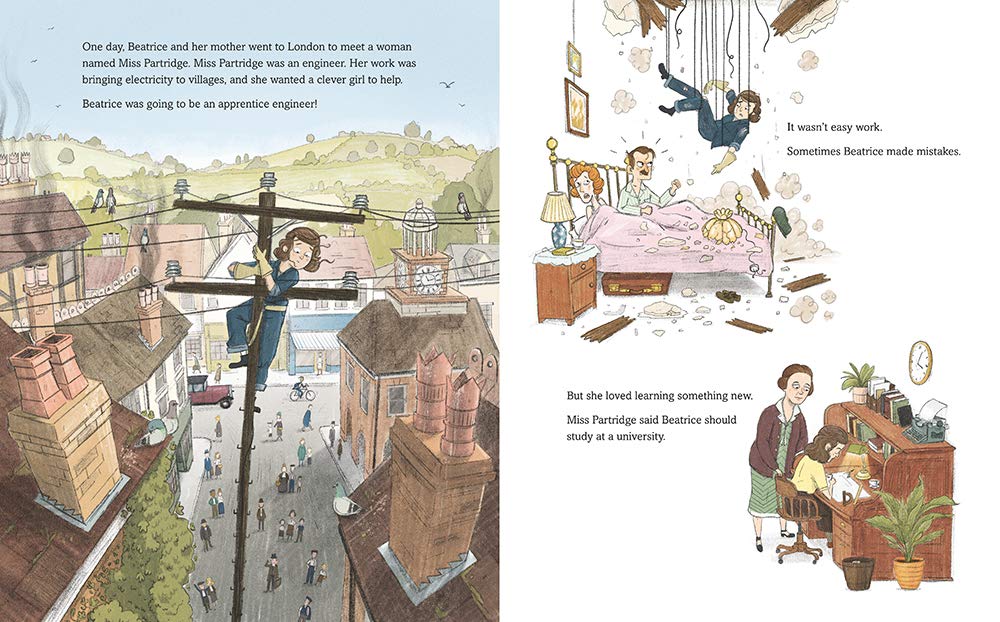
Beatrice Shilling wasn’t quite like other children. She preferred tools to sweets.

Because tools can take things apart. They can put things together. They can fix things that are broken.

Beatrice wanted to be an engineer, and was fortunate to meet a mentor who encouraged her to study at the university. Where she wasn’t quite like the other students. And when she graduated, there weren’t any jobs for women engineers. But finally, one company gave her a chance. Which was a good thing, because she figured out how to solve a serious problem with fighter planes.

What I like about this book: I am always looking for books about women in STEM fields – and engineering is one of those fields where women are underrepresented. I also love reading stories about strong girls who solve problems. Plus, there is back matter: more juicy details about Beatrice’s life. And – the end pages are wonderful ~ diagrams of engine parts and bolts and other fun things.


Beyond the Books:

Make a tool kit. An unused tackle box or lunch box work well. Here are the basics you’ll need: safety goggles, a variety of screwdriver sizes in both flat and Phillip’s head, a hammer, needle nose pliers, wire cutters, tweezers, and a crescent wrench. Also a plastic tray for collecting screws and washers while working on a project – we use take-out containers.

Take apart some things that no one is using. Some fun things to take apart are old computer keyboards, old computer mouse, broken electronic toys, toaster, radio, VHS or DVD player, old printer. Make sure you remove batteries and snip off the cord before unscrewing the first screw. For safety reasons, don’t take apart anything with glass, sharp edges, or tubes that can break.

Today we're joining Perfect Picture Book Friday, an event where bloggers share great picture books at Susanna Leonard Hill's website. Review copy provided by the publisher.

Friday, October 15, 2021

What's Buried in Your Backyard?


The Deepest Dig 
by Mark David Smith; illus by Lily Snowden-Fine 
32 pages; ages 3-7
Owlkids, 2021 

theme: mammoth, bones, STEAM

Caden found something in the backyard.

It was as long as a fence post. It was as hard as a stone. It pushed up through the soil like a root. But it wasn’t a stone or a root or even a fence post. It was definitely a treasure, said his neighbor, Martha. But no one else believes Caden about his treasure. If it was a treasure, we could go traveling, says mom. If it was a prehistoric animal, I’ll eat my hat, says Caden’s science teacher. But Caden, with Martha’s help – and her truck and winch – pull up the bone. Then more. And soon an entire skeleton which Caden tries to assemble in increasingly funny ways.

What I like about this book: It’s a fun take on finding bones in your backyard. And I love the nonchalance of Caden’s parents. I like that Martha has the truck and encourages Caden to dig deeper. And I really like that the story is based on a real event: a farmer in Michigan discovered mammoth bones in his soybean field. What I would have liked even better was if there had been back matter. 

Beyond the Books:

Find out more about the discovery of mammoth bones in the farmer’s field. Here’s an article from the Detroit News. What other articles can you find about people discovering mammoth – or even dinosaur – bones in their backyards?

What does a mammoth site look like when scientists are digging? Check out this video of University of Michigan paleontologists.

Are mammoths ancient relatives of modern elephants? Here’s one article that compares the two. If you can, visit elephants at a zoo and make your own observations.

Today we're joining Perfect Picture Book Friday, an event where bloggers share great picture books at Susanna Leonard Hill's website. Review copy provided by the publisher.

Friday, October 1, 2021

A Boy, a fox, and a forest fire


The Fox and the Forest Fire 
by Danny Popovici 
44 pages; ages 5-8
Chronicle Books, 2021

theme: animals, forest fire

I wasn’t sure I’d like my new home.

When a boy moves from his home in the city to a new house in the woods, he wonders whether he will ever like it. It’s too quiet at night; too loud in the morning, and bugs fly into his mouth when he’s hiking with mom. But over time he discovers things that he does like, and makes friends with a fox. Then disaster strikes: a forest fire. The boy and his mom have to evacuate ~ but where do the animals go?


What I like about this book: What looks like a simple story has layers: a house, the woods, the trees and plants, the animals living in the woods. Everything is connected, even if you don’t see those connections. Given the fires this summer, this is a timely book. The author, at one time, was part of a forest firefighting crew, and he writes about that and the impacts of wildfires in the back matter.

Beyond the Books:

The western part of the US has seen lots of wildfires this summer. You can find out more about wildfires here.

If you were a forest animal, what would you be? Where would you hide – or go – during a wildfire? Here’s an article about animals and the fires in California this summer.

Today we're joining Perfect Picture Book Friday, an event where bloggers share great picture books at Susanna Leonard Hill's website. Review copy provided by the publisher.
Friday, September 24, 2021

Blink and Block are Friends

 
Friendbots: Blink and Block Bug Each Other (I Can Read Comics)
by Vicky Fang 
32 pages; ages 4-8
HarperAlley, 2021

theme: friendship, STEAM, robots

Hey, Block. Let’s play!

Blink and Block are friends. They are robots. That makes them FriendBots! Blink is round, and silly, and playful. Block is square, and serious, and logical. They may not be a perfect fit, but … eventually they figure out how to solve problems together. In book one, they were looking for treasure, and ended up finding friendship. In this book, Block is busy working and Blink wants to play. If you've ever had a friend who pesters  and bugs you, then you will identify with these two friendbots.

What I like about this book: Comics! Who doesn’t love comics? There are three or four panels per 2-page spread. The drawings are uncomplicated and, combined with simple text presented in speech bubbles (aka: word balloons), guides the beginning reader through the story.

Front matter in this book shows how to read a comic, and defines the different kinds of word balloons: dialogue, thought, whisper, excited exclamation! Back matter is a single page, and in this book focuses on buttons. Why? Because Blink pushes Block’s buttons. But also because a button – at least on a robot – is a type of sensor, just like the power button on your tv remote.

This book is part of a series. In the first book, Blink and Block use a scanner to locate treasure. Scanners are sensors, too. They allow robots to see and understand the environment around them.

Blink and Block are so likeable that I just had to ask Vicky One Question.

Me: Can you talk about how you came to illustrate these comics yourself? Is drawing a part of your tech career? 

Vicky: My expertise is in interaction design, not visual design. So, I’m familiar with digital art tools, but I never used them professionally for art! At one time I thought I would illustrate my own stories. But when I saw the amazing art and the arduous editing process of the kidlit world, I focused on writing. 

And yet, I always drew sketches to help me write my stories. They were messy, and hidden in my sketchbooks for me to reference as I wrote. Eventually I started adding a little concept sketch when my manuscripts went out on submission. My intention was to set the tone for the editor, not to pitch myself as the illustrator. Over time, the sketches turned into full dummies, and my agent began submitting me as illustrator-optional on some of my projects.

Andrew Arnold, my eventual editor for FRIENDBOTS, saw potential in the dummy I had sent and worked with me to polish my style. When he made me an offer for text and illustrations, I was slightly terrified. But I took the leap and I’m so glad that I did. It was so much fun, I learned a ton, and I feel like illustration is properly a new tool in my arsenal.

I also have to thank my kid for making me practice. He constantly asked me to draw him pictures, mostly stormtroopers. And he was an unforgiving critic with high standards! So I got a lot of practice drawing and my skills improved.

Now, I’m working on a lot of new projects including a new chapter book and a non-fiction book. And guess what? I’m illustrating all of them.

Beyond the Books:

Look for sensors in and around your house. You probably don’t have a robot, but you may have a remote control with on and off buttons. Other sensors might include a camera, and microphones. I use the mic in my smart phone to pick up bird calls so the Merlin App can identify the bird. 

Draw or build (using recycled materials) a simple robot with at least one sensor. Write about what the sensor does for the robot. What sort of information does it collect? Or does it have another job?

Back in June, I chatted with Vicky about how she integrates technology, engineering, and coding in her kid’s stories. You can find that at the GROG blog. Check out this review of her Layla and the Bots series for middle graders.

Vicky is a member of #STEAMTeam2021. You can find out more about her at her website.

Today we're joining Perfect Picture Book Friday, an event where bloggers share great picture books at Susanna Leonard Hill's website. Review copy provided by the publisher.

Friday, September 10, 2021

BLOG TOUR: Good Night, Oppy!


Good Night, Oppy! 
by James McGowan; illus. by Graham Carter 
32 pages; ages 4-8
‎Boyds Mills Press, 2021 

theme: Mars, exploration

Opportunity loved her job. 

Opportunity was one of two rovers sent to explore Mars. She and her sister, Spirit, landed on the planet in January, 2004. In his book, McGowan endows Oppy with the voice to describe the Mars mission in her own words. And he shows how hard she worked, navigating more than 28 miles over the uneven and rocky Martian surface. She sledded down hills into craters, discovered minerals, and searched for proof of ancient watery environments. Through the marvels of NASA technology, Oppy talked with her scientists and engineers. The original mission was for 90 days, but Oppy kept on going, and going, and going for fifteen years – until a huge dust storm prevented her from recharging her solar batteries. 

What I like about this book: The story is fun, and both author and illustrator give Oppy real personality. I like how Oppy is presented as an explorer, on the trail of discovery. Though a work of fiction, each page contains an additional layer of factual text filled with details to help answer questions young listeners are sure to come up with. 
 

Yes! There is Back Matter! In the author’s note, McGowan shares some of the history of the real Oppy and reminds readers that there are two more rovers actively exploring the planet. And there are photos ~ some of Oppy’s “postcards from Mars.”

Beyond the Books:

Learn more about the Mars Exploration Rover Opportunity. You can find out more here, here, and here

Make your own rover out of cardboard. Here’s how.

Pretend you are a rover. Draw a picture of what you think you would see on Mars. Then check out some of these “postcards” of images from Opportunity.

Head over to Archimedes Notebook to discover more new books about Mars and space exploration. 


Make sure to visit the other stops on the Blog Tour

Today we're joining Perfect Picture Book Friday, an event where bloggers share great picture books at Susanna Leonard Hill's website. Review copy provided by the publisher.


Friday, September 3, 2021

Avocado in Search of Self

Avocado Asks 
by Momoko Abe 
32 pages; ages 3-7
Doubleday Books for Young Readers, 2021 

theme: imagination, identity

Avocado was feeling just fine in the fruit and vegetable aisle of the supermarket.

At least he was until a kid asked whether he was a fruit or a vegetable. Avocado didn’t know the answer! So Avocado did what any other item in the produce section would do: set off in search of his identity. 
Was Avocado a Vegetable?
No, said the veggies.
Was Avocado a fruit?
You’re not sweet like us, they answered.

What I like about this book: I love, love, love when Avocado’s “insides felt like they were turning to guacamole.” I love how Avocado searches for identity amongst the lentils and eggs, fish and cheeses. And I love the tomato skulking around in the background. But most of all I love the fun language Momoko Abe uses to show how Avocado feels.


Beyond the Books:

Take a trip to a grocery store. Notice how the produce is displayed. Where is Avocado?

Check out the book trailer here.

Did you know you can make brownies using avocados? Well, I didn’t either. But here are a whole bunch of ways to enjoy avocados. So ask Avocado over for lunch!

Today we're joining Perfect Picture Book Friday, an event where bloggers share great picture books at Susanna Leonard Hill's website. Reviewed from a library copy.

Friday, July 16, 2021

What if you Found a Thingity-Jig?


The Thingity-Jig 
by Kathleen Doherty; illus. by Kristyna Litten 
32 pages; ages 4-8
Peachtree, 2021   

theme: mystery, fun, invention

One night, under the light of a silvery moon, all of Bear’s friends were deep asleep.

But not Bear. He wandered about tapping, poking, and sniffing things until he found a Thingity-Jig! It was bouncy! So Bear decides to take it home – but he needs something to pull it or drag it or roll it home. So he builds that thing, and then realizes he needs help lifting the Thingity-Jig onto his contraption to carry it home. But no one will help, so Bear builds a lifter-upper.

What I like about this book: I love the language! Smack. Wallop. Whack. That’s the sound of Bear building something. He clinks and clanks, fiddles and whittles… until he’s built a rolly thing, a lifter-upper thing, and other things with fun-to-say names that describe their function.

I love that Bear invents Rube-Goldberg-type things to help get the job done. I love that he runs into problems trying to get the Thingity-Jig back to his home. I love that Kathleen Doherty puts the best, most fun words to say into her text. I love that I actually have a Thingity-Jig at my house, and my kids used it in much the same way Bear does. 


Beyond the Books:

Bear has to move a huge Thingity-Jig and has no one to help him. So he invents a way to move it. Design and – if you can – build your own thingity-jig mover. Raid the recycling bin for materials, put old wagons into use, think about pulleys and rope. But mostly, have fun!

Build a crazy contraption. Need ideas? Check out this video.

We’ll join Perfect Picture Book Friday once they resume. It’s a wonderful gathering where bloggers share great picture books at Susanna Leonard Hill's website. Review copy provided by the publisher.


Friday, July 2, 2021

When it's Hot Enough to Fry an Egg on the Sidewalk...


This book was published three years ago, but because of the heat wave in the northeast, it seems like a perfect pick for today. It got so hot in Oregon that roads buckled and Portland shut off the streetcars because heat was melting the cables. Scorching temperatures soared to 116 F in some places – hot enough to fry an egg on the sidewalk!

Iqbal and His Ingenious Idea: How a Science Project Helps One Family and the Planet 
by Elizabeth Suneby; illus. by Rebecca Green 
32 pages; ages 5-10
‎Kids Can Press, 2018

theme: STEM, sustainability, problem-solving

Iqbal lives in Bangladesh and it’s the monsoon, when “gusts of rain whip across your face and make you squint your eyes.” At home, Iqbal’s mother cooks the meals over an indoor fire. The smoke irritates her lungs, causing her and the baby to cough.

Iqbal wants to win the prize at the science fair so he can use the prize money to buy his mother a gas cookstove. He’s got a month to come up for a project that fits with the theme of sustainability.

What I like about this book: This is a fun story to read, while broaching a serious topic at the same time. We see Iqbal trying to come up with ideas. He sketches gadgets with gears, he conceives of contraptions, he dreams of devices. Could he build a smokeless cooker? With help from his teacher, they get ideas from the internet, and Iqbal designs a solar cooker from things most people have in his village: broken umbrellas. He lines his umbrella with foil, borrows a soot-blackened cookpot, and is ready to test his stove. All he needs is a sunny day to test it.

Beyond the Books:

Can you really fry an egg on the sidewalk? Probably not. Eggs need to reach a temperature of 158 F to cook through – hard to do on a white surface. A better idea would be to fry an egg on the hood of a car sitting under the hot sun (remember: eggs will run, and car hoods are curved). One Arizona girl had a brilliant idea: put the greenhouse effect to use and fry an egg inside a car on a hot day. You can watch her video here. It’s also a good reminder of why you don’t leave pets – or people – inside cars.

Make your own solar cooker. Here’s how to turn a pizza box into a solar oven, and here’s how to turn any kind of box into a cooker.  You can also use an old umbrella and lots of shiny foil, like Iqbal. A good test is to use your oven to make s’mores.

We’ll join Perfect Picture Book Friday once they resume. It’s a wonderful gathering where bloggers share great picture books at Susanna Leonard Hill's website. Review copy found on the library shelves.

Friday, June 11, 2021

Catching up on picture books


These picture books somehow managed to evade review over the past year, and I’m not sure how. After all, the book basket isn’t that big! Both were published by Chronicle in 2020.

theme: family, friendship, read-aloud


For the youngest listeners (from 3-5):
Mabel: A Mermaid Fable, by Rowboat Watkins 

What was weird about Mabel wasn’t her mustache.

Turns out her entire family had mustaches. Nope, having a mustache wasn’t the problem. NOT having one was! Poor Mabel. She tried to make a mustache out of everything she could think of – but no luck. And then she meets a friend – an octopus named Lucky who fit his name except for one thing… he didn’t have eight legs. That didn’t matter to Mabel. They had fun together, playing and exploring and doing the things friends do.

What I like about this book: The idea of mustaches on merfolk is funny, the problem with being the odd one out isn’t. I love Mabel’s attempts at creating a mustache, and her easy acceptance of Lucky. And I love the illustrations. But I mostly love the way she learns to accept herself. 

Oh, and I love the nudibranchs, too.


For the “older” crowd (5-8):
Everyone’s Awake, by Colin Meloy; illus, by Shawn Harris 

The crickets are all peeping.

It’s time for folks to be sleeping, but in this house, Everyone’s Awake! Dad is baking bread. The mice are playing cards. Mom’s tap-dancing and brother’s juggling kitchen plates.

What I like about this book: It’s fun to read aloud, with rhymes and humorous happenings. The pages are bright, with simple, bold illustrations. And as the night goes on, the attempts to stay awake get crazier and crazier.

Beyond the Books:

You may not find any mermaids in the ocean, but you will find nudibranchs, or sea slugs. Learn more about them here. The photos are stunning.

If you’re planning to stay awake all night, make sure you have some games to play. Here are six games and all you need is one deck of cards.

Today we're joining Perfect Picture Book Friday, an event where bloggers share great picture books at Susanna Leonard Hill's website. Review copies provided by the publisher.

Friday, April 16, 2021

Earth Day reading

Earth Day is next week, April 22. So today I’m sharing two books about the Earth, and how we can live more in tune with our planet.

Themes: Earth Day, environment, nature

My Friend Earth
by Patricia MacLachlan; illus by Francesca Sanna 
44 pages; ages 3-5
Chronicle Books, 2020

My friend Earth wakes from a winter nap.

And when she does, she has a lot to do. She’s got animals to attend to, large and small. She cares for the creatures of the tundra, the prairies, the ocean. She pours rain from the clouds and blows autumn leaves from trees. She sprinkles snow across the land before snuggling down for another long nap.

What I like about this book: The die-cut pages are fun to explore – though sometimes hard to turn – and I love the lyrical text. A sweet book to read for Earth Day.


My Green Day: 10 Green Things I Can Do Today 
by Melanie Walsh 
40 pages; ages 3-7
Candlewick, 2020

When I wake up I eat a free-range egg for breakfast.

Over the course of a day we follow the main character as she does simple things, from putting breakfast eggshells into the compost bin to helping hang the laundry. 

What I like about this book: I like how it shows concrete, simple things kids can do to help the Earth. From recycling scraps to make Earth Day cards to remembering the cloth bags for the trip to the grocery store, this book highlights 10 things any kid can do. I also like the bold illustrations.

Beyond the Books:

Do some Earth Day activities
~ here’s a list of 50 ideas from Tinker Lab.  

Make a list of some things you can do to help the Earth. Could you take smaller portions so you finish all the food on your plate? What about hanging laundry on a line or drying rack? Taking a short shower instead of a bath? Putting on a sweater instead of turning up the heat?

Visit a nearby state park and take a walk. If you can’t travel, try a virtual tour of one of our gorgeous national parks. Here’s a link to Yellowstone National Park and one to the Grand Canyon. Find more here.

Go outside and hug a tree. Ask someone to take a photo of you hugging your tree, then print it out so you can remember Earth Day 2021. Remember to visit your tree every now and then to see how it’s doing.


Today we're joining Perfect Picture Book Friday, an event where bloggers share great picture books at Susanna Leonard Hill's website. Review copies provided by the publishers.

Friday, February 19, 2021

STEM in the Garden

It’s never too early to think about planting a garden. My seeds are ordered and now I’m mapping out where I want to plant things – much like Maxine and Leo in this brand-new hot-off-the-press STEAM book.

Maxine and the Greatest Garden Ever
by Ruth Spiro; illus by Holly Hatam 
40 pages; ages 4-8
Dial Books, 2021

 theme: friendship, STEAM, creativity

 Maxine and Milton made a perfect pair.

 They do everything together. And Maxine loves making things for Milton. “If I can dream it, I can build it,” she says. When their friend, Leo suggests they make a garden, Milton grins gill to gill because the new garden will have a pond. For him. (Milton is a goldfish)

What I like about this book: Maxine and Leo see the world differently from each other. When Leo plans his garden, it’s colorful drawings with notes. Maxine’s is a careful blueprint. But when veggie-munching marauders visit their garden at night, the duo work together to build a scarecrow. There’s only one problem: it doesn’t scare anyone. So they add lasers and gadgets and … that doesn’t work either. Just when their garden threatens their friendship, they figure out the perfect solution.


Beyond the Books:

What sort of animals and birds live in your neighborhood? Do any of them eat garden plants? If so, what do they like to eat?

Design a scarecrow – or other solution – that will keep those veggie-nibbling animals and birds out of your garden. Think about things you’ve got around the house or in the basement or garage. Draw a picture to show how it works.

Ruth is a member of #STEAMTeam2021. She’s the author of the Baby Loves Science series. You can find out more about her at her website.

We’ll be joining Perfect Picture Book Friday, an event where bloggers share great picture books at Susanna Leonard Hill's website. Review pdf provided by the publisher.

Join me next month for a look at chapter books.

Friday, February 5, 2021

Beatrix Potter Saves the Countryside

Saving the Countryside: The Story of Beatrix Potter and Peter Rabbit 
by Linda Marshall; illus. by Ilaria Urbinati 
40 pages; ages 4-8
little bee books, 2020

theme: biography, environment, illustrator

On the third floor of a London town house, a young girl sketched pictures of her pet rabbit, Benjamin Bouncer.

That’s not all she drew. The girl, Beatrix Potter also sketched frogs and mice, turtles and salamanders and, later, detailed drawings of mushrooms. Beatrix loved nature and art. She also wanted to “do something” with her life, in a time when most women were expected to focus on their family. Beatrix also loved writing stories and ended up penning some of my favorites: Peter Rabbit, The Tale of Benjamin Bunny… and about 20 more. She painted gentle scenes of her English countryside – and took steps to preserve it for the future.

What I like about this book: I love how Linda Marshall focuses on the broader environmental accomplishments of Beatrix Potter. And I love the illustrations by Ilaria Urbinati that are so reminiscent of Potter’s, drawing us into a time of teas and bunnies and cottages and sheep grazing in the meadow.

Beyond the Books:

Sketch an animal living in and around you
– it could be a pet, or the stray cat that hangs out by the garden, a bird or rascally squirrel raiding the feeder. After you’ve sketched it a few times, think about dressing it up in a jacket or vest. Beatrix Potter’s rabbit was her inspiration for Peter Rabbit.

Read a Beatrix Potter story and linger on the illustrations. What do you notice about her characters and her artwork?

Are there any land trusts or nature preserves in your area? If so, try to visit one. How does it contribute to your community?

If you have a backyard, ask for permission to let part of it “go wild” for the summer. Write notes and draw pictures about what you see there. 

Today we're joining Perfect Picture Book Friday, an event where bloggers share great picture books at Susanna Leonard Hill's website. Review copy provided by the publisher.

Friday, January 29, 2021

Don't Hug Doug


Don't Hug Doug: (He Doesn't Like It) 
by Carrie Finison; illus. by Daniel Wiseman 
32 pages; ages 3-7
G.P. Putnam's Sons Books for Young Readers, 2021

theme: hugs, individuality
 

You can hug a pug. You can hug a bug.
 
You could probably even hug a porcupine… ve-e-ery carefully. Just don’t hug Doug because he doesn’t like it! Even though Doug is a seriously no-hug type of guy, he likes you. Just not hugs.
 
What I like about this book: I love the illustration showing what Doug thinks about hugs: too squeezy and squashy. I love that Carrie Finison shows the great diversity of things that Doug likes. She then shows other ways that Doug lets his friends know that he likes you. Turns out Doug is a master of high fives. But here’s the point – and it’s important: everybody, including your cat, gets to decide for themselves whether they want a hug or not.


Beyond the Books:
 
Do you like to be hugged? Or would you rather not be hugged? Are there some people you let hug you and others you don’t?
 
Draw a picture of what you think about hugs. What are the things you like – or don’t like – about hugs?
 
How do you show your friends that you like them? Do you do high fives? Fist bumps? Jump-twirls? Elbow tags?
 
Today we're joining Perfect Picture Book Friday, an event where bloggers share great picture books at Susanna Leonard Hill's website. Reviewed from a copy provided by the publisher.