Showing posts with label middle grade. Show all posts

Friday, July 23, 2021

Two Books Explore Life Under Hitler

Two books about life under Hitler came out earlier this year. At the time, I was busy reading escapist stories of adventure, fantasy, and science fiction – you know, typical pandemic fare. But this spring I dug through my book basket and plucked these two out to read. 

Ensnared in the Wolf's Lair: Inside the 1944 Plot to Kill Hitler and the Ghost Children of His Revenge 
by Ann Bausum
‎144 pages; ages 10-14
National Geographic Kids, 2021

Anne Frank wasn’t the only one writing in her diary in 1944. Sometime during the summer of that year, “a 12-year-old German girl named Christa von Hofacker picked up her pen and began to write in her own diary.” Like Anne Frank, Christa wrote to try to make sense of her world. Her father was entangled in an assassination attempt against Hitler, deemed a traitor, and vanished into the Nazi criminal court system. Days later Gestapo agents took away her mother and older brother and sister. And then it was Christa’s turn to be uprooted – sent on a three-day, 500-mile journey to a youth retreat center. Now it was a detention center for children of German men and women who were resisting Hitler’s regime. The overseers took away family photos and were given new names. They weren’t allowed to enroll in local schools, attend church, or visit the nearby community. Instead they were hidden and denied outside contact.

In this book, Ann Bausum explores Hitler’s rise to power, the German resistance attempts to limit that power, and his demise. During the first part of the book, she shows how easy it was for Hitler to control the message and reality of what people heard and saw. His regime was built on lies and fears. But a few brave people, some in his government, worked to overthrow him. When that attempt failed, Hitler not only went after members of the resistance, but also their families and children. 

A great mix of history, adventure, and insight into how a charismatic fascist leader can create a world of alternate facts. “…he connected with people on an emotional level that made it easy for them to dismiss logical counterarguments … his message was simple and it was compelling: You’ve been wronged, and I can make things right.” Serious, but essential reading for this time.


I Survived the Nazi Invasion, 1944 (graphic novel)
by Lauren Tarshis; illus. by Álvaro Sarraseca 
160 pages; ages 8-12
Graphix (Scholastic), 2021

It’s been two months since the Nazis have taken papa away, and now Max and his sister, Zena, are on their own. They live in a Jewish ghetto in Poland, and are hungry. When Max sneaks under the fence to gather berries, he’s spotted by a guard and marched back into camp. When his sister is threatened, Max makes a lunge, a gun goes off, and chaos ensues – but Max and Zena run for the forest. They meet Jewish resistance fighters who take them to a safe camp, but soon grenades are exploding, planes are flying overhead, and soldiers are marching through the woods.

The story is told through comic panels, with text and dialog. It gets information and emotion across with a minimum of words, leaving plenty of room for a reader to imagine.


Thanks for dropping by today. On Monday we'll be hanging out at Marvelous Middle Grade Monday with other  bloggers. It's over at Greg Pattridge's blog, Always in the Middle, so hop over to see what other people are reading. Review copies provided by the publishers.


Friday, April 23, 2021

Off on Another Explorer Academy Adventure

Explorer Academy: The Tiger’s Nest (book 5)
by Trudi Trueit
216 pages; ages 8-12
National Geographic Children’s Books, 2021

Cruz joins his best friends in another race-around-the-globe adventure in search of the next clue to his mom’s secret formula. This time we go along with him beneath the sea in the submersible Ridley. So many wonderful fish to see: trumpet fish, Seychelles anemonefish, moray eels, Bengal snappers… it’s hard to catch pictures of them all.

There’s robot-building and other classwork, and then there’s the secret mission: figuring out what the inscription on the back of the Aztec crown charm means. Is it a secret code? There’s a lost professor, a first kiss, and a mystery buried somewhere beneath the Taj Mahal. But the treacherous defenses protecting the next clue nearly does Cruz in. 

This time Cruz ends up in a marvelous archive where his mother’s notebook is housed. But the message is confusing and scary. If he read it correctly, his mom had an accident in the lab – an accident that will alter his destiny.

Like the other books in the series, the back matter explains the truth behind the fiction. You’ll meet a sea turtle researcher, someone who helped design Ocean Space Habitat, and some ocean explorers studying pollution and coral reefs.

You can check out reviews of previous books in the series here  and here . Thanks for dropping by today. On Monday we'll be hanging out at Marvelous Middle Grade Monday with other  bloggers. It's over at Greg Pattridge's blog, Always in the Middle, so hop over to see what other people are reading. Review copy provided by Media Masters Publicity.

I'll be back with more books in June!

Friday, December 4, 2020

Explorer Academy: The Star Dunes


Explorer Academy: The Star Dunes (Book 4) 
by Trudi Trueit 
216 pages; ages 8 - 12 
Under the Stars (National Geographic), 2020

In this most recent addition to the Explorer Academy series, we travel across scorching sand and through steamy jungles across Africa. Cruz Coronado and his friends are on their fourth mission (we met them previously here and here). Now the Explorer Academy students have been called upon to help deliver medication that can treat and prevent a virus from spreading through the mountain gorilla population in Bwindi Impenetrable Forest in Uganda.

In the process, they discover that protecting the world’s threatened species can be a dangerous business.

Before they even begin the mission, Cruz is in trouble. While on an archaeological trip in Turkey, he decided to explore a cave by himself (breaking rule #1) and without telling the group leader (there goes rule #2). Now he’s at the bottom of a well, possibly pushed by an enemy trying to steal his journal. In Indiana Jones style, he manages to escape his predicament and get back to the group only to be tossed into yet another misadventure.

What I like about this book: In addition to mountain gorillas, the students get involved in creating a conservation plan for pangolins. There is a novel disease, requiring quarantine (this book hit the shelves days after our state began closing things and asking people to isolate). There are high-tech gadgets, nanobots, codes, puzzles, and tons of conservation science.

And no, I will not spoil the adventure. Suffice it to say this page-turner is laced with enough STEM stuff to (maybe) qualify for science class credit. Or at the very least inspire a few homeschooling kids to head out on a few explores of their own.

What’s really cool? There is a Field Journal for kids who want to be more involved in the Explorer Academy. Just sign in – there’s a Recruit Intake Form at the beginning – and pack your bags because the pages in this book take you on missions. You’ll explore your favorite spots, boldly plot future world travels, decipher a code, design a drone, and record your innermost thoughts and feelings along the way.

Thanks for dropping by today. On Monday we'll be hanging out at Marvelous Middle Grade Monday with other  bloggers. It's over at Greg Pattridge's blog, Always in the Middle, so hop over to see what other people are reading. Review copies provided by Media Masters Publicity.


Friday, November 27, 2020

How to Build a Kitten Caboodle (maybe)


Clara Humble and the Kitten Caboodle 
by Anna Humphrey; illus. by Lisa Cinar 
232 pages; ages 8-12
Owlkids, 2020 (paperback; originally published 2018)

Clara and Bradley are best friends. They liked the same things (creamsicles and comic books) and went on adventures together. “But things took a turn for the worse when we began building the Kitten Caboodle…” she reflects.

To be honest, things had been changing. Bradley took up a new hobby (treasure hunting) and developed a friendship with another guy from treasure hunter camp. Still, Clara expected him to be just as excited as she was about their new project. She had discovered a lovely, and very pregnant, stray cat. In addition to food and water, the cat and her kittens needed shelter.

There was only one problem. Okay, there were a bunch of problems. But here’s the big one: the cat and kittens had taken up digs beneath a bench in the overgrown churchyard. And Clara wanted to build them a Kitten Caboodle – she had heard her dad talk about kitten caboodles. And she borrowed (without permission) tools and boards from her dad. And a construction company is getting ready to demolish the church to build new apartments.

Can Clara and Bradley keep the cats secret? Will Clara’s internet cat video raise enough money to save the day? Who does the mama cat belong to? And what the heck is a kitten caboodle anyway?


Thanks for dropping by today. On Monday we'll be hanging out at Marvelous Middle Grade Monday with other  bloggers. It's over at Greg Pattridge's blog, Always in the Middle, so hop over to see what other people are reading. Review copy provided by the publisher.

Friday, April 24, 2020

Adventure! Danger! and totally true


Into The Clouds: The Race to Climb the World’s Most Dangerous Mountain
by Tod Olson
288 pages; ages 10-14
Scholastic Focus, 2020

All they needed were three good days. Three days without winds strong enough to blow them off the mountainside… Three days of weather clear enough to see the route between their lonely tents and the top of the second-highest mountain on Earth. 

But on the afternoon of August 6, 1953, Charlie Houston knew the odds of getting those three days were slim. This was not his first attempt to summit K2, the second highest peak in the world. It was a craggy peak located on the border of China and Pakistan, about 900 miles northwest of Everest. Formidable and unforgiving of mistakes.

The first time Charlie climbed K2 was in 1938. His mission: to discover a route that would allow climbers to make it to the summit the following year. The next year, Fritz Wiessner set off with an expedition to conquer the peak. But mistakes and ego resulted in tragedy.
credit: SY; CC BY-SA 4.0

And now, fifteen years after his first attempt, Charlie was once again trying to find a route to the top. But a vicious storm and sudden illness puts the expedition on the edge of disaster. What began as a quest reach the summit turned into a rescue mission.

Into the Clouds is a tale of adventure, for sure. You will find yourself pulling on a sweater or heating up a mug of tea to drink as you read – because it is cold on that mountain! But Tod Olson examines a philosophical divide in the climbing community. Is a climbing expedition the means to allow an individual to reach the top to mark a personal triumph? Or is climbing, as Charlie believed, a team effort? A “fellowship of the rope” that understands no single person can reach a summit without the team.

Olson tells the stories of three expeditions and climbing rivalry. Fortunately, you won’t need crampons or an ice ax to enjoy this adventure; Olson has done the hard work of pounding in the pitons and setting a guide rope. All you have to do is enjoy the story. Be forewarned: it is page-turning nonfiction and a story you will not want to put down, so make sure you have adequate provisions before setting off on this adventure.

If you like nail-biting nonfiction adventures, check out Olson’s LOST series. Last winter I posted a review of Lost in the Antarctic, a tale of Ernest Shackleton's 1914 expedition.

Thanks for dropping by today. On Monday we'll be hanging out at Marvelous Middle Grade Monday with other  bloggers. It's over at Greg Pattridge's blog, Always in the Middle, so hop over to see what other people are reading. ARC provided by Blue Slip Media.

Friday, July 19, 2019

Taking Cover

Taking Cover, One Girl’s Story Of Growing Up During The Iranian Revolution
By Nioucha Homayoonfar
160 pages, ages 12 &  up
National Geographic Children’s Books, 2019

“I knew I was in trouble when the white jeep made a U-turn. Driven by the Zeinab Sisters (or the Black Crows, as I called them), it raced toward me and screeched to a stop.”

This book opens like an action movie: a young girl is snatched off the street, pushed into the back of a car, and taken to an apartment building that’s under construction. There she’s locked in a room.

For what? Showing the tiniest bit of skin. A sliver of her wrist. A crime, in the eyes of the “Moral Police” and the religious leaders who, after the revolution, control Iran. Post-revolution, the country has become a place where women and girls have lost the rights to work, attend school, have an opinion.

Though it sounds like a dystopian novel, this is a true story of one girl’s life – Nioucha – and what happened to her country after the fall of the Shah.

But Nioucha didn’t always live in Iran. She spent her early life in Pittsburgh, PA until she was five years old. That was when her father wanted to move back to his home country, back to relatives and a vibrant civilization that he missed.

Things were fine, at first. But when Nioucha was eight years old the Shah went into exile and the country moved in a different direction. Where she was once free to run and play and go to school, now her world is circumscribed by rules. Her loss of rights begins simply: she must wear a scarf. Girls must attend a separate school from boys. There is mandated religion class. She can’t be seen in public with a boy who is not related.

This is a book about how easy it is to lose your freedom. Lose your voice. So Nioucha uses her words and stories to give voice to those who are still taking cover. And maybe to warn us about just how easily we could lose the rights we take for granted.

Thanks for dropping by today. On Monday we'll be hanging out at Marvelous Middle Grade Monday with other  bloggers. It's over at Greg Pattridge's blog, Always in the Middle, so hop over to see what other people are reading.  Review copy provided by the publisher.

Friday, May 31, 2019

Mr Penguin and the Lost Treasure


Mr. Penguin and the Lost Treasure
by Alex T. Smith
208 pages; ages 8-12
Peachtree, 2019

Mr. Penguin is a dapper gent, what with his hat and bow tie and satchel. He has just started a new business: Professional Adventurer. But it wasn’t going according to plan and he’s down to his last fish finger sandwich.

“It was supposed to have been nonstop Adventures—people ringing up with mysteries for him to solve, missing diamonds to find, jungles to run through under a shower of poison-tipped darts….” Instead, his phone stayed silent. And if he didn’t get an Adventuring job soon, there would be no more crabsticks!

Fortunately, the phone rings! Mr. Penguin’s services are required to find a Lost Treasure somewhere in the Museum of Extraordinary Objects. Accompanied by his sidekick, a karate-kicking spider named Colin, Mr. Penguin heads off on a crazy Indiana Jones-style quest.

What I like about this book:

The wacky characters, from Edith the pigeon lady to Mrs. Bones and her brother Montague.

The clues, including a carved saber-toothed ostrich tusk.

An X that literally marks the spot!

I like how Alex Smith uses color to help tell the story. Most pages include illustrations in black, white, and orange – great penguin colors. But as the adventurers descend into the darkness of the basement, the pages are gray with white text.

I like that there are lessons to learn. If a large knobby tree trunk floats by at exactly the same time you need to cross a river, you might want to check for teeth!

And I like that there is always a way to save the day, though it will invariably require a personal sacrifice. So carry extra candy bars – or fish finger sandwiches, as the case may be.

Beyond the Book: Have some fun with these Mr. Penguin activity sheets!

Thanks for dropping by today. On Monday we'll be hanging out at Marvelous Middle Grade Monday with other  bloggers. It's over at Greg Pattridge's blog, Always in the Middle, so hop over to see what other people are reading. Review copy provided by the publisher.

Friday, May 24, 2019

The Becket List

The Becket List: A Blackberry Farm Story 
by Adele Griffin; illustrated by LeUyen Pham
208 pages; ages 7 - 11
Algonquin Young Readers, 2019

Rebecca Branch is a city kid, born and bred. From subways to sidewalks, she knows how to navigate her habitat. But now that third grade has ended, her family is moving to the country to live with Grandma at Blueberry Farm. Family includes mom and dad, who are veterinarians, older sister, Caroline, who is on the cusp of teendom, and Rebecca’s twin brother, Nicholas, who is his own person.

Rebecca is looking forward to being a country kid. She wants to get a “country dog” even though Mr. Fancypants has been a faithful canine companion. And she decides to change her name to Becket because, she points out to her family, “Rebecca doesn’t fit me…”  Still, she does bring some of her old life with her, like an entire moving box filled with penguins. The stuffed kind, not the live, fishy, flippery kind.

One of the things Becket does is start a list about How To Be a Country Kid. The other thing she does is shout out “beautiful alerts” to remind people to enjoy the natural beauty around them.

Becket wants to be of use, so she adopts farm chores: feeding Grandma’s donkey, mule, and 97 chickens – including the mean Lady Godiva. There’s summer camp, a lemonade business, and tractor-driving lessons. But mostly, there’s a story about family and friendships and growing up.

Thanks for dropping by today. On Monday we'll be hanging out at Marvelous Middle Grade Monday with other  bloggers. It's over at Greg Pattridge's blog, Always in the Middle , so hop over to see what other people are reading. Review copy provided by the publisher.

Friday, February 15, 2019

Lost in the Antarctic

A couple months ago I read Tod Olson's book, Lost in Outer Space, a story about Apollo 13. It was so fun to read that I knew I had to grab a copy of one of his new titles in the Lost series. It being one of those winters where the polar vortex comes whistling down with below-zero temperatures, this one seemed the perfect choice!

Lost in the Antarctic: the doomed voyage of the Endurance
by Tod Olson
224 pages; ages 8-12
Scholastic, 2019

Weddell Sea, Antarctica. 
October 26, 1915
The ship didn't stand a chance, and Frank Hurley knew it. He'd been in the engine room with the carpenter, trying desperately to keep the water out.

The ship is the Endurance, trapped in a sea of ice 1,000 miles wide. She is being squeezed to death by the ice. With no time to spare, the crew rescues crates of food and pike tents and sleeping bags on the ice. For fourteen months the crew and scientists of this expedition to the Antarctic had made this ship their home. Now, in zero-degree weather, they would leave it and head off onto the ice. And, if they are lucky, to safety.

Lost is the tale of Ernest Shackleton's 1914 expedition. His goal: to cross the Antarctic continent by dogsled - a trek of 1800 miles. But to get to the continent they first had to navigate the Weddell Sea. And they were stuck in the ice.

Like other books in this series, it is a page-turning read. Gleaning stories from journals and letters, Tod Olson gives readers an inside look at an expedition that went sideways. There are maps, photos, packing lists, and enough ice and frigid weather to make you head to the kitchen for a mug of cocoa. He puts it in historical context: England was on the cusp of entering World War I as the Endurance set sail. While young men fought and died in trenches, Shackleton's men fought the elements and, sometimes, each other to survive.

There are moments of shared fun: a soccer game beneath the midnight sun; a race to determine once-and-for-all the fastest sled dog. There are moments of sheer terror: watching the ship sink with their stores of food; a wild slide down a glacier. There is no way you can read this book and not come away with a greater appreciation for central heating and a neighborhood grocery store.

Back matter provides perspective on Antarctica in this age of climate change, a list of sources, and end notes documenting dialog and events. If you're interested in learning more about the Endurance, check out the Weddell Sea Expedition. An international crew of scientists are exploring the Weddell Sea off Antarctica, using underwater robots, drones and other state-of-the-art technology. You can read their expedition blog here. But you may want to put on some gloves and a hat first!

Thanks for dropping by today. On Monday we'll be hanging out at Marvelous Middle Grade Monday with other  bloggers. It's over at Greg Pattridge's blog, Always in the Middle , so hop over to see what other people are reading. Review copy provided by Blue Slip Media.

Friday, December 8, 2017

Revolutionary Rogues


Revolutionary Rogues: John Andre and Benedict Arnold
by Selene Castrovilla; illus. by John O'Brien
48 pages; 9-11 years
Calkins Creek, 2017

Major John Andre was bright and well educated. He served in the British army and, in 1779 was put in charge of secret intelligence.

Major General Benedict Arnold was one of America's finest soldiers - even George Washington agreed. But reward and recognition passed him by, and after being shot in the leg at Saratoga, he knew he would not gain glory on the battlefield.

What drew these two men into collusion? Was it Arnold's wife, a British sympathizer? Was it that both men wanted to see an end to this war?

Author Selene Castrovilla takes readers through a fast-paced espionage adventure, highlighting the similarities and differences in these two Revolutionary rogues. The tragedy: that they brought about their own tragic ends. A great read for any young historian. Back matter includes timelines for each soldier and, for those who like to dive deeply into history, a list of places to visit in New York and London.

 Review copy provided by publisher.

Friday, November 17, 2017

The Journey that Saved Curious George

The Journey that Saved Curious George
by Louise Borden; illus. by Allan Drummond
96 pages; ages 7 - 10
Houghton Mifflin Harcourt, 2016 (reprinted)

Eight-year-old Hans A. Reyerback loved to visit the zoo. He would imitate the sounds of animals, and loved to draw the animals. After serving in the German Army (WWI) he traveled to Brazil where he wore a broad hat and watched monkeys along the Amazon.

Margaret Waldstein loved art and studied photography. When Hitler came to power, life changed in Germany so she eventually traveled to Brazil. She was seeking new work and adventure and had heard that an old family friend (Hans) was living in Rio.

They teamed up as artists, eventually married, and traveled to Paris. They planned to visit for 2 weeks; they stayed for 4 years. In 1939 they began working on a story about a very curious monkey. That year war broke out. Paper was scarce and typesetters had joined the army. And war was marching closer! They had to flee Paris on bicycles, sleeping in barns, and narrowly escaping the bombing.

As refugees, waiting for visas, they were questioned by officials: what were the papers they were carrying? Were they spies? No, just writers.... Four months later they arrived in New York City and after another year they published the first book of many about Curious George.

What I like about this book: Adventure! Danger! Escape from Nazis! and Curious George! It's got history and mystery and biography all rolled into one exciting story. 

Review copy provided by publisher.

Friday, September 23, 2016

In the Shadow of Liberty

In the Shadow of Liberty
by Kenneth C. Davis
304 pages; ages 10 - 14
Henry Holt, 2016

"Most of us learn something about the US presidents," writes Kenneth Davis. "But this book is about some people who are not so famous."

Davis introduces us to five enslaved people who lived with and worked for four famous founding fathers: George Washington, Thomas Jefferson, James Madison, and Andrew Jackson. These enslaved people were bought and paid for by the writers of the Declaration of Independence, the very same men who declared that all men are created equal and fought for their own freedom from another master, the king.

William "Billy" Lee, Ona Judge, Isaac Granger, Paul Jennings, and Alfred Jackson witnessed extraordinary events in America's history. Because they were "owned" by men we consider great presidents, we know their names and part of their stories, says Davis. Because of their connections to these presidents, there are records about who they were and how they lived - records that help us understand what being enslaved meant in early America.

It is fitting that this book hits the shelves this week, as September 22, 1862 is the day that President Abraham Lincoln issued a preliminary Emancipation Proclamation. Under the War Powers act, Lincoln warned that he would order the freedom of all slaves in any state that did not end its rebellion against the Union by January first 1863.

Davis begins his history with a look at how slavery began, and the importation of slaves to the colonies. By 1700, he notes that enslaved people are being imported into Virginia at the rate of 1,000 per year. Each subsequent chapter focuses on the story of one enslaved person and his (or her) connection with a president.

Billy Lee was George Washington's valet, a personal manservant who attended Washington at home and on the battlefield. He was entrusted to deliver notes and letters, he rode in hunts, he accompanied Washington when the Founding Fathers signed the Declaration of Independence. Davis points out that Washington, having seen black soldiers fight against the British, began to question slavery. "The contradiction between the ideals he had fought for and the enslavement of people like Billy Lee was now obvious," writes Davis. And yet, when Ona Judge escaped to find her freedom, Washington posted a reward for her return.

At the end of each chapter is a timeline of slavery in America. These points in history - British banning the slave trade (1804), Thomas Jefferson signing a ban on importing slaves (1807) put the personal stories into a national and international context. Historic photos, cartoons and illustrations from the archives add to our understanding of the history. I appreciate the chapter notes, bibliography, and index.

"The history we learn is often about dates, battles, famous speeches, and court decisions," writes Davis. "But in the end, history is not just about wars and constitutional amendments, facts we memorize. It is about people. This book tells the real story of real people—all of them born in slavery’s shackles—who were considered the property of some American heroes." You can read an excerpt from the book here.

On Monday  we're joining the roundup over at the Nonfiction Monday blog where you'll find even more book reviews Review copy provided by the publisher.

Friday, February 12, 2016

Most Dangerous: Daniel Ellsberg & the Pentagon Papers


 Most Dangerous: Daniel Ellsberg and the Secret History of the Vietnam War

by Steve Sheinkin
384 pages; ages 10 & up
Roaring Brook Press, 2015

This is a riveting tale of intrigue and power… a tale of an obscure government analyst turned whistle-blower that reads like a fast-paced spy novel.

“In the summer of 1964, Daniel Ellsberg was thirty-three,” writes Steve Sheinkin. After serving in the Marines he worked as an analyst with the Rand Corporation, a think tank that focuses on military and international issues. He was asked to work on a project focusing Vietnam as our country headed into war.

At that point, Ellsberg was hawkish. He believed the US was doing the right thing. He also knew that to get good information, you had to actually go to where the action was, so he visited Vietnam.

Upon his return, he tried to show that peace was preferable to continued war, but the presidents – first Johnson and then Nixon – didn’t want to “lose” a war. So the fighting escalated, with more and more young men being drafted and sent to die.

As he collected information, Ellsberg realized that his government was deceiving the people. He came to the realization that he would have to do something to end the war. That’s when he decided to photocopy thousands of pages of what became known as the Pentagon Papers – a study that revealed the US bombings of Cambodia and Laos and other activities not reported in the media. The papers demonstrated that the Johnson administration had systematically lied to the people and to the Congress about what was going on in Vietnam.

Forty years later history repeated itself. This time with Edward Snowden, and instead of seven thousand pages of photocopied documents, a flash drive. But the big questions are the same. “Governments must keep some information secret in order to function – but how much secrecy is too much?” asks Sheinkin. Is there ever a time when citizens are justified in leaking information about their government?


On Monday we're joining the roundup over at the Nonfiction Monday blog where you'll find even more book reviews.  Review copy from the library.

Friday, January 29, 2016

Woodford Brave

Woodford Brave
by Marcia Thornton Jones; illus. by Kevin Whipple
192 pages; ages 9-12
Calkins Creek, 2015

Cory Woodford's best friend has deserted him, his father is fighting overseas, and a Nazi spy lives just down the street. Cory needs to be brave, like his father and grandfather. Like his favorite superhero, Mighty Space Warrior. He needs to be Woodford Brave. He writes letters to his dad, drawing cartoons at the bottom of the page - the Space Warrior's Kid. Will his dad notice that he's drawn his own face tucked inside Warrior Kid's Helmet of Power?

This is a fun mystery - is the guy with the suitcase really a Nazi spy? - with a dash of ghost story - is the house down the street really haunted?- some baseball, and a crazy go-cart race that nearly ends in disaster.

The black-and-white comic book illustrations add to the feeling of going back in time. And even though it's fiction, there's an author's note with resources for anyone who wants to lean more about World War II, women's baseball, and the history of comic books. Review copy provided by the publisher.

Friday, January 15, 2016

Three Girls; One Message-in-a-Bottle

Currents
by Jane Petrlik Smolik
336 page; ages 9-12
Charlesbridge, 2015

Bones, Lady Bess, and Mary Margaret have never met and don't know each other, but a bottle bearing a message crosses the ocean - twice- connecting their lives. Bones is a slave, working in Virginia in the fall of 1854. She was too young to remember the day her pappy had been sold to another landowner - "but she remembered everything about how she learned she was the personal property of another human being."

When Bones finds the Slave Birth Records for the plantation, she tears out the page with her name and birth date. Burdened with this incriminating evidence of her actions, she rolls the paper up, puts it into a bottle, adds a heart carved by her pappy, and seals the cork with wax. Then, in the dark of night, she sneaks down to the James River and tosses the bottle as far as she can.

The bottle bobs its way downstream and into the Atlantic where it gets picked up but the Gulf Stream current and pulled across the sea.

In August of 1855 Lady Bess finds the bottle, half buried in sand, on a narrow beach on the Isle of Wight. Could it be from pirates? Lady Bess wants to be an explorer like her father, and she's heard plenty of tales of adventure on the high seas. But no. When she unfurls the paper it says only: Agnes May Brewster. Born: July 1843. Colored slave. When a lad who works for the farm is accused of stealing, Bess discovers who the real thief is and determines to help her friend escape from jail. She gives him the bottle, adding a treasure of her own. Maybe when he reaches London he can find someone who can help solve the mystery of Agnes May.

Instead of reaching London, the bottle ends up traveling with the North Atlantic Drift back across the ocean. Mary Margaret discovers it bobbing against the pilings when she and her da go to the wharf to buy fish. It looks like a genie bottle and when she opens it she finds an engraved gold cross with pearls embedded in it, and the birth record of Agnes May.

Three very different girls whose lives touch each other's because of a bottle. Could a bottle really travel from Virginia to England and back to Boston? In back matter, author Jane Smolik writes about the history of sailors placing messages in bottles. Using ocean current charts, she figured out where a bottle tossed into the James River might land. Then she had to learn what was happening across the world in the 1850s to tie the stories together.

A fun story backed by research, sure to appeal to kids who love exploring history and mysteries. Review copy provided by the publisher.

Friday, January 8, 2016

The Way to Stay in Destiny

With the coming of a New Year, I've decided to post book reviews on a weekly basis. Look for book talk, author interviews and other book-related stuff on Fridays. Starting with...


The Way to Stay in Destiny
by Augusta Scattergood
192 pages; ages 8-12
Scholastic Press, 2015

January is such a perfect month to curl up with a good book. So for the next few Mondays, I'll be digging into my book basket for some longer reads, both fiction and non.

I was pulled into this book by the first line: The crazy lady in seat 2B hasn't stopped singing "You Are My Sunshine" since the glare hit the windshield three hours ago. When the bus pulls to a stop in Destiny, Theo grabs his bags and baseball glove and follows his uncle out the door and into the Florida heat. He sees old men wearing shorts and flip flops... and slithery gray stuff hanging from the trees. What am I doing here? Theo wonders.

Sharing a room with his uncle at Sister Grandersole's Rooming House and Dance Academy, doing the laundry on Saturdays, finding some unexpected friends, and discovering he has an ear for the piano - that's what Theo's doing in Destiny. And then there's the history of baseball tied up with the history of the town: did Hank Aaron really play there?

Add to that the mystery of interpersonal relationships: Who is this girl who ditches dance class to play ball? Can Theo manage to play the piano when his uncle expressly forbids it? And why is his uncle so angry?

This book is a perfect blend of mystery and adventure, and a warm story about what it means to be family.


Monday, March 30, 2015

Fatal Fever ~ Book Give-Away & Author Interview

Last Monday I introduced Gail Jarrow's newest book, Fatal Fever (Calkins Creek, 2015). Since then, I've had a chance to sit down and talk with Gail about writing Fatal Fever. And you still have a chance to win a copy ~ just leave a comment.

Sally: What inspired you to write about Typhoid fever?

Gail: When I was researching Red Madness (about Pellagra), I read a lot of public health bulletins. I kept seeing mentions of typhoid fever - which was happening at the same time. I'd heard about Typhoid Mary, but didn't know much about her, so I decided to investigate. Then, as I began doing the research I discovered links between the people tracking down Mary and my town of Ithaca, NY, which also suffered an outbreak of typhoid fever. Learning about the people - Mary and the scientists tracking her - gave me a connection to this story.

Sally: This book is packed with information. Talk about your research.

Gail: Because residents in Ithaca - and students at Cornell University - contracted typhoid fever, I found a lot of interesting information in Cornell's rare manuscript collection. There were some student scrapbooks from 1903 filled with news articles, and letters. Then, when I looked at George Soper's book (Soper was a sanitary engineer) I noticed that there were photos of the village just a couple miles from my house. I didn't visit the island that Mary was confined to - it's closed to the public - but I could gain a lot of information from photos. When you go back to those places (in aerial photos), they don't look like they did 100 years ago.

Sally: Mary was quarantined for the remainder of her life. Can you talk about individual rights within the context of a community's right to protect the health of its citizens?

Gail: These issues have not gone away, especially when you have no cure for a disease that can kill so many people. We got a sense of this with Ebola. If people get Ebola, they can die. So the question is: do you isolate people who are sick? And do you quarantine people who have been exposed? Back during the typhoid epidemic people were just beginning to understand that some people could be carriers of a disease but not show symptoms. The medical community erred on the side of caution. Today, we have a rise in tuberculosis, with antibiotic-resistant strains. So we're facing similar questions: do you want someone serving food or working with you who could pass on tuberculosis?
Mary was isolated because she refused to comply with medical directives and kept cooking and serving food. Today, state and federal governments have the authority to isolate people with tuberculosis who refuse to take their medications.

Sally: This is your second book on disease. What's next?

Gail: I'm working on my last book in what I call my "deadly diseases" trilogy. It's about bubonic plague. Interestingly, all three books take place at the turn of the century - in the very first years of 1900 - right after they discovered germ theory but hadn't yet discovered antibiotics.

Sally: Thank you for sharing your insights with us. You can check out Gail's website here.

Book Giveaway Rules: leave a comment. also - please send me an email to sueheaven[at]gmail[dot]com so I can contact you if I draw your name. (If I can't contact you, I can't send you a book!) Giveaway ends on Friday is only for US addresses.

Today we're joining the roundup over at the Nonfiction Monday blog where you'll find even more book reviews. It's also Marvelous Middle Grade Monday and we're hanging out with other MMGM bloggers over at Shannon Messenger's blog. Hop over to see what other people are reading. 

Monday, March 23, 2015

Fatal Fever: Tracking Down Typhoid Mary & Book Give-Away

Book Giveaway - see end of post

Fatal Fever ~ Tracking Down Typhoid Mary
by Gail Jarrow
192 pages; ages 10 & up
Calkins Creek, 2015

I love a good mystery - especially when it's true. And this is a mystery. A medical mystery. It involves villains (germs) and disease detectives, victims and suspects.

I love how it begins:

Early on a damp March morning in 1907, Mary Mallon answered the knock at the servant's entrance of a New York brownstone house. She took one look at the visitors and lunged at them with her sharp fork. As they flinched, she ran toward the kitchen.
 Mary hides in a closet. What she doesn't know is that inside of her there are billions of deadly microorganisms hiding, too. They are typhoid bacteria.

What we learn about Mary is that she is, by some fluke of nature, a typhoid carrier. She's never had symptoms of the disease, and so can't believe that she carries the germs inside her.

We meet the detectives: doctors, scientists, and public health officials trying to stop the spread of this deadly disease. "In 1900," writes Jarrow, "it struck nearly 400,000 Americans, and more than 35,000 died." It ranked with influenza, tuberculosis, and pneumonia up there in the top five fatal infectious diseases.

At the turn of the last century, nobody understood how typhoid was spread or where it came from. But they did know that it could be passed from one person to the next. College students died. Parents died. Entire families got sick. People were scared. How could they control the spread of this disease? One solution: quarantine sick people. Isolate them so they don't contaminate others. But how do you do that when they run and hide? And is it possible to keep these people out of your community?

Another solution: find out how the disease is spread and address environmental issues such as sewage and water.

And another solution: try to create immunity before the disease takes hold.

One of the tales Jarrow tells is about a wealthy family in Oyster Bay. Here's Radio Lab's take on the event.

Except in cases of disaster, we rarely see typhoid. On the other hand, we do have a new highly infectious disease spreading rampantly from person to person: Ebola. Reading Jarrow's book you see connections between the 1900 typhoid epidemic and our current need for better public health control of Ebola - not to mention the flu, SARS, measles, and other diseases.

You can find out more about Jarrow and her books at her website. She seems to be working up a series on "deadly diseases".... And check out another review of this book over at Abby the Librarian.

 Today we're joining the roundup over at the Nonfiction Monday blog where you'll find even more book reviews.
It's also Marvelous Middle Grade Monday and we're hanging out with other MMGM bloggers over at Shannon Messenger's blog. Hop over to see what other people are reading.  

Book Giveaway This is such a great book that I want to pass on my nearly-new copy ~ so leave a comment and I'll choose a winner sometime next week.  Review copy provided by publisher.


Monday, February 23, 2015

Schools of Hope ~ changing African American education in the early 1900s

A couple weeks ago I ran a give-away contest for The Girls of Gettysburg. Clara Bowman-Jahn is the lucky winter. Congratulations!

Schools of Hope: How Julius Rosenwald Helped Change African American Education
by Norman H. Finkelstein
80 pages; ages 10-16
Calkins Creek, 2014

Jacket flap intro: "Julius Rosenwald's life was forever changed when he met Booker T. Washington, the well-known black educator. Washington introduced the president of Sears, Roebuck and Company to the deplorable conditions of African American schools in the South..."  and, as they say, the rest is history.

In the early 1900s, Rosenwald led Sears to become the largest retail establishment in the world. He became a wealthy man, but felt that people should share their wealth during their lifetime. In addition to charities, Rosenwald became involved in the education of blacks - from offering college fellowships to matching funding for building schools in communities for their children.

The schools that black children attended during that time, 1895 - 1914, were deplorable. Courts had held that education could be separate but equal - but there was little equal about the quality of the education black children received. Rosenwald was inspired by Booker T. Washington's book, Up from Slavery, and more than that, Washington's philosophy of self-help. When he got to meet the great man, they talked about the need for better schools.

The first school Rosenwald helped build was in Loachapoka, Alabama in 1913. It wasn't far from Tuskegee. Rosenwald donated $300 towards the cost of the school. The entire cost to build it was just under $950. Rosenwald insisted that communities be part of the building projects, raising funds and maintaining the schools so they had ownership. Families, both black and white, contributed.

In this book, Finkelstein weaves together a story about two men with vision - Washington and Rosenwald - and a time of great change. He also includes a neat section on how to build a school, from site selection to construction. He talks about fundraising, and the sacrifices families made to see their children educated towards a better future.

Where did the graduates from these schools end up? They were the parents of the generation who marched and sang and pushed this country towards civil rights. For more on schools and equality, check out reviews here and here.

Today we're joining the roundup over at the Nonfiction Monday blog where you'll find even more book reviews.  Review copy from publisher.


Monday, July 7, 2014

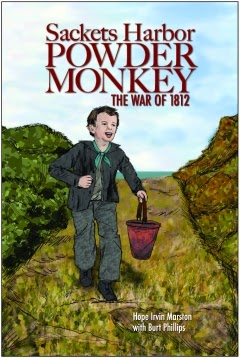
Sackets Harbor Powder Monkey and the War of 1812

Sackets Harbor Powder Monkey and the War of 1812
by Hope Marston with Burt Phillips
 114 pages; ages 9 - 12

It's the fall of 1810 and young Rankin McMullin can't wait to see the warship Oneida. She should be pulling into the harbor any day now. So before dawn, he sneaks out of the cabin and makes his way to the harbor.

There she is: a grand vessel with two huge masts - a brig that will help protect Sackets Harbor from a British invasion. And he, Rankin McMullin, intends to be part of the crew. There's only one problem.... Rankin is 11 years old. 

Not everyone is thrilled that a warship has anchored in town. What if she stops their lucrative - but illegal - business of shipping smuggling potash to Canada? Still, Rankin wants to serve aboard the Oneida, even if it means lying about his age. His job: powder monkey - they guy who carries the powder from the hold to the cannons. It's a dangerous job, even when everything goes right. But when things go wrong, Rankin has to improvise.

Author Hope Marston has written more than 30 children's books, many of them nonfiction. I caught up with her last week to ask three questions about the Powder Monkey.

Sally: What inspired this story?

Hope: It started when the site manager at Sackets Harbor Battlefield asked me to write a children’s book about the War of 1812. That was two years before the Bicentennial Celebrations, and she hadn't been able to find any books for kids about the war. At first I wasn’t interested; war is not my favorite topic.  But once I decided to do it, and began my research, I discovered the first two battles of the War of 1812 were fought at Sackets Harbor on Lake Ontario. I decided to focus on the first, fought July 19, 1812. 

Sally: Tell me about your process, what sort of research you did and how you got the story to the page.

HopeI began by  investigating library materials and permanent displays at the Battlefield in Sackets Harbor.  One of the most helpful things I found there was a list of the local men who enlisted when the warship Oneida came to Sackets looking for recruits. That’s where I found the names of my characters - including the powder monkey, Rankin McMullin. 

I did a lot of library and online research and visited the museum at the battlefield. I attended the annual re-enactment weekend at Sackets, where I could ask questions and see just how a long gun was loaded. O attended other reenactments and a couple of area "War of 1812 Symposiums". I also read any historical novel about the War of 1812 I could - they helped me learn how to express myself in nautical war terms.  Also a colleague who grew up in Sackets Harbor taught me such things as there are no “steps” on a warship. Those things that look like steps are referred to as “ladders.”

Sally: Why did you decide to tell it as historical fiction rather than write a nonfiction book? 

HopeMy first drafts were nonfiction, but, according to my Critique Group, they lacked kid appeal. I scratched my head trying think what would make kids want to read my book - powder monkeys! I couldn't remember reading about them, but must have somewhere along the line ... because when that thought came to me I knew I wanted to pursue it.  When I searched the ship's log for names I noticed that the  enlistee’s job on board was listed as well. When I read Rankin McMullin’s name, he was simply listed as boy. I knew I had my main character.

The Sackets Harbor Historical Society liked the story so much that they asked me to adapt it for a stage play. So I contacted a local playwright who got a grant for making the adaptation and agreed to direct the play. The premier is scheduled for Sackets Harbor in mid-November.

Hope has a page at her website filled with videos and more about Sackets Harbor Powder Monkey.  She's just finished another historical novel set in almost the same time period called Hannah Brown, New England Pioneer and it is, as she puts it, "out looking for a publisher".

Beyond the Book: 

Visit Sackets Harbor Battlefield State Historic Site. During the summer, guides dress in military clothing of 1813 and reenact camp life of the soldiers. August 1 - 3 is their annual War of 1812 reenactment. Learn more about events here.