Showing posts with label farm life. Show all posts

Friday, May 24, 2019

The Becket List

The Becket List: A Blackberry Farm Story 
by Adele Griffin; illustrated by LeUyen Pham
208 pages; ages 7 - 11
Algonquin Young Readers, 2019

Rebecca Branch is a city kid, born and bred. From subways to sidewalks, she knows how to navigate her habitat. But now that third grade has ended, her family is moving to the country to live with Grandma at Blueberry Farm. Family includes mom and dad, who are veterinarians, older sister, Caroline, who is on the cusp of teendom, and Rebecca’s twin brother, Nicholas, who is his own person.

Rebecca is looking forward to being a country kid. She wants to get a “country dog” even though Mr. Fancypants has been a faithful canine companion. And she decides to change her name to Becket because, she points out to her family, “Rebecca doesn’t fit me…”  Still, she does bring some of her old life with her, like an entire moving box filled with penguins. The stuffed kind, not the live, fishy, flippery kind.

One of the things Becket does is start a list about How To Be a Country Kid. The other thing she does is shout out “beautiful alerts” to remind people to enjoy the natural beauty around them.

Becket wants to be of use, so she adopts farm chores: feeding Grandma’s donkey, mule, and 97 chickens – including the mean Lady Godiva. There’s summer camp, a lemonade business, and tractor-driving lessons. But mostly, there’s a story about family and friendships and growing up.

Thanks for dropping by today. On Monday we'll be hanging out at Marvelous Middle Grade Monday with other  bloggers. It's over at Greg Pattridge's blog, Always in the Middle , so hop over to see what other people are reading. Review copy provided by the publisher.

Friday, December 9, 2016

Picture books you can sing

 Marianne Berkes has two more fun sing-along-while-you-read books. One features mother and baby animals found on the African Savanna: zebras, giraffes, hippopotamuses, lions, chimps, apes... and my favorite, meerkats.

The other features familiar barnyard animals: goats, cats, cows, horses, ducks and even owls. As in her other books, the text introduces the less familiar baby names - "kid" for goat, "poult" for turkey - and is structured as a counting book. There's also lots of action as the mothers and their babies gallop, swing, strut, stalk, yip, neigh... all things that the kids listening to the book will want to act out on their own.

What I love about these books is that at the end there's the music so you can sing along with the story ... which, if you grew up singing "Over in the meadow" you might do automatically.

There's also lots of "beyond the book" activities at the back of the book, including more information about each featured animal. Back matter in Over in the Grasslands includes a map of Africa showing where the animals live, a key to "hidden" animals (they show up in the book but you really have to take a second or third look to find them!), and some awesome tips from the illustrator, Jill Dubin, that might inspire you to try your own cut-paper art. More activities here.

Activities in Over on the Farm focus on math, science, language arts, music, movement, and art. Did you know you can grow a plant from the top of a carrot? There's also a section about food "from farm to table" with activities for making butter and "honey corn". More activities here.

Review copies from the publisher.


Monday, December 14, 2015

Thomas Jefferson Grows a Nation

Thomas Jefferson Grows a Nation
by Peggy Thomas; illus by Stacy Innerst
48 pages; ages 9-12
Calkins Creek, 2015

"Thomas Jefferson loved to grow things," begins Peggy Thomas. He grew potatoes and peppers, pippins and peaches and peas. "Throughout his lifetime, he scattered seeds, like a brisk wind, around the world."

He even helped grow the nation, writing the Declaration of Independence. But there was one thing that bothered Jefferson: a French naturalist wrote that wildlife in the new country was small and weak.

So Jefferson set out to prove him wrong. He wanted to introduce Europeans to American wildlife and crops - and he got the chance to do that when Congress appointed him "minister plenipotentiary" to France. There, in his garden he planted corn and watermelons, and he passed out persimmon plants and sumac seeds to friends.

This is a delightful look at Jefferson's agricultural explorations and his attempts to "grow" a nation from the soil on up. Back matter includes discussion about the Founding Fathers' struggle over a vision for this new nation: one of agriculture and farmers? or one of merchants and industry?

Today we're joining the roundup over at the Nonfiction Monday blog where you'll find even more book reviews. Review copy provided by the publisher.

Monday, November 23, 2015

Farmer Kobi's Hanukkah Match

Farmer Kobi's Hanukkah Match
by Karen Rostoker-Gruber & Rabbi Ron Issacs; illus. by CB Decker
32 pages; ages 4-7
Apples & Honey Press, 2015

With less than two weeks to Hanukkah, it's time to polish the menorah, lay in a supply of candles, find that yummy sweet potato latke recipe you used last year, rescue the dreidel from the goat ... and squeeze in some time to read a new story.

I love the way this one begins: Donkey's legs shook so hard he could barely stand. Tonight, on the second night of Hanukkah, Farmer Kobi had invited Polly to his farm for a date.

Farmer Kobi's farm is part of a moshav, a cooperative farming community in Israel. On this, the second day of Hanukkah, he is a bit late finishing up his chores and the animals are worried because Polly could show up any minute. Things are under control, though, because the sheep have checked on the baa-baa-ghanoush and it's ready.

Things seem to go well until Farmer Kobi heads to the kitchen, leaving Polly in the sitting room with his animals. She thinks they should be outside, not hanging around the dining room table. Things come to a head when Polly storms out, snapping that if she wanted to be with animals she'd go to the zoo.

She was definitely not the perfect match, the animals decide. Before they can feel too sorry for Farmer Kobi there's a knock on the door... Has Polly returned? Will Farmer Kobi meet his match? Will they get to eat the falafel balls and latkes before all the food gets cold?

Karen Rostoker-Gruber is pretty busy getting ready for the holidays at her home, but was gracious enough to answer Three Questions when I dropped in via email.

Sally: Why did you want to write this book?


Karen: I had written a story earlier called "Farmer Ted's Dinner Date" to follow my first book, Rooster Can't Cock-a-Doodle-Doo. For a number of reasons, it ended up on the back burner until I talked with my Rabbi, Ron Isaacs. He told me that there were a lot of Jewish values in the story, so I did a lot of thinking.

A lot of my family members live in Israel and some live on the most famous moshav there--The Nahalal Moshav.  There are no children's books about life on a moshav, so I contacted my cousins in Israel and asked them to send me photographs of the tractors that they drive, the houses that they live in, the clothes that they wear, animals that they have, and things that they keep in their pantry. Then I rewrote the book. The editors loved the story, but they wanted the date to take place during Hanukkah.

Sally: You really play around with language. Talk about the word play.

Karen: When my daughter was about 3 or so, I began the quest for the purr-fect puns for my characters. If I was working on a cat book, I'd look through the whole dictionary and list words like purr-fect, purr-fectionist. If it was a book with a cow, I’d jot down  moo-vies or moo-ve over. In "Farmer Kobi's Hanukkah Match," I needed puns for geese, goats, and donkey.  First I write the dialog as if people were talking, making sure that it flows easily and is not labored, then I stick in animal puns where I can. 

Sally: Favorite Hanukkah food?

Karen: My mother’s latkes. We have them every Hanukkah.  I used to help her make them, now my daughter helps her. Here’s what you need:
pound bag of Yukon gold potatoes (wash--don't peel them)
1 1/2 onions
3 eggs
1/4 cup matzo meal
1 tsp baking soda

Shred the potatoes. Then take 1/3 of all of the potato shreds and turn them into mush (a food processor works well).
Mix together the 2/3 shredded potatoes and the 1/3 mush with 3 eggs, 1/4 cup matzo meal, pepper to taste, and 1 tsp baking soda.
Put the oil in a frying pan and get it hot. Then use a tablespoon to measure out each latke, and fry until it’s brown it on both sides. Put latkes on a paper towel to drain.

You can find out more about Karen and her books at her websiteReview copy from the publisher.

Monday, June 1, 2015

Big Tractor

Big Tractor
by Nathan Clement
32 pages; ages 4- 8
Boyds Mills Press, 2015

You don't need to live on a farm to love tractors. This book introduces young children to all the different things a tractor does on the farm, and lets them get a good look at the huge wheels and the implements.

The text is simple, with two lines of text on each page. "Wake up, Ol' Partner," says the farmer, pushing the barn doors open. It's time to hitch up the plow. Then disc the soil and plant the corn (or soybeans or...).

Readers follow the seasons through the work of the tractor. I like the break Tractor gets when the combines head into the wheat field ... tractor can hang out in the shade sipping lemonade. But then, before you know it, tractor's back to work harvesting corn - a job that runs into overtime. Good thing tractor comes with headlights.

Finally, after all that hard work it's time for some fun - a hayride! And then a well-deserved rest.

Today we're joining the roundup over at the Nonfiction Monday blog where you'll find even more book reviews. Review copy provided by the publisher.

Monday, January 26, 2015

Steering Toward Normal

Steering Toward Normal
by Rebecca Petruck
336 pages; ages 9-14
Amulet Books (Abrams imprint), 2014

Eighth grade is going to be different, Diggy promises himself. For one thing, he won't name his 4-H calf - he's learned from first-hand experience that naming steers destined for auction never ends well. And this year he'll be less shy around July - now a senior, and the reason he attended his first 4-H meeting.

His first resolution lasts 10 minutes, about the length of time it takes to unload his new calf and  be rewarded with a pile of warm steer manure on his boots. "Joker!" Diggy says... and it sticks. A name.

Within hours his "going to be awesome" year gets another whack: Wayne Graf is left on the doorstep. Wayne's mama died and his real father happens to be Diggy's father - Pops. OK, maybe having a brother won't be so hard after all.

Then, Wayne decides he wants to raise a steer and try for the prize: scholarship money. Suddenly Wayne and July seem to be spending more time together and Diggy is on the outside.

What a great coming-of-age novel, penned by author Rebecca Petruck who has an inside scoop on county fairs, having served as 4-H president herself.

Today we're hanging out with other bloggers over at the Marvelous Middle-Grade Monday round-up. Drop by Shannon's blog to see what other reviewers are talking about. Review copy provided by publisher.

Monday, February 17, 2014

The Vine Basket

The Vine Basket
by Josanne La Valley
256 pages; ages 9 - 12
Clarion Books, 2013

Mehrigul lives in a village in northwest China. She is one of the Uyghur people, working on her family farm and selling produce at the local market. As much as Mehrigul loves her family and her home, she feels trapped. She wants to go to school, but can't because her brother - who would be working the farm - is hiding from the authorities. She wants to weave baskets with her grandfather, but has to hide them from her father who values practicality over art. And her biggest worry is that she will be sent to work in the factories in southern China.

Then one day at the market a foreigner buys one of Mehrigul's baskets. And the foreign lady asks Mehrigul to weave more. She'll return in three weeks. What an opportunity! If Mehrigul can make more baskets and sell them, then her family will have more opportunities. But one obstacle after another blocks her from weaving all the baskets she wants to.  Still, Mehrigul finds a way to embrace the artist within and shape her destiny.

This story was born from an experience Josanne La Valley had while traveling in northwest China. She was visiting local artists and, at one home, a young girl offered her a peach from the family orchard while La Valley watched the grandfather weave willow baskets. When La Valley learned that Uyghur girls were being forced to leave their homes to work in factories, she knew she had to tell a story. La Valley includes notes and a map in the back of the book for readers who want to know more about Uyghur culture.

Check out what other bloggers are reviewing for Marvelous Middle Grade Monday over at Shannon Messenger's blog. Review copy provided by publisher.

Friday, March 15, 2013

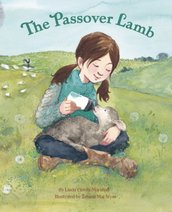
The Passover Lamb


The Passover Lamb
By Linda Elovitz Marshall; illustrated by Tatjana Mai-Wyss
32 pages, ages 6 - 9
Random House 2013
 
As Miriam scatters chicken feed and gathers eggs, she practices chanting the questions she’ll ask tonight at Grandma’s house. “Ma nishtana ha-laila ha-zeh…? Why is this night different from all other nights?

Of course, this is the day Snowball has her lambs – triplets. She won’t nurse the smallest, so Miriam fills a bottle with special milk for newborns and feeds the hungry lamb. But newborns need to be fed every four hours - how can they go to seder?

Miriam wants to take part in the Passover meal where they retell the story of how the Jews were slaves in Egypt. And how one mother hid her baby, Moses, in a basket to….

“Hey!” she says, “I know what to do!”

Linda Marshall’s story is inspired by an actual event that happened on her farm – when her children took a newborn lamb along with them to seder. I was lucky enough to get Linda to answer Three Questions about her book.

Sally’s Bookshelf: Did you carry him in a basket?

Linda: It happened a long time ago, but as I recall, we didn’t use a basket. Instead, the lamb sat on my kids’ laps or under the table where he nibbled our toes as we told the stories. My kids named him “Moses” as a gentle joke. And lamb nibbles? They feel soft and furry...and tickley.

SB: Your books focus on Jewish themes. Why?

Linda: Not all of my books focus on Jewish themes. But it’s only recently that I began writing for children and, as it’s turned out, the books that have been published so far have Jewish themes. My stories, though,  are inspired by many things - from farm life to word-plays to everyday mysteries like vacuum cleaners.

SB: The inspiration for many of your stories comes from relatives or family stories. How do you craft universal stories from these - what sort of process do you go through?

Linda: This is a great question; thank you for asking. I think everyone has a different process for this, so I'll tell you what I try to do – even though it doesn’t always work. First, I think about what actually happened. Then, I ask myself what story do I want to tell? How can adapt (or invent) story elements to build tension? Then I start writing.  For me, the first draft is the hardest part because I'm literally making “something from nothing.” When the first draft is finally written, I let it “simmer” in my subconscious....That’s when I ponder what I call the “deep structure” of the story – the thing that makes it universal. How does this particular vignette speak to the human heart? The answers generally come while I'm driving or swimming or in the shower. They don't come while I’m consciously thinking about the story! When I finally understand my story’s deep structure, I try to put it in context with other literature with a similar deep structure so I can learn from what came before. And, if I can do that, I often have a much stronger story. It’s a complicated process for what seems simple: a picture book – and that’s only the beginning of the process.

Review copy from publisher.