Showing posts with label 1800s New York. Show all posts

Monday, July 7, 2014

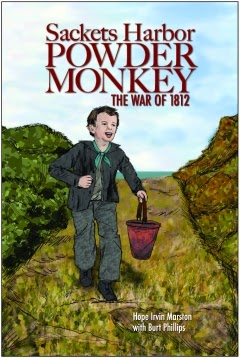
Sackets Harbor Powder Monkey and the War of 1812

Sackets Harbor Powder Monkey and the War of 1812
by Hope Marston with Burt Phillips
 114 pages; ages 9 - 12

It's the fall of 1810 and young Rankin McMullin can't wait to see the warship Oneida. She should be pulling into the harbor any day now. So before dawn, he sneaks out of the cabin and makes his way to the harbor.

There she is: a grand vessel with two huge masts - a brig that will help protect Sackets Harbor from a British invasion. And he, Rankin McMullin, intends to be part of the crew. There's only one problem.... Rankin is 11 years old. 

Not everyone is thrilled that a warship has anchored in town. What if she stops their lucrative - but illegal - business of shipping smuggling potash to Canada? Still, Rankin wants to serve aboard the Oneida, even if it means lying about his age. His job: powder monkey - they guy who carries the powder from the hold to the cannons. It's a dangerous job, even when everything goes right. But when things go wrong, Rankin has to improvise.

Author Hope Marston has written more than 30 children's books, many of them nonfiction. I caught up with her last week to ask three questions about the Powder Monkey.

Sally: What inspired this story?

Hope: It started when the site manager at Sackets Harbor Battlefield asked me to write a children’s book about the War of 1812. That was two years before the Bicentennial Celebrations, and she hadn't been able to find any books for kids about the war. At first I wasn’t interested; war is not my favorite topic.  But once I decided to do it, and began my research, I discovered the first two battles of the War of 1812 were fought at Sackets Harbor on Lake Ontario. I decided to focus on the first, fought July 19, 1812. 

Sally: Tell me about your process, what sort of research you did and how you got the story to the page.

Hope: I began by  investigating library materials and permanent displays at the Battlefield in Sackets Harbor.  One of the most helpful things I found there was a list of the local men who enlisted when the warship Oneida came to Sackets looking for recruits. That’s where I found the names of my characters - including the powder monkey, Rankin McMullin. 

I did a lot of library and online research and visited the museum at the battlefield. I attended the annual re-enactment weekend at Sackets, where I could ask questions and see just how a long gun was loaded. O attended other reenactments and a couple of area "War of 1812 Symposiums". I also read any historical novel about the War of 1812 I could - they helped me learn how to express myself in nautical war terms.  Also a colleague who grew up in Sackets Harbor taught me such things as there are no “steps” on a warship. Those things that look like steps are referred to as “ladders.”

Sally: Why did you decide to tell it as historical fiction rather than write a nonfiction book? 

Hope:  My first drafts were nonfiction, but, according to my Critique Group, they lacked kid appeal. I scratched my head trying think what would make kids want to read my book - powder monkeys! I couldn't remember reading about them, but must have somewhere along the line ... because when that thought came to me I knew I wanted to pursue it.  When I searched the ship's log for names I noticed that the  enlistee’s job on board was listed as well. When I read Rankin McMullin’s name, he was simply listed as boy. I knew I had my main character.

The Sackets Harbor Historical Society liked the story so much that they asked me to adapt it for a stage play. So I contacted a local playwright who got a grant for making the adaptation and agreed to direct the play. The premier is scheduled for Sackets Harbor in mid-November.

Hope has a page at her website filled with videos and more about Sackets Harbor Powder Monkey.  She's just finished another historical novel set in almost the same time period called Hannah Brown, New England Pioneer and it is, as she puts it, "out looking for a publisher".

Beyond the Book: 

Visit Sackets Harbor Battlefield State Historic Site. During the summer, guides dress in military clothing of 1813 and reenact camp life of the soldiers. August 1 - 3 is their annual War of 1812 reenactment. Learn more about events here.

Monday, November 18, 2013

A Kite, A Waterfall, A Bridge

The Kite that Bridged Two Nations
by Alexis O'Neill; illustrated by Terry Widener
40 pages; ages 8 - 11
Calkins Creek, 2013

In 1848 an ordinary boy flew a kite across Niagara Falls and helped build a bridge. His name was Homan Walsh and he was 16 years old. He built the kite for a contest - a contest sponsored by the US and Canadian bridge-building companies to generate publicity for their endeavor of building a bridge to span the falls and connect two nations.

There were news articles, and later the event was included in history books. But author Alexis O'Neill wanted to tell the tale from the Homan's point of view - a kid who was caught up in the (air) currents of history.

Homan loves to build kites. What seems like play to his father ("Apply yourself, Your studies must come first.") is filled with learning: "reading the wind, calculating lift, gauging line length...". We see Homan building his kite from the spars up, cutting the sail from calico in Mother's sewing basket, adding tails and finally twine - more than a thousand feet to reach across the gorge that separates Canada from the US.

There's adventure, too. After determining that the best wind comes from the Canadian side, Homan rides across on the ferry. Like any good adventure story, his first attempt fails, and he is trapped across the gorge by ice that halts ferry traffic for days. But does Homan give up? No - when he finally gets home his first order of business is to repair his kite and try again. There's a lot at stake in his venture: prize money and a chance to go down in history.

This is a true story. But, says O'Neill, the dialogue is created to "express emotions that are not obvious in the straight narrative accounts of this event." In her back matter she outlines what is known about the facts of the event, and what is not known. For example, in her story she mentions a handbill advertising the kite contest. While there was a contest, no one has found evidence of how the contest was promoted. Handbills - like the flyers of today tacked to telephone poles - were a common way to announce things.

O'Neill includes a timeline of the bridge construction, adds sources and websites for further exploration, and even provides a link on how to build your own barn door kite - the kind that was popular when Homan would have built his kite.

Which leads to this question: While a true story, is this nonfiction? Dianne White asked O'Neill about this very issue in a recent interview posted at ReaderKidZ.  O'Neill's resoponse: "... if a writer makes up even one teeny, tiny thing that can’t be verified (a piece of dialogue, a neighbor’s name, an emotional reaction), the piece becomes fiction. Nonfiction means that everything is verifiable." She calls her story "historical fiction". But since it is about a real person, and is factual, other people would consider it a "fictionalized biography" - meaning that the story is pretty much true except for some dialogue.

Check out more Nonfiction reads today over at NC Teacher Stuff. Review copy provided by publisher.


Friday, July 19, 2013

The Book Boat's In!

The Book Boat's In
by Cynthia Cotten; illustrated by Frane Lessac
32 pages; ages 4-8
Holiday House 2013

One day when Jesse goes into town with his dad, he sees the book boat tied up along the canal wharf. It's part library, part bookstore.  Jesse browses the shelves and finds the perfect book: The Swiss Family Robinson, with a bright read cover. The cost: twenty cents. But Jesse doesn't have 20 cents.

He figures he can earn that money before the book boat returns - in a week. So Jesse works odd jobs around town: sweeping the general store, chopping wood, running errands. This story of life around the canal is illustrated with folk-art paintings that set the mood and keep us in the 1800's.

If we can have book boats, anything is possible: book burros, books on bikes, even libraries in old phone booths. This is a great story for book lovers of all ages.

Review f&g provided by publisher.

Friday, March 8, 2013

Women in History: Nellie Bly


It Can't Be Done, Nellie Bly! A Reporter's Race Around the World
by Nancy Butcher; illus by Jen Singh
144 pages, ages 7-10
Peachtree 2003

I confess, I wanted to read this book because I remember sneaking into the school library to read Jules Verne’s Around the World in Eighty Days sometime in fourth grade. Traveling around the world seemed like such an adventure … something I would have done at the drop of a hat.

I also wanted to read this book because I’m a reporter – and Nellie Bly is my hero. Instead of writing about conventional women’s topics (tea parties, charity events) she wrote about social problems of her day: poor work conditions, lack of decent housing, crooked politicians.

But mostly I wanted to read this book because it’s a grand adventure. In 1889 Nellie Bly took off on a round-the-globe trip to see if a person could, indeed, make it in 80 days or less. No one had done it, outside of Verne’s fantasy. She had to convince her newspaper that this would be a worthwhile investment, and promised to send stories along the way – without cell phone or blogs!

She traveled light, packing only a small satchel and wearing a sturdy travel dress for the nearly three-month venture. She journeyed by ship, train and foot, timing her connections down to the minute and almost missing some. Then, unbeknownst to her, another newspaper decided to send its own reporter to try to beat Nellie Bly home.

A reporter, a race against time, and a pet monkey… what’s not to like? And at the end of the book, author Nancy Butcher provides some additional reading and more details about Nellie’s life and the race. Review copy provided by publisher.

Monday, March 4, 2013

Women in History: Esther Morris


I Could Do That! Esther Morris Gets Women the Vote
By Linda Arms White; illustrated by Nancy Carpenter
40 pages, ages 7 - 9
Melanie Kroupa Books (Farrar, Straus and Giroux)  2005
 
 “In 1820, six-year-old Esther McQuigg studied her mother making tea. ‘I could do that,’ she said.
‘Make tea?’ asked Mama. ‘The older girls do that.’
‘But I want to learn,’ said Esther, and she did.”

So begins the story of Esther Hobart Morris, a woman who thought women “could do that” – whether it was supporting their families with jobs to voting for president.  Linda White paints a portrait of a young girl who has gumption and doesn’t let social convention hold her back from her dreams.

Esther was born in Spencer, NY – a town 20 minutes to the west of me. When she was a young woman, she opened a hat shop in Owego – a town 20 minutes to the south of me. She attended abolitionist meetings, married, raised a family and, when her husband died, tried to claim his land. But inheritance laws worked against women back then.

She eventually remarried, saw one son off to the Civil War, attended lectures by Susan B Anthony and retained her belief that one day she would vote. In 1869 she joined her husband and oldest son in South Pass City, Wyoming where she opened another hat shop.

Esther Morris memorial & home, South Pass City, WY
“One day,” writes White, “Esther read a proclamation tacked to a wall: ALL MALE CITIZENS 21 AND OLDER ARE CALLED TO VOTE IN THE FIRST TERRITORIAL ELECTIONS. Esther looked around at the disorderly young men.
‘It’s time I did that,” she said.”

After a politically strategic tea party, lots of lobbying and a testy legislative session, she and the women of Wyoming won the vote. That same year she was elected to public office, and became the first woman justice of the peace in the nation and the world – but that’s a different story.

What I love about this book is the theme of “I can do that” – a sentiment all children can identify with. Check out more nonfiction about amazing women and other cool topics over at Supratentorial today. Review copy from Finger Lakes Library System.

Monday, February 18, 2013

A History of Ice


ICE! The Amazing History of the Ice Business
By Laurence Pringle
80 pages; ages 8-12
Calkins Creek, 2012
 
When you want something cold to drink, you open the fridge. But what did people do before refrigerators were invented? Rural folks could store potatoes and carrots in cool root cellars, or chill perishable foods in a river or spring. But how did city-dwellers keep their meat and milk from spoiling?

Ice.

Back in the 1800’s ice was a big business. Hundreds of people would show up at a lake to harvest the ice – and the best ice was 10 inches thick. Lawrence Pringle gives us a glimpse into a very cool business, one with its own tools and skill set. There were men who sawed the ice, men who hauled the ice, men who packed it between layers of sawdust in insulated houses that would keep it through the summer months, and men who delivered 25-pound blocks up three flights of stairs to apartment iceboxes.

Pringle accompanies his tale with photos of ice saws and tongs – who knew there were so many kinds? And he describes ice riots caused by warm winters, when the lakes didn’t freeze. It was those warm winters that drove the invention of more reliable refrigeration.

Altogether a fun read for a winter day. This is part of the Nonfiction Monday round-up, hosted today by Roberta over at Wrapped in Foil. Review copy provided by publisher.


Friday, December 28, 2012

Molly by Golly!


Molly, by Golly!
by Dianne Ochiltree; illus. by Kathleen Kemly
32 pages, ages 7 – 10
Calkins Creek, 2012

Molly Williams whips up hasty pudding, chicken roly-poly and johnnycakes for the volunteers of New York City’s Fire Company No. 11. But one wintry day, when snow covered the streets and flu had laid many of the volunteer firefighters low, church bells clanged out a fire alarm. Molly wrapped her shawl around he shoulders and headed outside to help any way she could.

In 1818, New York City is still a small town. Volunteers and townspeople spill into the street to lend a hand battling the blaze. People toss leather buckets to the streets below for the “bucket brigade”. Molly jumps into action, helping push the pumper engine through snowdrifts, cranking the long pump handles, and pulling down bits of burning roof with a long iron hook. And, according to legend, became the first female firefighter in the United States.

Though legend, there’s a lot of history in this book: info-packed back pages and historically accurate illustrations. This is a great book for any kid whose dad – or mom – is a volunteer on the local squad, and for anyone who thinks they want to drive a fire engine when they grow up.

Review copy from publisher.