Showing posts with label ocean animals. Show all posts

Friday, January 24, 2020

Great books for Ocean-Dreaming

Since all the water around my house is frozen, I’m dreaming about oceans. Fortunately I found a couple of books in my basket that will feed my fantasy.

Theme for today: water, oceans, ocean animals


This Is a Sea Cow 
by Cassandra Federman
32 pages; ages 5-7
Albert Whitman & Company, 2019

This is a Sea Cow. “Hello! I prefer Manatee, please.”

Written in the style of a school report, this book attempts to lay out the facts about sea cows manatees. But the subject of the report Is. Not. Pleased. with the report, and refutes what she perceives as unflattering comments. For example, the kid writes that sea cows eat grass like cows do. “I’m not a lawnmower,” Manatee retorts, clarifying that she dines on seagrass.

What I like about this book: I love the sassy manatee who makes sure she corrects the record with respect to how cool manatees really are.


I like the facts that are thrown in, comparing manatees to sharks, and I like that the text is written in pencil-like font on wide-ruled paper. Illustrations are crayoned in. AND – there is Back Matter! Three pages of manatee facts including how you can adopt a manatee. I love that the story begins – and ends – on the endpapers.

Hey, Water! 
by Antoinette Portis
48 pages; ages 4-8
Neal Porter Books, 2019

Hey, water! I know you! You’re all around.

From faucet to sprinkler, rain to snow, a girl named Zoe explores water. Water can be a lake or steam, dew on a leaf or tears. And it’s all around us. Illustrations are done with brush and sumi ink, and then digitally colored.

What I like about this book: The text is simple and supported with the wonderfully textured illustrations. And there’s Back Matter! On one page, Portis shows the forms water takes: solid, liquid, and gas. On another, she provides an easy-to-follow map of the water cycle. There’s a section about things we can do to conserve water, and resources to explore.

And one more, for the littles to dive into:

National Geographic Kids Little Kids First Board Book Ocean
26 pages; ages 4 - up
Publisher: National Geographic Children's Books (October 29, 2019)

Just a fun little book, filled with verbs for tots to learn: race, play, swirl, twist, and more. The last spread provides a “can you find?” challenge.


Beyond the Books:

You can learn more about manatees here, and find webcams to watch your favorite manatees here.

Become a Water Saver. Check out this list of things you can do, and choose one to do this week.

Today we're joining Perfect Picture Book Friday, an event where bloggers share great picture books at Susanna Leonard Hill's website. Review copies provided by the publisher.

Friday, March 29, 2019

Garbage Island

Garbage Island
written & illustrated by Fred Koehler
288 pages; ages 8-12
Boyds Mills Press, 2018

I was captivated by this book from page one, when we're introduced to Archibald Shrew. He's pedaling through the waves on his newly-invented sea cycle - "a pair of plastic bottles, poked through with Popsicle sticks and tongue depressors like paddle wheels" with rubber band belts, a framework of plastic tubing, and propelled by a coiled spring.

Next best thing to having a shrew as a main character is having an inventive shrew. Until those inventions go bolly-wonkers and cause all kinds of trouble.

Fred Koehler's debut middle grade novel is the first in a new series. Take one garbage patch, add an assortment of animals that normally don't live together, and force them to coexist in a community. Toss in an enemy, a kidnapping, a spider invasion, and mix well with politics and you've got a recipe for a fun, adventuresome read.

This book makes you want to raid the recycling bin to invent your own machines. Hopefully it will shine a light on a serious problem: the Pacific garbage patches. And while there aren't any shrew communities living on those patches - at least none that we know of - you might want to learn more about plastic in the ocean and its impact on wildlife. This post from the Smithsonian Institution is a good place to start.


Thanks for dropping by today. On Monday we'll be hanging out at Marvelous Middle Grade Monday with other  bloggers. It's over at Greg Pattridge's blog, Always in the Middle , so hop over to see what other people are reading. Review copy provided by the publisher.

Friday, June 16, 2017

End of School and Underwater Games


It’s getting close to the end of the school year here. The time when you clean out your cubbie, wash crayon marks off your desk, and say goodbye to your friends and teachers. Maybe promise to meet at the park for some games of follow the leader.

Mrs McBee Leaves Room 3
By Gretchen Brandenburg McLellan; illus. by Grace Zong
32 pages; ages 3-7
Peachtree, 2017

It’s the end of the school year and all the kids are getting ready to leave. So is their teacher, Mrs. McBee. She won’t be back in the fall. Before she leaves for the summer, she gets all the kids involved in cleaning up and releasing the butterflies. The kids don hardhats and get to work – all except William, who sits in the thinking corner.

When the boxes are loaded and gone, no one can find William. Where is he?

This is a delightful story about growing up, changes, and finding ways to remember the good things in your life. And to share those memories with others.
 
Swallow the Leader
By Danna Smith; illus. by Kevin Sherry
32 pages; ages 4-7
Clarion Books, 2016

What happens if you let shark play follow-the-leader? This delightful, wickedly funny counting book starts with one fish, then another. It draws in denizens of the sea in rhyme:
Follow the leader
Play like I play
Pretend you are me.
Flap like a ray.

From one to 10 they collect followers… but then it becomes a game of swallow the leader as bigger fish gulps down the smaller until the biggest one of all – GULP!

But all is not lost – BURP!

Review copies provided by publishers.

Monday, November 11, 2013

How to Rescue a Whale


The Eye of the Whale: A Rescue Story
By Jennifer O’Connell
32 pages; ages 6 – 8
Tilbury House, 2013

On the morning of December 11, 2005, a fisherman came upon a Humpback whale tangled in crab-trap lines. He was about 18 miles off the coast of San Francisco. “Whale in distress!” he calls over his radio. On shore, Captain Mick picked up the call and contacted the Marine Mammal Center. A volunteer rescue crew rushed to Captain Mick’s boat and they set off to do what they could. 

When the rescue crew got to where the whale was supposed to be, all they could see was ocean and a single sea lion. Then a puff of mist shoots into the air. They realize that the whale is floating, not moving. Lines, wrapped around the whale, cut into her skin and trap her. She can’t even swim to the surface to breathe. 

Undeterred, the crew begin their rescue operation. It's tricky: how does one liberate a 50-foot whale so that she doesn’t take off swimming before the team is finished cutting all the lines? How do they make sure they stay safe? But they do it, and the whale disappears down, deep under the water. 

Where is she? The team can't see her. Then a loud humming vibrates through the water and the whale begins to whirl around the divers. Is she going to attack them? She heads straight towards one, then nudges him gently. After nudging her thanks to divers, she disappears into the ocean. This is a well-told tale of bravery, rescue, and inter-species connections. Here's the trailer for the book:


This week's Nonfiction Monday is hosted by Wrapped in Foil. Bloggers who love children's nonfiction will share the cool books they are reading over at her site. Review copy provided by publisher.

Friday, November 8, 2013

Shark Babies in the Ocean!


Shark Baby
By Ann Downer; illustrated by Shennen Bersani
32 pages; ages 4-8
Sylvan Dell, 2013

Shark Baby lives in a works of “stripes and shadows, where seahorses played,” writes Ann Downer. He’s impatient to get out of his egg case and see the wide blue ocean. Then, even before he hatches, a storm snaps the egg case free of its attachment to kelp, The current bounces him off rough coral and drags him along the bottom of the sea. All that tumbling rips a hole in the egg case and Shark Baby can see spots. 

“What are you?” asks Shark Baby. The spotted shark answers that he’s a horn shark. “Maybe I’m a horn shark, too, says Shark Baby. 

But horn sharks have spiral egg cases, and Shark Baby’s is a flat “mermaid’s purse”.  When he sees a striped pajama shark he thinks he might belong to that sort of family. Then he’s advised by a wise octopus to seek the mermaid; she will have the answers. Shark Baby meets other sea creatures and eventually makes it home where he hatches and learns what kind of shark he is. 

Though the story is fanciful, it’s backed up with four pages of shark information, fun facts, and a comparison of different kinds of shark egg cases. 
 
 This is part of the STEM Friday round-up. Check out the other science books and resources reviewed this week. Review copy provided by publisher.

Monday, November 4, 2013

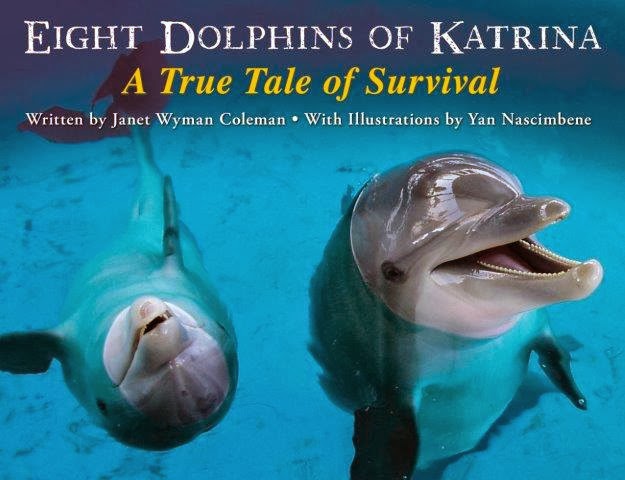
Saving Dolphins... Eight Dolphins of Katrina


Eight Dolphins of Katrina: A True Tale of Survival
By Janet Wyman Coleman; illustrated by Yan Nascimbene
40 pages, ages 6-0
Houghton Mifflin, 2013

In the early morning hours of August 29, 2005, Hurricane Katrina slammed into Gulfport, Mississippi. A huge wall of water washed over the Marine Life Oceanarium, crushing the dolphin house. A scant few hours earlier, trainers had moved some of the dolphins to temporary quarters in hotel swimming pools four miles inland. But eight dolphins were left in the Oceanarium. 

When the trainers returned after the hurricane, the dolphins were gone. They were swimming free in the ocean. But there was a problem: the dolphins had been raised in captivity and didn’t know how to feed themselves in the wild. Using helicopters and motorboats, the trainers searched for their dolphins. This is the story about how the rescue operation – how they trained the dolphins so they could lift them out of the ocean and transport them back home. It’s also a story about how dolphins have rescued people. There’s also a “scrapbook” with photos and diary entries of the rescue operation.
 This is part of the Nonfiction Monday round-up. You can find more reviews of kid's nonfiction over at Apples with Many Seeds. Review copy provided by the publisher.

Friday, April 26, 2013

On the Move - Animal Migrations


On the Move: Mass   Migrations
by Scotti Cohn; illustrated by Susan Detwiler
32 pages; ages 4-8
Sylvan Dell, 2013

Spring is migration time. In our area thousands of salamanders move from their winter homes in the woods to the ponds and pools where they'll mate and lay eggs. The air is filled with vees of geese honking their way north, while on the coast thousands of horseshoe crabs scuttle out of the bay and onto sandy beaches.

Scotti Cohn shares migration secrets from across the animal kingdom, through different habitats and over a year of seasons. Chimney swifts and monarch butterflies are more visible during fall migrations; come winter, elephant seals are on the move. There's information galore for earthkeepers and animal lovers who want to know more about the creatures who share our planet.

This post is part of STEM Friday round-up. Review copy provided by publisher.

Monday, December 31, 2012

About Oceans


About Habitats: Oceans
by Cathryn Sill; illustrated by John Sill
32 pages, ages 4- 8
Peachtree Publishers 2012

Once again Cathryn and John Sills team up to introduce children to ecological diversity. This time it’s a field trip into the oceans of the world. Oceans, they explain, cover most of the earth’s surface. And all those oceans are joined together. While Cathryn describes the variety of ocean bottom surfaces – flat and sandy, deep valleys, tall mountains – John illustrates the animals that live in those places: stingrays, scalloped hammerhead sharks, dolphins.

The simple text is accompanied by detailed illustrations. For older readers the Sills have included six fact-filled pages at the back. That’s where you learn that Wandering Albatrosses have 11-foot wingspans, why Beluga Whales are called “sea canaries”, and that Giant Kelp can grow 24 inches in a single day. About Oceans is part of a series that explores deserts, wetlands and other habitats.

Check out other books that celebrate nonfiction at Nonfiction Monday, hosted this week by Prose & Kahn. Review copy provided by the publishers.