Friday, March 15, 2013

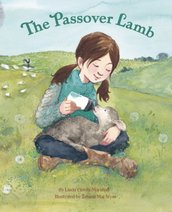
The Passover Lamb


The Passover Lamb
By Linda Elovitz Marshall; illustrated by Tatjana Mai-Wyss
32 pages, ages 6 - 9
Random House 2013
 
As Miriam scatters chicken feed and gathers eggs, she practices chanting the questions she’ll ask tonight at Grandma’s house. “Ma nishtana ha-laila ha-zeh…? Why is this night different from all other nights?

Of course, this is the day Snowball has her lambs – triplets. She won’t nurse the smallest, so Miriam fills a bottle with special milk for newborns and feeds the hungry lamb. But newborns need to be fed every four hours - how can they go to seder?

Miriam wants to take part in the Passover meal where they retell the story of how the Jews were slaves in Egypt. And how one mother hid her baby, Moses, in a basket to….

“Hey!” she says, “I know what to do!”

Linda Marshall’s story is inspired by an actual event that happened on her farm – when her children took a newborn lamb along with them to seder. I was lucky enough to get Linda to answer Three Questions about her book.

Sally’s Bookshelf: Did you carry him in a basket?

Linda: It happened a long time ago, but as I recall, we didn’t use a basket. Instead, the lamb sat on my kids’ laps or under the table where he nibbled our toes as we told the stories. My kids named him “Moses” as a gentle joke. And lamb nibbles? They feel soft and furry...and tickley.

SB: Your books focus on Jewish themes. Why?

Linda: Not all of my books focus on Jewish themes. But it’s only recently that I began writing for children and, as it’s turned out, the books that have been published so far have Jewish themes. My stories, though,  are inspired by many things - from farm life to word-plays to everyday mysteries like vacuum cleaners.

SB: The inspiration for many of your stories comes from relatives or family stories. How do you craft universal stories from these - what sort of process do you go through?

Linda: This is a great question; thank you for asking. I think everyone has a different process for this, so I'll tell you what I try to do – even though it doesn’t always work. First, I think about what actually happened. Then, I ask myself what story do I want to tell? How can adapt (or invent) story elements to build tension? Then I start writing.  For me, the first draft is the hardest part because I'm literally making “something from nothing.” When the first draft is finally written, I let it “simmer” in my subconscious....That’s when I ponder what I call the “deep structure” of the story – the thing that makes it universal. How does this particular vignette speak to the human heart? The answers generally come while I'm driving or swimming or in the shower. They don't come while I’m consciously thinking about the story! When I finally understand my story’s deep structure, I try to put it in context with other literature with a similar deep structure so I can learn from what came before. And, if I can do that, I often have a much stronger story. It’s a complicated process for what seems simple: a picture book – and that’s only the beginning of the process.

Review copy from publisher.

Sunday, March 10, 2013

NF Monday - Women in History: Phillis Wheatley


Welcome to Nonfiction Monday, a round-up of cool books readers are reading and bloggers are reviewing. Check below for links to reviews.

As for me, I'm continuing my celebration of Women's History month and women writers. Today, a look at a young poet who, despite all odds, discovered her strong voice.

A Voice of Her Own: The Story of Phillis Wheatley, Slave Poet
By Kathryn Lasky; illus by Paul Lee
40 pages, ages 8 – 12
Candlewick Press 2003

“At first there was blackness. Complete blackness. Then the blackness dissolved into darkness, and the world in the creaking hold of the slave ship slid with shadows…” So Kathryn Lasky introduces us to a seven-year old slave without a name until she is sold to the Wheatley family in Boston in 1761.

“We’ll call her Phillis,” says Susannah Wheatley, naming the slip of a girl after the ship in whose hold she’d traveled. It turned out that Phillis has a passion for learning, and her owners encouraged her to read, write, learn Latin, Greek, geography, math. But what Phillis loved best was poetry; so she wrote.

She documented the Stamp Act, the Boston Massacre … the tumultuous beginnings of a country seeking independence. She read her poetry in fancy parlors for teas, traveled abroad, gained freedom and, in 1774, saw her book of poetry published. But most importantly, she reclaimed something that had been taken away from her and slaves everywhere: a voice of her own.

This book is sure to inspire young writers looking for a voice of their own. It's also perfect for Marvelous Middle-Grade Monday - where you'll find other books for the mid-grade age, both fiction and non. Review copy provided by publisher.
 
Nonfiction Monday Roundup

Leave a comment; I'll check throughout the day & post links:


 Over at True Tales & Cherry on Top, Jeanne reviews Emily & Carlo.


At NC Teacher Stuff, Jeff reviews Ocean Counting.


Tara at a Teaching Life reviews Master George's People.


 Laura Purdie Salas posted a review of Too Hot? Too Cold?


Mary Ann celebrates Women's History with Annie and Helen at Great Kids Books.


Loree Burns reviews Ocean Sunlight.


Over at Kidlit Celebrates, Alexandra celebrates women in history with a collection of nonfiction addressing the question of what made them who they became?


Ms Yingling is reading ICE.


Check out Mrs Harkness and the Panda over at Perogies & Gyoza.


 Ami's posted three great picture books on black history over at A Mom's Spare Time.


Jennifer is ready for spring with a review of It's Our Garden at Jean Little Library.


Tammy posted three books about forensic science at Apples with Many Seeds.


Over at All About the Books, Janet's reviewed Cars on Mars.


Got kids interested in their rights? Guide them to A Kid's Guide to America's Bill of Rights at Liz's kid lit about politics site


Lynn and Cindy review The Price of Freedom over at their blog, Bookends.


Check out nature's Zombie Makers over at Proseandkahn .


Stacking Books reviews Even an Ostrich Needs a Nest.
Last-minute addition:  Bomb: The Race to Build and Steal the World’s Most Dangerous Weapon, reviewed at Challenging the Bookworm


Friday, March 8, 2013

Women in History: Nellie Bly


It Can't Be Done, Nellie Bly! A Reporter's Race Around the World
by Nancy Butcher; illus by Jen Singh
144 pages, ages 7-10
Peachtree 2003

I confess, I wanted to read this book because I remember sneaking into the school library to read Jules Verne’s Around the World in Eighty Days sometime in fourth grade. Traveling around the world seemed like such an adventure … something I would have done at the drop of a hat.

I also wanted to read this book because I’m a reporter – and Nellie Bly is my hero. Instead of writing about conventional women’s topics (tea parties, charity events) she wrote about social problems of her day: poor work conditions, lack of decent housing, crooked politicians.

But mostly I wanted to read this book because it’s a grand adventure. In 1889 Nellie Bly took off on a round-the-globe trip to see if a person could, indeed, make it in 80 days or less. No one had done it, outside of Verne’s fantasy. She had to convince her newspaper that this would be a worthwhile investment, and promised to send stories along the way – without cell phone or blogs!

She traveled light, packing only a small satchel and wearing a sturdy travel dress for the nearly three-month venture. She journeyed by ship, train and foot, timing her connections down to the minute and almost missing some. Then, unbeknownst to her, another newspaper decided to send its own reporter to try to beat Nellie Bly home.

A reporter, a race against time, and a pet monkey… what’s not to like? And at the end of the book, author Nancy Butcher provides some additional reading and more details about Nellie’s life and the race. Review copy provided by publisher.